

Risks and Compliance Considerations
By Michael Freeman | Acacia Business Solutions
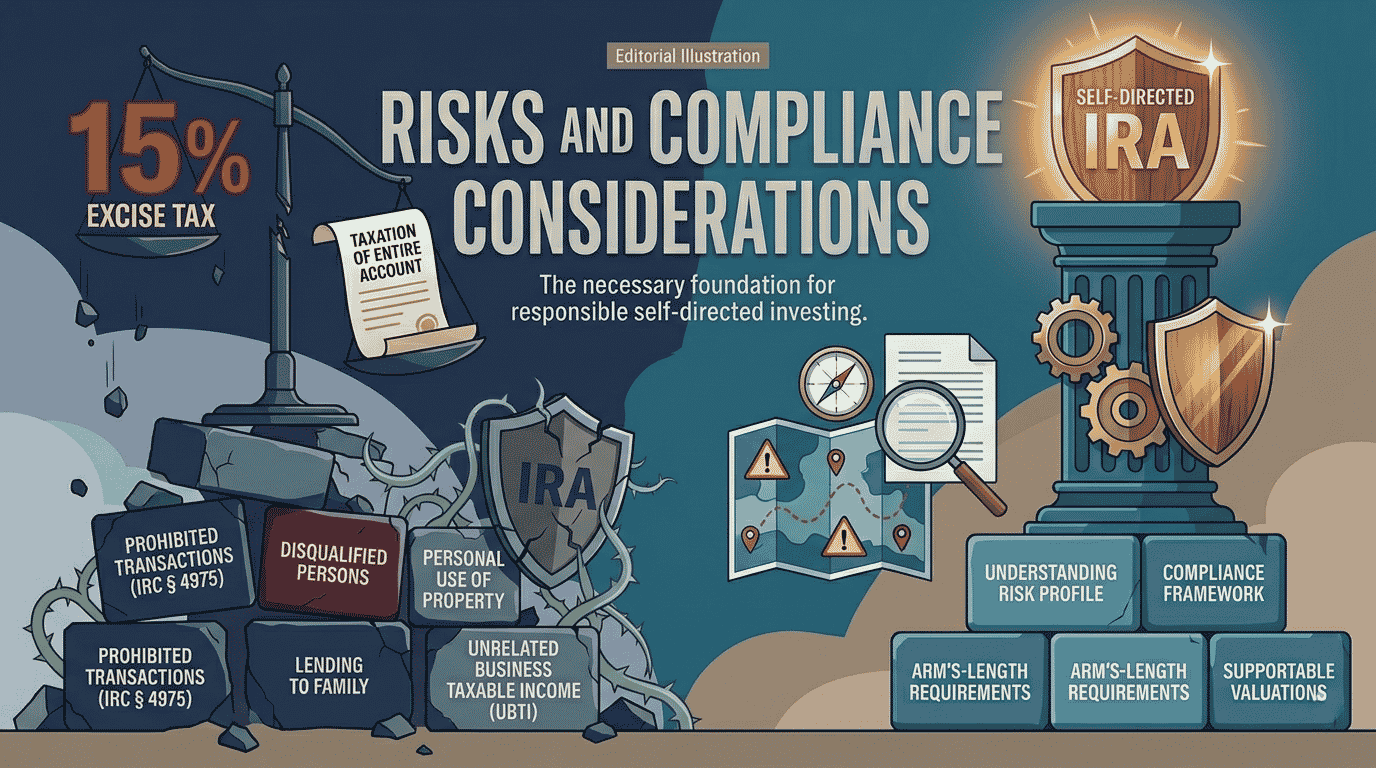
The self-directed IRA is a legitimate and powerful planning tool, but it carries compliance obligations that are more demanding than those associated with a conventional brokerage IRA. The consequences of getting those obligations wrong are not minor. A prohibited transaction can disqualify the entire IRA, triggering immediate taxation of the account’s full value as ordinary income, plus a 15 percent excise tax on the prohibited transaction amount, plus potential additional penalties depending on the circumstances. Understanding the risk profile of self-directed IRA investing is not optional; it is the foundation of using the structure responsibly.
The compliance framework for self-directed IRAs is built around two distinct sets of rules: the prohibited transaction rules under Section 4975 of the Internal Revenue Code, and the prohibited investment rules under Section 408. Both matter, and both need to be understood before making any investment through a self-directed IRA.
Prohibited Transactions: The Core Risk
Section 4975 of the Internal Revenue Code prohibits certain transactions between an IRA and a disqualified person. A disqualified person is defined to include the IRA owner, the IRA owner’s spouse, the IRA owner’s lineal descendants and ancestors and their spouses, any fiduciary of the IRA, and any entity in which the IRA owner or a combination of disqualified persons owns 50 percent or more.
The prohibited transaction categories include the sale or exchange of property between the IRA and a disqualified person; the leasing of property between the IRA and a disqualified person; the lending of money or extension of credit between the IRA and a disqualified person; the furnishing of goods, services, or facilities between the IRA and a disqualified person; and the use of IRA assets by a disqualified person for personal benefit. These categories are stated broadly in the statute, and the IRS interprets them broadly.
The prohibited transaction rules apply regardless of whether the transaction appears commercially reasonable or beneficial to the IRA. If the transaction is between the IRA and a disqualified person and falls within one of the prohibited categories, it is a prohibited transaction. The reasonableness of the terms is not a defense.
Common Prohibited Transaction Scenarios
The prohibited transaction scenarios that come up most frequently in self-directed IRA practice are worth understanding in concrete terms, because they are often not obvious at first glance.
Purchasing real estate from a disqualified person is a prohibited transaction. This means the IRA cannot buy a property that the IRA owner or a family member already owns, even at fair market value. The identity of the counterparty, not the pricing of the transaction, is what matters.
Selling real estate to a disqualified person is also prohibited. The IRA cannot sell an investment property it owns to the IRA owner or to a family member, even at fair market value, and even if the IRA owner intends to use the proceeds for a legitimate IRA investment.
Using IRA-owned property personally is a prohibited transaction. This is a common source of problems in real estate investing. The IRA owns the rental property. The IRA owner, while traveling for a vacation, decides to stay at the property for a few days. That personal use is a prohibited transaction, regardless of whether rent is paid. The IRA-owned property must be used exclusively for investment purposes.
Lending IRA funds to a disqualified person is prohibited. The IRA cannot make a loan to the IRA owner or to a family member, even on commercially reasonable terms with full documentation.
Performing services for IRA-owned property personally, without fair market compensation paid through the IRA, can be a prohibited transaction. If the IRA owns a rental property and the IRA owner performs repair and maintenance work on that property, the owner’s personal services may be considered a contribution of value to the IRA that violates the arm’s-length requirement. This is an area with some nuance depending on the nature and extent of the services, but it is an area to approach carefully.
The Consequences of a Prohibited Transaction
If a prohibited transaction occurs within an IRA, the tax consequences are severe. Under Section 4975, the IRA is treated as having distributed its entire balance as of the first day of the tax year in which the prohibited transaction occurred. The full value of the IRA is included in the account owner’s gross income for that year and taxed as ordinary income. If the account owner is under 59 and a half, the 10 percent early distribution penalty also applies to the full amount. In addition, the party that engaged in the prohibited transaction is subject to a 15 percent excise tax on the amount of the prohibited transaction itself.
These consequences are not proportional to the size of the prohibited transaction. A small, inadvertent prohibited transaction in an IRA with a large balance can trigger taxation of the entire account. That asymmetry is what makes the prohibited transaction rules the most important compliance consideration in self-directed IRA investing.
Unrelated Business Taxable Income
An IRA is a tax-exempt entity, but it is not exempt from all taxes. Unrelated business taxable income, known as UBTI, is income that an IRA earns from an active trade or business that is not substantially related to its tax-exempt purpose. When an IRA earns UBTI above the annual threshold, the IRA must file Form 990-T and pay tax on the excess at the trust income tax rates, which are currently compressed and reach the highest rate at relatively low income levels.
The most common source of UBTI in a self-directed IRA is debt-financed income. When an IRA purchases real estate using a non-recourse loan, the portion of the income and gain attributable to the borrowed funds is UBTI. This is called unrelated debt-financed income, and it is taxed even though the investment itself is otherwise a permissible IRA investment. Non-recourse loans are the only type of financing an IRA can use, since the IRA owner cannot personally guarantee the loan without creating a prohibited transaction, but using even a non-recourse loan creates the UBTI exposure on the leveraged portion of the investment.
UBTI can also arise when an IRA invests in an LLC or partnership that operates an active business. If the LLC conducts a business rather than making passive investments, the IRA’s share of the LLC’s income may be UBTI. This is worth evaluating before an IRA invests in any operating business or active trade, not just in the real estate context.
Valuation Requirements
An IRA that holds alternative assets must provide the custodian with a fair market valuation of those assets as of December 31 each year for IRS reporting purposes. This valuation requirement applies to real estate holdings, private notes, LLC interests, and any other alternative assets held within the IRA.
The valuation must be supportable and documented. For real estate, that typically means an independent appraisal, a broker’s price opinion, or a documented methodology based on comparable sales. For private notes, it means documentation of the outstanding principal, interest rate, payment history, and an assessment of the borrower’s creditworthiness. For LLC interests, it means a valuation of the LLC’s underlying assets using appropriate methods.
Unsupportable or inflated valuations create compliance risk and can attract IRS scrutiny. The valuation is not a formality; it is the basis for the IRS’s understanding of the IRA’s value and the foundation for detecting potential prohibited transaction issues. Acacia IRA services include guidance on documentation practices that support accurate and defensible valuations.
Custodian Fees and Structural Costs
Self-directed IRA custodians charge fees that differ significantly from the fee structures of conventional brokerage IRAs. Rather than earning revenue through transaction commissions or fund expense ratios, self-directed IRA custodians typically charge account maintenance fees, transaction processing fees, and asset-based fees for holding alternative assets. These fees vary considerably by custodian and by the volume and type of transactions the account involves.
The checkbook IRA structure reduces per-transaction custodian fees because most transactions are executed through the LLC without custodian involvement. But it adds the costs of LLC formation, LLC maintenance, and the time and attention required to manage the compliance obligations that the structure places directly on the IRA owner. The cost-benefit analysis of the checkbook structure depends on the number and frequency of transactions the account will make.
Understanding the full cost structure of a self-directed IRA, including both the direct fees and the indirect compliance costs, is part of evaluating whether the investment flexibility the structure provides is worth the complexity it introduces.
The information in this article reflects general structural principles and practical observations from consulting experience and is provided for educational purposes only. It should not be interpreted as individualized legal or tax advice.
Expand your knowledge of asset protection, business planning, taxation, and private trusts. Explore the available books on Amazon.