
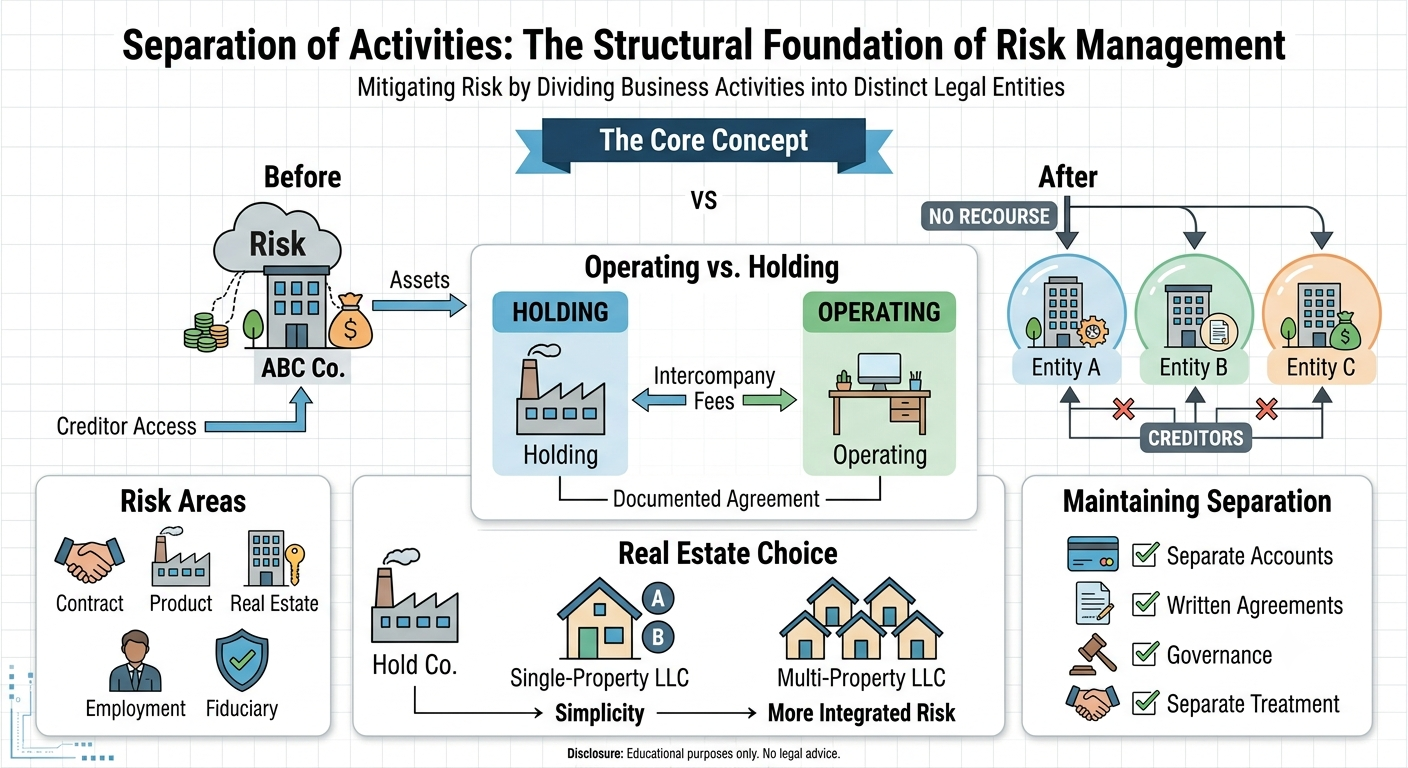

Separation of Activities: The Structural Foundation of Risk Management
Foundation of Risk Management
The concept behind separating activities into distinct legal entities is not complicated, but it is frequently under-implemented. The idea is straightforward: when different activities have different risk profiles, combining them into a single entity means that a problem arising from one activity can affect the assets associated with all the others. Separating them means that liability arising from one activity is contained within the entity that conducts that activity, and assets held elsewhere are not exposed.
In practice, implementing this principle requires thinking clearly about which activities generate liability, which assets are worth protecting, and how to draw structural boundaries that hold up legally and operationally.
Identifying the Risk-Generating Activities
The starting point is an honest assessment of where liability is most likely to originate in a given business. Not all activities carry the same risk. A service business that interacts with clients carries contract and professional liability risk. A business that manufactures or sells products carries product liability risk. A business that owns real estate carries liability risk. An employer carries employment-related risk. A business that handles client funds or sensitive information carries fiduciary and privacy-related risk.
Each of these risk categories has a different profile: different claim frequencies, different potential damage magnitudes, different insurance availability, and different structural responses. Understanding the risk profile of each activity enables more informed decisions about which activities need to be structurally separated from one another and from the assets that should be protected.
Operating Entities and Holding Entities
The most widely used structural separation in business planning is the division between an operating entity and a holding entity. The operating entity conducts business: it employs people, enters into contracts, generates revenue, and assumes the liability associated with those activities. The holding entity owns assets that the operating entity uses, such as real property, equipment, intellectual property, or investment capital.
In a basic version of this structure, the operating entity leases real property from the holding entity, pays licensing fees for intellectual property owned by the holding entity, or borrows equipment from the holding entity under a lease or service arrangement. The operating entity’s creditors have recourse against the operating entity’s assets. They generally do not have recourse against assets owned by the holding entity, provided the two entities are genuinely separate, and the intercompany arrangements are documented and commercially reasonable.
This structure requires discipline to maintain. The holding entity needs to be capitalized, operated with its own accounts, and managed as a genuine separate entity. Intercompany arrangements need to be documented in writing, at arm’s-length terms, and actually performed. A holding entity that exists only on paper, with no genuine intercompany arrangements and no independent operation, is vulnerable to being disregarded by a court evaluating a creditor’s claim.
Separating Multiple Operating Lines
Businesses that operate multiple distinct lines of activity face a more complex version of the same problem. If a company operates a consulting practice, a technology product, and a commercial real estate portfolio through a single LLC, the liabilities of each activity are available to creditors of all of them. A judgment arising from the consulting practice can reach the real estate. A product liability claim arising from the technology product can reach assets associated with the consulting business.
The structural response is to give each activity its own entity, or at least to separate activities with the most significant or distinct risk profiles. The consulting practice operates through one LLC. The technology product operates through another. The real estate is held in a third. A holding company may sit above all of them, owning interests in each operating entity.
This structure creates meaningful separation between the liabilities of each activity. A judgment creditor of the consulting LLC has recourse against that entity’s assets. They do not automatically have recourse against the real estate held in a separate entity or the assets of the technology business, provided the entities are maintained as genuinely separate legal entities.
Real Estate as a Structural Consideration
Real property occupies a particular place in separation-of-activities planning because it generates its own liability risk, through premises liability claims, environmental liability, landlord-tenant disputes, and financing obligations, while also representing a significant asset that owners want to protect from operating business risk.
The standard approach is to hold real estate in a dedicated entity separate from operating businesses. An LLC that holds a single property, or a small number of related properties, is a common structure. This accomplishes two things: it separates the property’s liability risk from the operating business, and it separates the operating business’s liability risk from the property.
For owners with multiple properties, the question of whether to hold all properties in a single entity or to use a separate entity for each property involves a tradeoff between simplicity and separation. A single multi-property LLC is easier to administer, but allows a judgment arising from one property to reach the others. Separate entities for each property provide maximum separation but involve more administrative overhead. A middle approach, grouping properties by geographic area, risk profile, or financing structure, can balance these considerations.
Employment-Related Risk
Employment-related claims are among the most frequent and unpredictable sources of business liability. Wage and hour claims, discrimination and harassment claims, wrongful termination claims, and workers’ compensation obligations all arise from the employment relationship, and they can be significant in both frequency and magnitude.
Some businesses address this by using a dedicated employment entity, a professional employer organization arrangement, or a management company structure that employs the workforce and provides services to the operating entities. These arrangements can create a structural separation between employment-related liabilities and the operating business’s assets, though they require careful implementation to achieve the intended separation and comply with applicable employment law.
Not every business need, or can practically implement, full-employment separation. But understanding employment-related risk as a structural consideration, rather than purely an HR or insurance matter, allows for more informed decisions about how the employment relationship is organized and what entity bears that exposure.
Maintaining the Separation
Structural separation is not self-maintaining. The entities need to be operated as genuine legal entities: separate accounts, separate contracts, documented intercompany arrangements, separate governance, and consistent treatment in all dealings. The failure to maintain separation in practice is one of the primary grounds on which courts disregard entity boundaries and allow creditors to reach assets in related entities.
The concept of single business enterprise liability, recognized in some states, allows a court to treat multiple related entities as a single enterprise for liability purposes when the entities are so integrated in their operations, management, and finances that they are effectively one business rather than several. The structural separation that was designed to contain liability can be undermined if the entities are not operated as genuinely distinct legal entities.
Periodic review of whether the separation is being maintained, with the help of legal or compliance advisors, is a worthwhile investment in the integrity of the structure.
Disclosure: The information in this article reflects general structural principles and practical observations from consulting experience and is provided for educational purposes only. It should not be interpreted as individualized legal or tax advice.
Expand your knowledge of asset protection, business planning, taxation, and private trusts. Explore the available books on Amazon.