
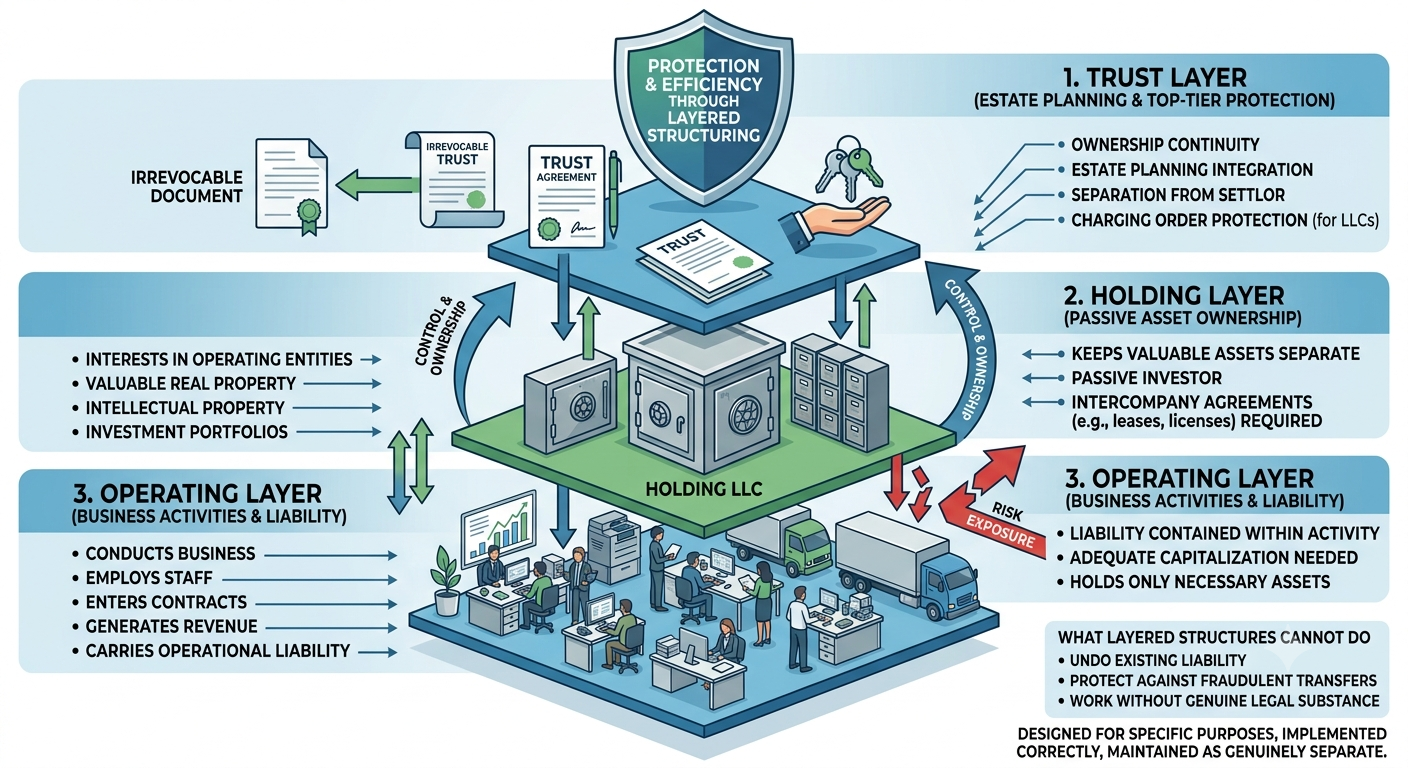

Layered Structuring Explained
Layered structuring refers to the use of multiple entities arranged in a deliberate hierarchy, where each layer serves a defined function and the combination of layers achieves outcomes that no single entity could provide on its own. It is a more sophisticated approach to business and asset structuring than simply forming one or two entities, and it is appropriate for situations in which the assets, activities, and risk exposures are complex enough to justify the additional structure.
The concept is not complicated, but it is frequently misunderstood, either oversimplified into a marketing promise of impenetrable protection or dismissed as unnecessary complexity. The reality is more practical: layered structures work when they are designed for specific purposes, implemented correctly, and maintained as genuinely separate legal persons over time.
The Basic Concept: Layers with Distinct Functions
A layered structure assigns distinct functions to distinct levels of the entity hierarchy. At the operating level, entities conduct business activities, employ staff, enter into contracts, generate revenue, and carry the liability associated with those activities. At the holding level, entities own assets, including interests in operating entities, real property, intellectual property, and investment holdings. At an upper holding or trust level, ownership of the holding entities may rest with a trust or a top-tier holding company, adding an additional layer of separation between the operating risk and the beneficial owner.
Each layer serves a purpose. The operating entities contain liability within the activity that generates it. The holding entities keep valuable assets separate from operating liabilities. The upper layer provides continuity, estate-planning integration, and, in some structures, an additional degree of separation between the assets and the individual owner’s potential creditors.
The layers do not need to be numerous to be effective. A three-tier structure, comprising an operating LLC, a holding LLC that owns the operating entity and any significant assets, and a trust that owns the holding LLC, is a coherent and commonly used arrangement. More complex structures involving multiple operating entities across different activities, multiple holding entities organized by asset class or geography, and multiple trust or upper-holding layers are appropriate for larger or more complex situations.
The Operating Layer
Operating entities are the entities that conduct business. They face the full range of business liability: contract claims, tort claims, employment claims, regulatory exposure, and industry-specific risks. Because operating entities are in the path of liability, they generally should not hold significant assets beyond what is necessary to conduct their operations.
The operating entity needs adequate capitalization to conduct its business legitimately; an undercapitalized entity whose assets bear no relationship to its liabilities and obligations is at risk of being disregarded by a court. But a business that holds far more capital than necessary within the operating entity, including real estate, investment accounts, or other assets that could be held separately, is unnecessarily concentrating risk. The goal is not to strip the operating entity of all assets, which would raise questions in itself, but to hold only what belongs at the operating level and to hold everything else elsewhere.
The Holding Layer
The holding entity owns things: interests in operating entities, real property used by the operating business, intellectual property licensed to the operating business, and investment assets that the owner wants held separately from operational risk. The holding entity generally does not conduct business operations itself; it is a passive owner and investor.
The holding entity’s separation from the operating entity is what creates structural protection for the assets it holds. A creditor of the operating entity has recourse against the operating entity’s assets. Without a valid claim against the holding entity itself, or without meeting the legal standard for piercing the entity boundary, that creditor cannot reach assets held at the holding level.
For the holding layer to function as intended, the intercompany relationships between the operating and holding entities need to be properly documented. If the holding entity owns real property that the operating entity uses, there should be a written lease at commercially reasonable terms, with rent actually paid and recorded. If the holding entity owns intellectual property licensed to the operating entity, there should be a license agreement. These arrangements need to reflect genuine economic substance, not merely paper transactions.
The Trust Layer
Placing a trust at the top of a layered structure and owning the holding entities or their interests is an approach used for several distinct purposes. In estate planning, a trust provides continuity of ownership after the owner’s death without the need for probate and can facilitate the controlled transfer of assets to the next generation according to the grantor’s specific intentions. In asset protection planning, certain types of irrevocable trusts, including domestic asset protection trusts available in a limited number of states and foreign asset protection trusts established under the laws of certain international jurisdictions, provide a layer of protection against future creditors of the settler, subject to significant legal requirements and limitations.
The effectiveness of a trust layer in asset protection terms depends heavily on the type of trust, the jurisdiction of the trust, the timing of transfers relative to any existing or anticipated claims, the nature of the assets transferred, and compliance with applicable fraudulent transfer law. Transfers made with the intent to hinder, delay, or defraud existing creditors are voidable under fraudulent transfer law in every U.S. jurisdiction, regardless of how the trust is structured. A trust layer is a planning tool for legitimate long-term structuring, not a mechanism for transferring assets in response to an existing or imminent claim.
LLC Charging Order Protection in a Layered Structure
One of the reasons LLCs are commonly used in the holding layers of a structure is the charging order protection available under many states’ LLC laws. A charging order is the exclusive remedy available to a judgment creditor of an LLC member in many states; it gives the creditor a right to receive any distributions made to the member but does not give the creditor the ability to force distributions, to participate in management, or to step into the member’s governance role.
The practical effect is that a creditor who obtains a charging order against an LLC interest may be entitled to distributions if and when the LLC makes them to that member, but cannot compel the LLC to make distributions and cannot take over the member’s ownership position. In a well-designed structure in which the managing member controls distribution decisions, a charging order against a non-managing member’s interest may have very limited practical value to the creditor.
The strength of charging order protection varies significantly by state. Some states provide explicit statutory language making the charging order an exclusive remedy. Others are less clear. The structure and governance of the LLC also affect how useful the protection is in practice. This is an area where the specific details of applicable state law and the structure of the particular LLC matter considerably, and it should be evaluated carefully rather than assumed.
What Layered Structures Cannot Do
A layered structure cannot undo existing liability. If a judgment has already been entered, or if a claim has already arisen, transferring assets into a new structure after the fact is a fraudulent transfer under applicable law. Courts and creditors have effective tools for unwinding such transfers, including the ability to reach assets that were improperly transferred in anticipation of a claim.
A layered structure also cannot provide protection that the owner is not genuinely willing to accept. A trust that is nominally irrevocable but over which the grantor exercises de facto control, through retained powers, undocumented arrangements with a compliant trustee, or use of trust assets as personal funds, is unlikely to provide the intended protection. The structure needs to reflect genuine legal substance, not just formal documentation.
The value of a layered structure lies in planning done before problems arise, implementation done correctly, proper maintenance, and design based on a realistic understanding of what each layer accomplishes and what it does not.
Disclosure: The information in this article reflects general structural principles and practical observations from consulting experience and is provided for educational purposes only. It should not be interpreted as individualized legal or tax advice.
Expand your knowledge of asset protection, business planning, taxation, and private trusts. Explore the available books on Amazon.