
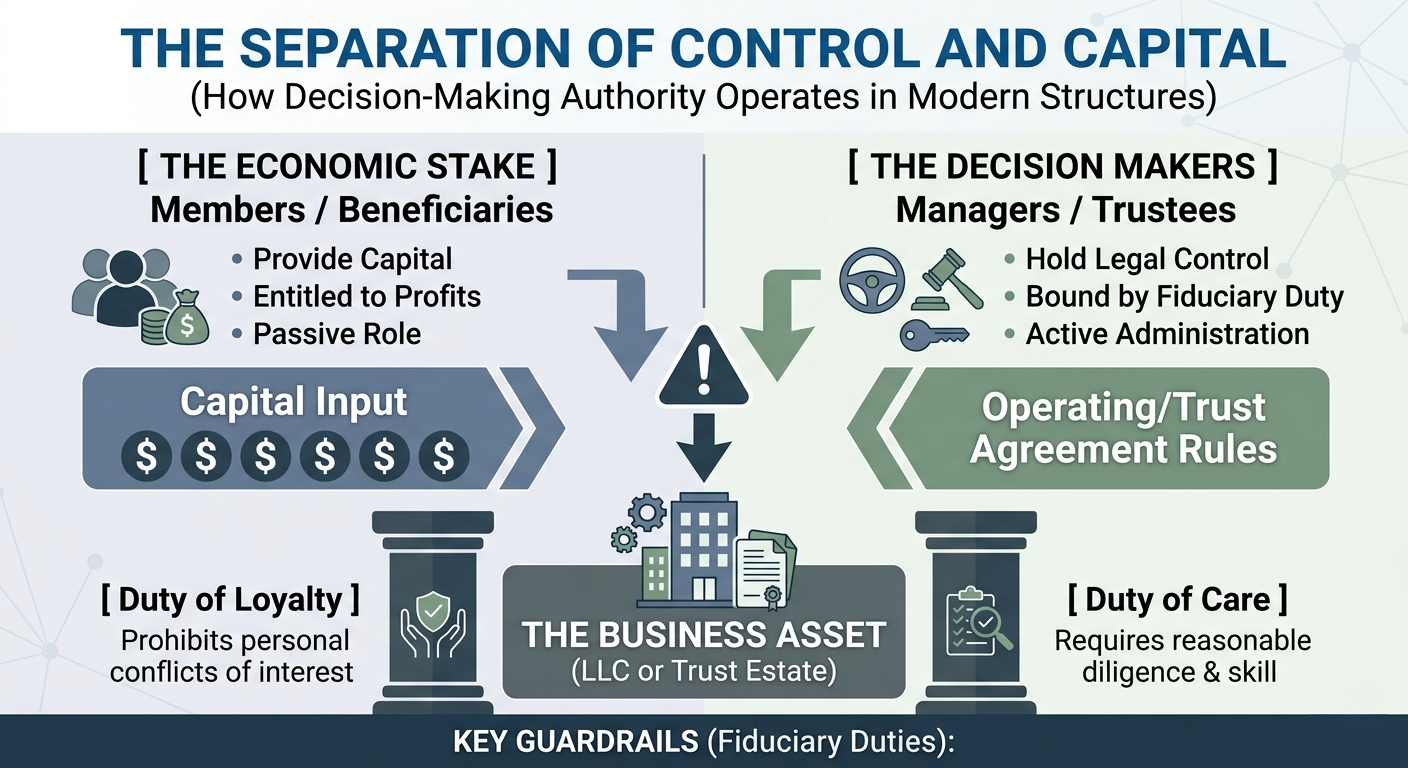

Common Governance Failures in Business and Trust Structures
Governance failures rarely announce themselves. They tend to develop gradually, through accumulated neglect, informal decision-making, undocumented arrangements, and the quiet erosion of whatever structure was put in place at the outset. By the time a governance problem becomes visible, it has usually been developing for some time, and the cost of addressing it is considerably higher than it would have been to prevent it.
Understanding the patterns of governance failure, particularly those that most frequently appear in business and trust structures, makes it easier to recognize and address them before they lead to serious consequences.
Treating Governance Documents as Formalities
The most common governance failure begins at formation. Operating agreements, shareholder agreements, trust agreements, and corporate bylaws are drafted, signed, and filed, and then rarely consulted again. The parties rely on informal understandings, verbal agreements, and assumptions about what the documents say without reading them when a specific question arises.
This creates a predictable problem: the documents govern whether the parties are following them. When a dispute arises or a transaction requires due diligence, the actual governance documents become the reference point. If the entity has been operating in ways that contradict the governing documents, the legal analysis becomes complicated, and the parties who assumed informal arrangements were sufficient find themselves in an awkward position.
The solution is straightforward but requires discipline: governance decisions should be made by reference to the governing documents, major decisions should be documented in minutes or resolutions, and the governing documents should be reviewed and updated periodically to reflect how the entity operates and what the parties currently intend.
Failure to Maintain Corporate Formalities
Corporations and, to varying degrees, LLCs are required to observe certain formalities: holding required meetings, maintaining minutes, documenting significant decisions, keeping financial records separate from personal accounts, and filing required state reports. These requirements exist because the liability protection afforded by the corporate structure depends on the entity being treated as a genuine legal person separate from its owners.
Courts evaluating whether to pierce the corporate veil, meaning to hold owners personally liable for entity obligations, look at whether the entity observed the formalities required of it. Commingled finances, absent or fabricated minutes, undocumented loans between the owner and the entity, and a pattern of treating the entity’s assets as personally available are all factors that support a veil-piercing claim. Each individual failure may seem minor; the cumulative pattern is what courts find significant.
For closely held businesses and single-member LLCs in particular, maintaining formalities requires intentional effort because there is no built-in accountability mechanism. No other shareholders are watching. No outside directors are asking questions. The discipline has to come from the owner or from outside advisors who make it a regular part of their engagement.
Undefined or Disputed Decision-Making Authority
In multi-party business structures, the most common source of governance disputes is ambiguity about who has the authority to make a particular decision. Operating agreements and shareholder agreements that define governance authority in general terms, without specifying what types of decisions require what level of approval, leave too much room for disagreement.
The question of whether a specific transaction, hiring decision, debt obligation, or strategic change required unanimous consent or only majority approval, or was within the manager’s unilateral authority, frequently becomes the central issue in business partnership disputes. If the governing documents do not answer that question clearly, the parties are left to argue about what was intended, what the practice was, and what state law implies. These disputes are expensive and destructive, and they almost always trace back to documents that were not specific enough at the outset.
Effective governance documents address decision-making authority in concrete terms. They specify which decisions require unanimous consent, a supermajority, a simple majority, or fall within the manager’s or officer’s unilateral discretion. They address what happens when the required approvals cannot be obtained and provide a dispute-resolution mechanism for situations where governance is genuinely deadlocked.
Succession Gaps
Governance structures that work well while the original principals are active and capable often fail when a principal dies, becomes incapacitated, or simply steps back. If the governing documents do not clearly address succession in the manager or trustee role, the transition creates a governance vacuum that courts, creditors, and family members must navigate without clear guidance.
In trust structures, the succession of trustees is particularly important. An irrevocable trust that names a single individual trustee, with no successor trustee designated, no mechanism for appointing a successor, and no trust protector with the authority to do so, is at risk of requiring a court proceeding to appoint a successor trustee when the original trustee can no longer serve. Court proceedings take time, cost money, and may result in the appointment of a trustee the grantor would not have chosen.
In LLC and corporate structures, the death or incapacity of a managing member, sole director, or controlling shareholder without a clear governance succession plan can leave the entity without anyone authorized to act on its behalf. This creates problems for ongoing operations, banking relationships, and any transactions that require authorized signatures.
Succession planning for governance roles is not the same as estate planning for economic interests, though the two are related. Effective succession planning addresses both who receives the economic interest and who exercises governance authority, as well as the timeline and conditions.
Conflict of Interest Without a Management Process
Transactions between an entity and its insiders, including loans to owners, compensation arrangements, related-party contracts, and business opportunities that could benefit either the entity or an insider personally, require careful handling. In the absence of a formal process for identifying and managing conflicts of interest, these transactions tend to be handled informally, without documentation, independent review, or the safeguards that protect both the entity and the individuals involved.
For corporations and nonprofit organizations, the conflict-of-interest problem is well established in law, and the consequences of mishandling it are significant. For LLCs, the analysis is governed by the operating agreement and state law, but the practical risks are similar. An insider transaction handled informally and without documentation becomes difficult to defend when later challenged by a co-owner, a creditor, or a tax authority.
A documented conflict-of-interest policy, applied consistently, is the most effective preventive measure. The policy does not need to prohibit insider transactions; it needs to require that they be identified, disclosed, reviewed by disinterested parties, and documented in a way that demonstrates the transaction was fair to the entity.
Governance Drift
Governance drift is the gradual divergence between how an entity is supposed to operate under its governing documents and how it actually operates. It happens in almost every closely held business over time, as informal practices develop, roles evolve, and the parties stop consulting the documents that were meant to define how things work.
The danger of governance drift is not that informal practices are inherently wrong, but that they create ambiguity about what the actual rules are. When a dispute arises, a transaction requires confirmation of proper authority, or a regulatory issue surfaces, the gap between the documents and the practice becomes a problem that requires resolution. The longer the drift has been occurring, the harder it is to reconstruct what was intended and what actually happened.
Periodic governance reviews, conducted with the help of legal or compliance advisors, are the most effective way to address governance drift. The review examines whether the governing documents reflect current intentions, whether required formalities have been observed, and whether any informal practices need to be formalized or corrected. It is considerably less expensive to conduct this review proactively than to address the consequences of prolonged governance drift in a dispute or transaction context.
Disclosure: The information in this article reflects general structural principles and practical observations from consulting experience and is provided for educational purposes only. It should not be interpreted as individualized legal or tax advice.
Expand your knowledge of asset protection, business planning, taxation, and private trusts. Explore the available books on Amazon.