

Multi-State Business Operations: Structure and Compliance
Running a business across multiple states is operationally more complex than operating in a single state, and that complexity extends well beyond the logistics of managing people and customers in different locations. The legal and compliance dimensions of multi-state operations require deliberate attention from the outset, because the obligations that accumulate across states are real, they differ from state to state, and they do not resolve themselves through inattention.
Business owners who expand into new states often focus on market opportunities and operational requirements, treating the legal and compliance side as something to address later. Later arrives and tends to do so at an inconvenient moment, often when a transaction or financing event triggers a due diligence review that surfaces unregistered operations, missed filings, or compliance gaps across multiple jurisdictions.
The Multi-State Compliance Map
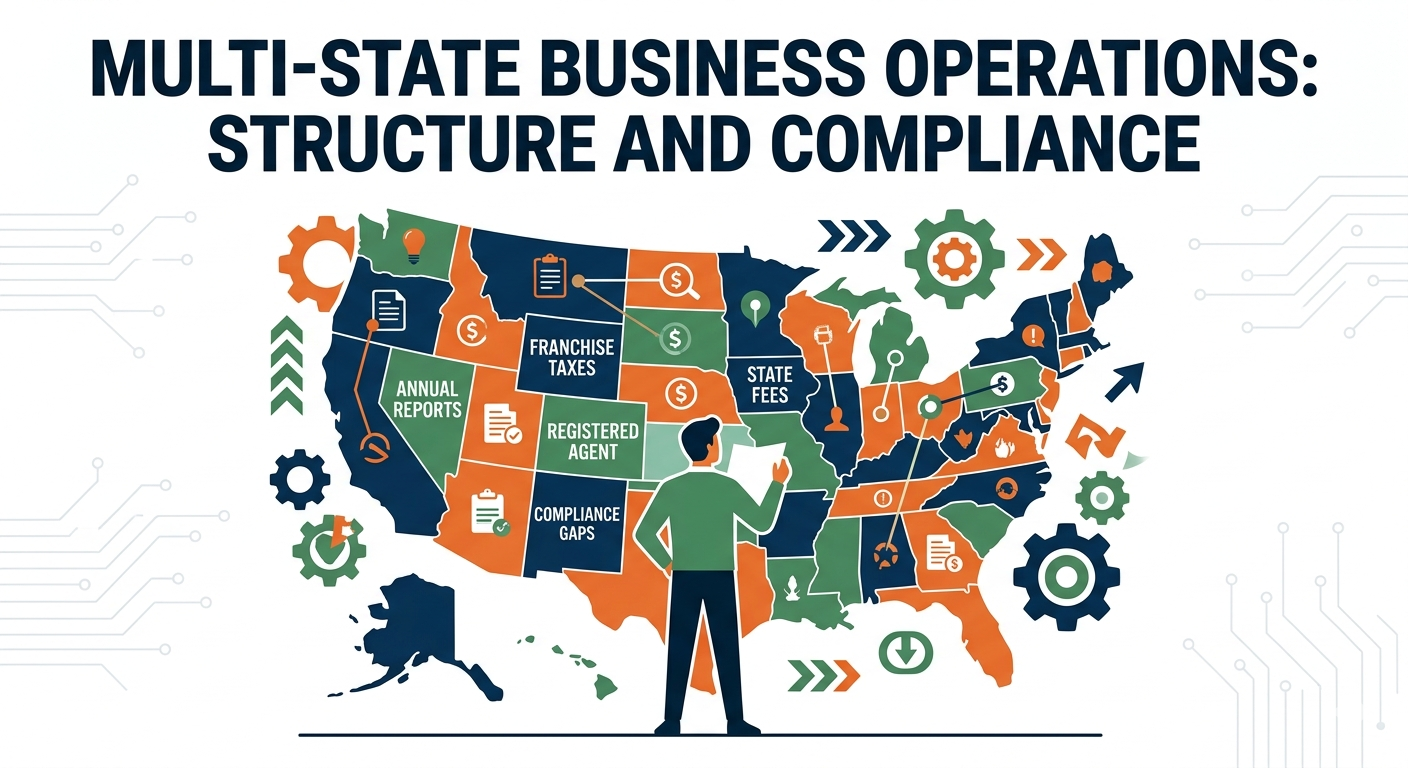
Every state in which a business is registered, whether as a domestic entity in its home state or as a foreign entity after qualification, imposes a set of ongoing obligations. The specific requirements vary by state and by entity type, but the categories are consistent: annual or biennial reports filed with the secretary of state; franchise taxes or annual fees paid to the state; maintenance of a registered agent with a physical address in the state; and compliance with any state-specific requirements applicable to the business’s industry or activities.
The practical challenge is that these obligations do not align neatly across states. Deadlines differ. Filing requirements differ. Fee schedules differ. Some states require annual reports on the anniversary of formation or qualification; others use a fixed annual deadline for all entities. Some states calculate franchise taxes based on revenue, authorized shares, or the value of assets held in the state; others charge a flat fee regardless of size. A business registered in ten states has ten sets of deadlines, fees, and filing requirements to track, each operating on a different schedule.
Without a systematic approach to tracking these obligations, missed filings and late fees are nearly inevitable. The consequences range from late fees and interest to loss of good standing to administrative dissolution in the state of residence. A business that is administratively dissolved in a state where it has ongoing operations, contracts, or employees faces serious legal and operational disruption.
Tax Nexus and Multi-State Taxation
Foreign qualifications and tax nexus are related but distinct concepts. Foreign qualification is a corporate registration requirement; it determines whether a business is authorized to conduct business in a state under that state’s business entity law. Nexus is a tax concept that determines whether a business has sufficient connection to a state to be subject to that state’s tax obligations, including income, sales, and payroll taxes.
A business can have tax nexus in a state without being required to foreign qualify there, and it can be registered in a state without having significant tax nexus. The activities that create nexus for tax purposes are defined by each state’s tax laws and regulations, and they have been interpreted broadly by many states, particularly following the U.S. Supreme Court’s 2018 decision in South Dakota v. Wayfair, which expanded states’ authority to impose sales tax obligations on remote sellers based on economic activity rather than physical presence.
For most businesses with physical operations in multiple states, both foreign qualifications and tax nexus will be present in each state of operation. But for businesses operating digitally or with remote employees, the Nexus analysis may extend to states where the business has not formally qualified. Understanding both dimensions is essential for a complete compliance picture.
Employment Law Across States
A business with employees in multiple states is subject to the employment laws of each state where those employees work. State employment laws cover a wide range of topics that vary significantly across jurisdictions: minimum wage requirements; paid leave obligations, including sick leave, family leave, and in some states paid family and medical leave; non-compete and non-solicitation enforceability; final paycheck timing requirements; wage statement content requirements; and employee classification standards for independent contractors.
The proliferation of remote work has made multi-state employment compliance a concern for businesses that previously operated in a single state. A business that hires a remote employee working from another state has immediately assumed employment law compliance obligations in that state, whether or not it has formally registered there or considered itself to have operations there. Those obligations are real regardless of what the employment agreement says about choice of law.
Payroll tax withholding is a related consideration. Each state where an employee works may require withholding of state income tax, and the business may need to register with the state’s tax authority to withhold and remit those taxes. Workers’ compensation insurance requirements also vary by state and apply based on where employees work, not where the employer is based.
Licensing and Regulatory Compliance
Beyond entity registration and tax compliance, many businesses are subject to industry-specific licensing and regulatory requirements that vary by state. Professional licensing, financial services licensing, contractor licensing, food service and health permits, and a range of other regulatory requirements are administered at the state level and require separate compliance in each state where the relevant activities are conducted.
A business that is properly licensed in its home state cannot assume that its license covers operations in other states. Many professional licensing boards require separate applications in each state, and some states have reciprocity arrangements with specific other states that streamline the process. Others do not, and the application requirements and processing times can be significant.
Multi-state regulatory compliance is an area where working with advisors who understand the specific requirements of the relevant states and industries is particularly valuable. The requirements are sufficiently varied and detailed that generalizations are unreliable, and the cost of noncompliance, including fines, cease-and-desist orders, and in some cases personal liability for operating without required licenses, is significant.
Practical Systems for Multi-State Compliance
Managing compliance across multiple states requires a system, not a set of reminders. The system needs to track every state where the business is registered or has compliance obligations; the specific filing requirements and deadlines in each state; the registered agent information in each state; the status of all required licenses and permits; and any upcoming renewal or reporting deadlines.
Many businesses that operate in multiple states use a combination of internal compliance tracking and external compliance services to manage this. A corporate compliance service that tracks state filing deadlines, handles annual report filings, manages registered agent appointments, and provides advance notice of upcoming obligations can significantly reduce the administrative burden and the risk of missed deadlines.
The investment in systematic compliance management is consistently less than the cost of addressing compliance failures after the fact. Good standing in every state of operation is not a bureaucratic formality; it is a genuine business asset that enables the business to operate, contract, litigate, and transact without the friction caused by compliance gaps.
Disclosure: The information in this article reflects general structural principles and practical observations from consulting experience and is provided for educational purposes only. It should not be interpreted as individualized legal or tax advice.
Expand your knowledge of asset protection, business planning, taxation, and private trusts. Explore the available books on Amazon.