
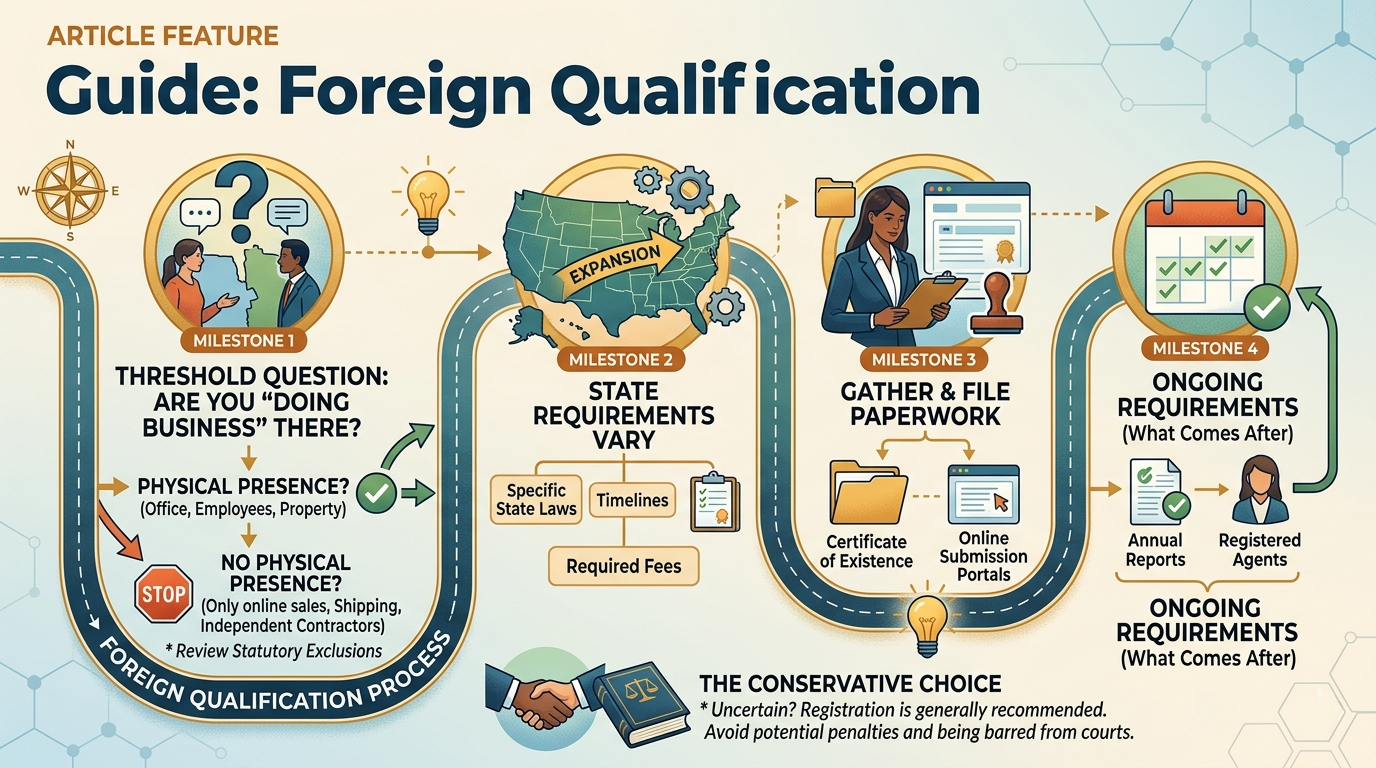

Guide: Foreign Qualification
This guide is for business owners and operators who are preparing to expand into a new state or who are already operating in multiple states and want to understand the foreign qualification process and what comes after. The process itself is not complicated, but it has several moving parts, and each state has its own requirements and timeline. Understanding the full sequence before you start makes the process significantly smoother.
Start with the Threshold Question: Are You Doing Business There?
Before filing anything, confirm whether your activities in the target state require a foreign qualification. As discussed earlier in this series, the doing business threshold varies by state, and many states include specific exclusions for activities that do not trigger the requirement.
If your company is making sales into a state through a website or through independent contractors, shipping products into the state from a warehouse located elsewhere, and has no physical office, employees, or other fixed presence there, you may not be required to foreign qualify even if the state represents a significant share of your revenue. If your company has an office, employees who work regularly from locations in the state, real property, or ongoing in-state client engagements that require a regular physical presence, you almost certainly need to register.
For situations that fall in the middle, which are common, review the specific statutory exclusions in the target state’s business entity law. If there is still genuine uncertainty after that review, the conservative choice is to register. The costs of a foreign qualification are known and manageable. The costs of being found to have operated without a required registration, including potential penalties, back fees, and being barred from using the state’s courts, are less predictable and potentially more significant.
Confirm Good Standing in the Home State
Before you can foreign-qualify in any state, your entity must be in good standing in its home state. The foreign qualification application in most states requires a certificate of good standing, a certificate of existence, or a similar document issued by the Secretary of State of the entity’s home state. This document confirms that the entity is properly formed, current on its filing and fee obligations, and authorized to conduct business.
If the entity is not currently in good standing in its home state due to missed filings or unpaid fees, those issues need to be resolved before a certificate of good standing can be obtained and before foreign qualification can proceed. Bringing an entity back into good standing in the home state is typically straightforward, but it takes time, and that time needs to be factored into any expansion timeline that depends on being registered in the new state by a specific date.
Identify and Appoint a Registered Agent in the New State
Every foreign qualification application requires designating a registered agent in the new state. The registered agent must have a physical street address in that state and must be available during normal business hours to receive process service and official state communications.
For businesses expanding into multiple states, using a national professional registered agent service with coverage in all fifty states simplifies this considerably. You designate the same service as your registered agent in each state of registration, and you have a single provider managing all registered agent functions with consistent notification and document-handling procedures.
If you are using a professional registered agent service, confirm before filing that the service is authorized to serve as registered agent in the specific state you are registering in and that you have the service’s address to include in the application. Using an incorrect or incomplete address in the application will delay processing and may require an amended filing.
Prepare and File the Application
The foreign qualification application, variously called an application for certificate of authority, a statement and designation by foreign corporation, or similar names depending on the state and entity type, requires several pieces of information. Most applications ask for: the entity’s exact legal name as it appears in the home state; the state of formation and date of formation; the entity’s principal office address; the registered agent’s name and address in the new state; the name and title of the person signing the application; and basic governance information such as the management structure of an LLC or the names of officers for a corporation.
Some states require additional information or attachments. California requires a Statement and Designation by Foreign Corporation that includes specific disclosures. New York requires publication of a notice of qualification in two newspapers designated by the county clerk in the county where the principal office is located, a requirement that applies to LLCs and adds cost and time to the qualification process there. Understanding the state-specific requirements before you begin filing prevents delays caused by missing information or omitted steps.
Filing fees vary by state and entity type. Most states accept online filings through the Secretary of State’s website, and many offer expedited processing for an additional fee. Standard processing times range from a few business days in states with efficient online systems to several weeks in states with higher filing volumes or manual review processes. If you need registration by a specific date, confirm the standard processing time for that state and request expedited processing if necessary.
Receive the Certificate of Authority and Verify the Registration
Once the application is approved, the state issues a certificate of authority or similar document confirming that the entity is authorized to do business in that state. Keep this document in the entity’s corporate records, along with the corresponding certificate of good standing from the home state used in the application.
After receiving the certificate, verify the registration by checking the Secretary of State’s online database to confirm that the entity appears as an active, authorized foreign entity. Confirm that the registered agent information in the database is correct. This verification step catches any data-entry errors in the filing and confirms that the registration is accurately reflected in the public record that others will use to verify the entity’s status.
Establish the Ongoing Compliance Obligations
The foreign qualification registration triggers ongoing compliance obligations in the new state that parallel those in the entity’s home state. These include annual or periodic report filings on the state’s required schedule; payment of annual fees or franchise taxes as applicable; maintenance of the registered agent in good standing; and compliance with any state-specific requirements applicable to the entity’s industry or activities.
Set up a compliance tracking system that captures the filing deadlines and fee obligations for each state of registration from the outset. A compliance service that manages multi-state entity maintenance can handle this tracking and filing systematically, but even if you manage it internally, a clear record of each state’s requirements and deadlines is essential.
The compliance obligations in a foreign state are not lighter than those in the home state; they are essentially the same, on the foreign state’s schedule. A business registered in eight states has eight sets of annual filing obligations to track and fulfill, and missing any of them begins the process of losing good standing and eventually facing administrative dissolution in that state.
Managing Name Availability and Name Reservations
A practical issue that arises in foreign qualifications is whether the entity’s legal name is available in the new state. If another entity is already using the same name in that state, the secretary of state will not register the foreign entity under that name. In that situation, the foreign entity must register under an assumed name or fictitious business name for use in that state, while retaining its legal name in the home state.
Before filing, search the target state’s business name database to confirm whether the entity’s name is available. If it is not, decide on an assumed name before filing the application; the application will include both the entity’s legal name and the assumed name it will use in that state. This does not change the entity’s legal name in the home state or require any amendment to the home state registration; it simply provides an alternative name for use in the state where the legal name is unavailable.
If there is a gap between confirming the name is available and filing the application, some states allow you to reserve the name for a set period by filing a name reservation application and paying a modest fee. This prevents another entity from registering the same name in the interim.
Withdrawal When No Longer Operating
When the business ceases operations in a foreign state, promptly file a withdrawal of the foreign qualification registration. Continuing to be registered without withdrawing means that ongoing filing and fee obligations continue to accrue, even if the business has no activities in that state.
The withdrawal process requires filing a certificate of withdrawal, confirming that the entity has ceased doing business in the state and is surrendering its authority to operate there. Most states require that all outstanding annual reports be filed and all fees be current before accepting a withdrawal. Some states require tax clearance from the state revenue department before processing the withdrawal. Confirming the specific requirements of each state before filing the withdrawal prevents delays and ensures the process is completed cleanly.
Foreign qualification, properly handled from registration through ongoing compliance to withdrawal when appropriate, is one of the more manageable areas of multi-state business law. The requirements are clear, the process is defined, and the costs of compliance are modest relative to the costs of noncompliance. The businesses that run into problems with it are almost always the ones that treat it as something to deal with later and then find that it arrives at an inconvenient time.Disclosure: The information in this article reflects general structural principles and practical observations from consulting experience and is provided for educational purposes only. It should not be interpreted as individualized legal or tax advice
Expand your knowledge of asset protection, business planning, taxation, and private trusts. Explore the available books on Amazon.