

Wyoming Nominee Services
Wyoming has built a well-deserved reputation as one of the most business-friendly jurisdictions in the United States. Its low fees, minimal reporting requirements, and strong privacy protections make it a practical choice for business owners and investors looking to structure their affairs sensibly. Within that environment, nominee services occupy a specific and often misunderstood role.
A nominee arrangement involves using a third party, whether an individual or a corporate entity, to appear in the public record on behalf of the actual owner or decision-maker. In Wyoming, this is a legitimate structuring tool when used correctly and for legitimate purposes. Understanding what it is, what it accomplishes, and where its limits lie is essential before deciding whether it makes sense in a given situation.
What Nominee Services Actually Involve
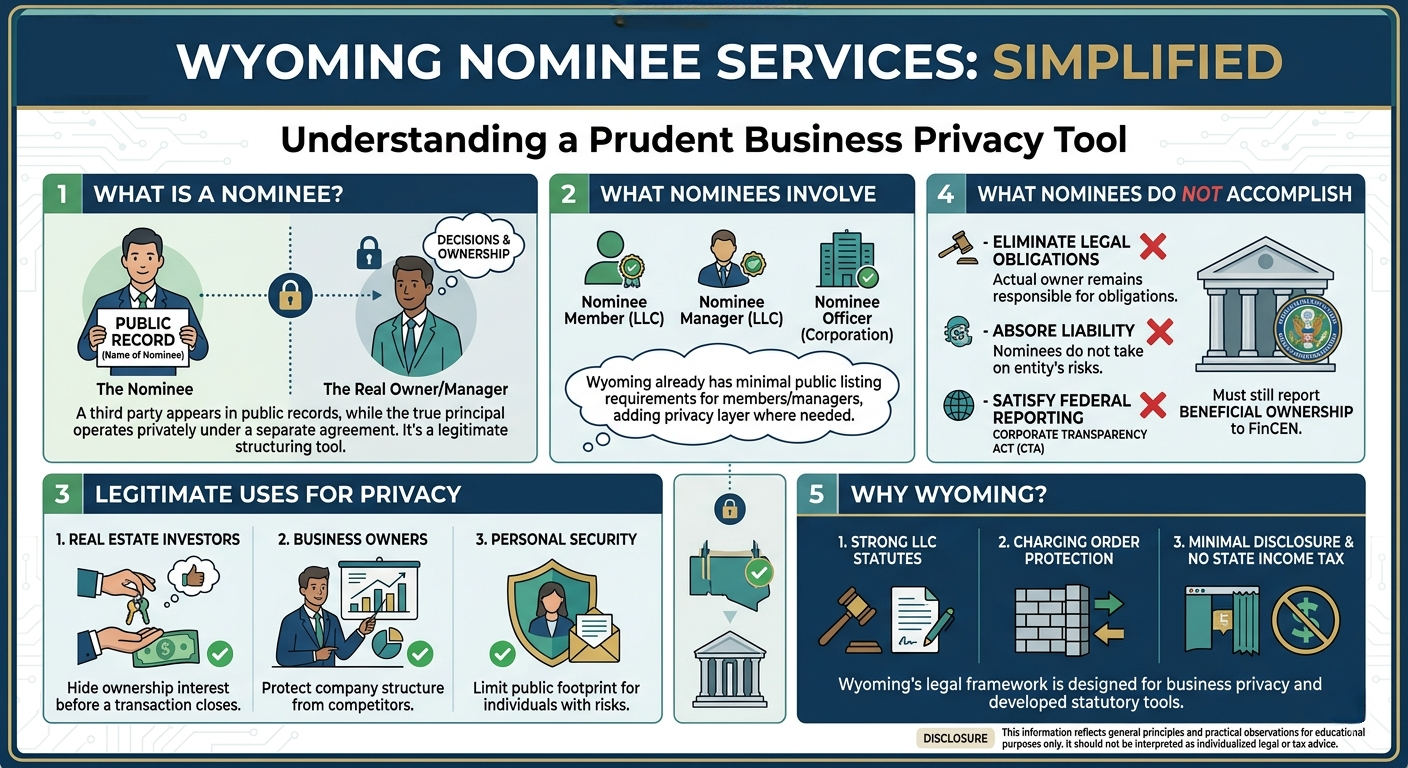
In the context of a Wyoming LLC or corporation, nominee services typically refer to the use of a nominee member, nominee manager, or nominee officer. The nominee’s name appears in formation documents or on record, while the actual owner or principal operates behind a separate agreement that defines the true relationship between the parties.
Wyoming does not require that LLC members or managers be publicly listed in the same way that some other states do. The state only requires a registered agent with a physical Wyoming address. This structural feature reduces the need for nominees in some cases, but in situations where formation documents or operating agreements are filed publicly or shared with third parties, a nominee arrangement can provide an additional layer of privacy.
Legitimate Uses for Nominee Arrangements
The use of nominee services is appropriate in several contexts. Real estate investors who do not want competitors or counterparties to identify their ownership interests before a transaction closes have a genuine reason to keep their names off public documents. Business owners who operate in competitive industries and prefer that their corporate structure not be immediately visible to rivals have similar concerns. Individuals who have received credible threats or face elevated personal security risks may have entirely practical reasons to limit their public footprint.
None of these uses require anything improper. The goal is not to conceal wrongdoing; it is to manage information in a way that reflects legitimate privacy interests. The distinction between legitimate privacy and impermissible concealment is real and important, and anyone using nominee services should understand where that line sits.
What Nominees Do Not Accomplish
Nominee arrangements do not eliminate legal obligations. The actual owner of a Wyoming entity remains responsible for the entity’s obligations, tax filings, and compliance with applicable law. A nominee who appears in a public record does not absorb liability that properly belongs to the true principal. The underlying legal relationships, ownership interests, and beneficial ownership are what courts and regulators look at when disputes arise.
It is also worth being clear that nominee arrangements do not satisfy beneficial ownership reporting requirements under federal law. The Corporate Transparency Act, which took effect in 2024, requires most domestic entities to report their beneficial owners to the Financial Crimes Enforcement Network. A nominee arrangement does not change who is a beneficial owner for these purposes. Compliance with federal reporting requirements coexists with whatever privacy structure is in place at the state level.
Wyoming as the Right Jurisdiction
Wyoming’s combination of strong LLC statutes, charging order protections, no state income tax, and minimal public disclosure requirements make it a sensible base for nominee-related structures. The jurisdiction’s legal framework was designed with business privacy in mind, and the statutory tools available there are more developed in this area than in many other states.
For those considering Wyoming nominee services as part of a broader structuring plan, the starting point is always a clear picture of what you are trying to accomplish, what your actual legal and compliance obligations are, and how a nominee arrangement fits within that larger framework. Done properly, it is a straightforward tool with real practical value.
Disclosure: The information in this article reflects general structural principles and practical observations from consulting experience and is provided for educational purposes only. It should not be interpreted as individualized legal or tax advice.