
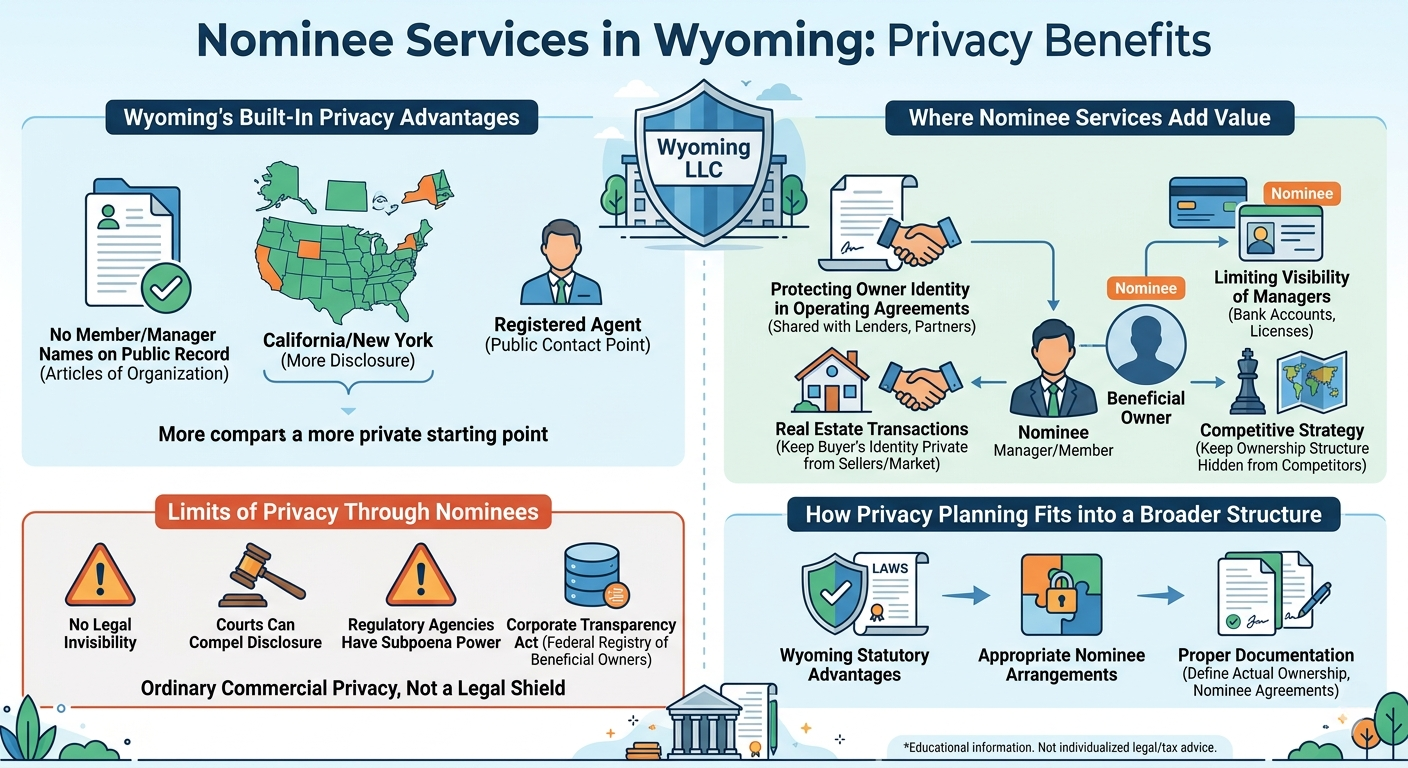

Nominee Services in Wyoming: Privacy Benefits
Privacy in business structuring is not about secrecy for its own sake. It is about controlling information in a way that protects legitimate interests, whether those are competitive, personal, or security-related. Wyoming offers a legal environment that supports this kind of thoughtful privacy planning, and nominee services are among the tools available in that environment.
Understanding the actual privacy benefits that Wyoming provides, and how nominee arrangements contribute to or complement those benefits, requires separating what the law genuinely allows from what promoters of offshore or complex structuring schemes sometimes oversell.
Wyoming’s Built-In Privacy Advantages
Wyoming law does not require that LLC members or managers be identified in public filings. The Articles of Organization filed with the Wyoming Secretary of State identify the registered agent and the organizer, but not necessarily the members or managers. This is different from states like California or New York, where more information flows into the public record as a matter of routine.
This structural feature means that a Wyoming LLC, even without any nominee arrangement, starts from a more private position than entities formed in many other jurisdictions. The registered agent requirement is satisfied by any Wyoming-based registered agent service, which is a widely available and inexpensive option.
Where Nominees Add Value
When nominee services add genuine value in Wyoming, it is typically in one of a few specific situations. If an operating agreement is going to be shared with a counterparty, a lender, or a business partner, and that document identifies the members, a nominee member arrangement keeps the true owner’s identity out of that disclosure. Similarly, if a manager is listed on a bank account or a state license, a nominee manager can limit what is visible to third parties in those contexts.
In real estate transactions, nominees are sometimes used so that a buyer’s identity is not disclosed to the seller or to the market before a transaction is finalized. In competitive business environments, keeping ownership structures out of easily searchable public records can limit the ability of competitors to map out a company’s structure and strategy.
These are practical and legitimate applications. They reflect the kind of information management that businesses of all sizes think about carefully.
The Limits of Privacy Through Nominees
No privacy structure, including nominee arrangements in Wyoming, insulates an owner from legal process. Courts can compel disclosure. Regulatory agencies have subpoena power. The beneficial ownership reporting requirements under the Corporate Transparency Act created a federal registry of beneficial owners that applies regardless of how an entity is structured at the state level.
The privacy that nominee services provide is real, but it is privacy in the ordinary commercial sense: your information is not easily visible to casual observers, competitors, or the general public. It is not legal invisibility, and treating it as such creates serious compliance risks.
How Privacy Planning Fits into a Broader Structure
The most effective privacy structures in Wyoming combine the state’s natural statutory advantages with appropriate nominee arrangements where warranted, along with proper documentation of actual ownership relationships. That documentation, typically in the form of nominee agreements and operating agreements, defines the rights and obligations of everyone involved.
When privacy planning is done correctly, it is coherent and defensible. The structure reflects real relationships, real ownership, and real decision-making authority. The public record simply does not reveal the full picture to those without a legal right to that information. That is exactly what Wyoming law is designed to support, and it is the appropriate goal of any privacy-focused structuring exercise.
Disclosure: The information in this article reflects general structural principles and practical observations from consulting experience and is provided for educational purposes only. It should not be interpreted as individualized legal or tax advice.