

Legal Advantages: Nevada Asset Protection
Nevada’s reputation in asset protection planning rests on a specific set of legal advantages that the state has built into its statutes over time. These are not marketing claims; they are features of Nevada law that practitioners rely on in actual planning and that courts have addressed in real disputes. Understanding them in some detail is useful for anyone evaluating whether Nevada makes sense as part of their structure.
Charging Order Protection: Scope and Meaning
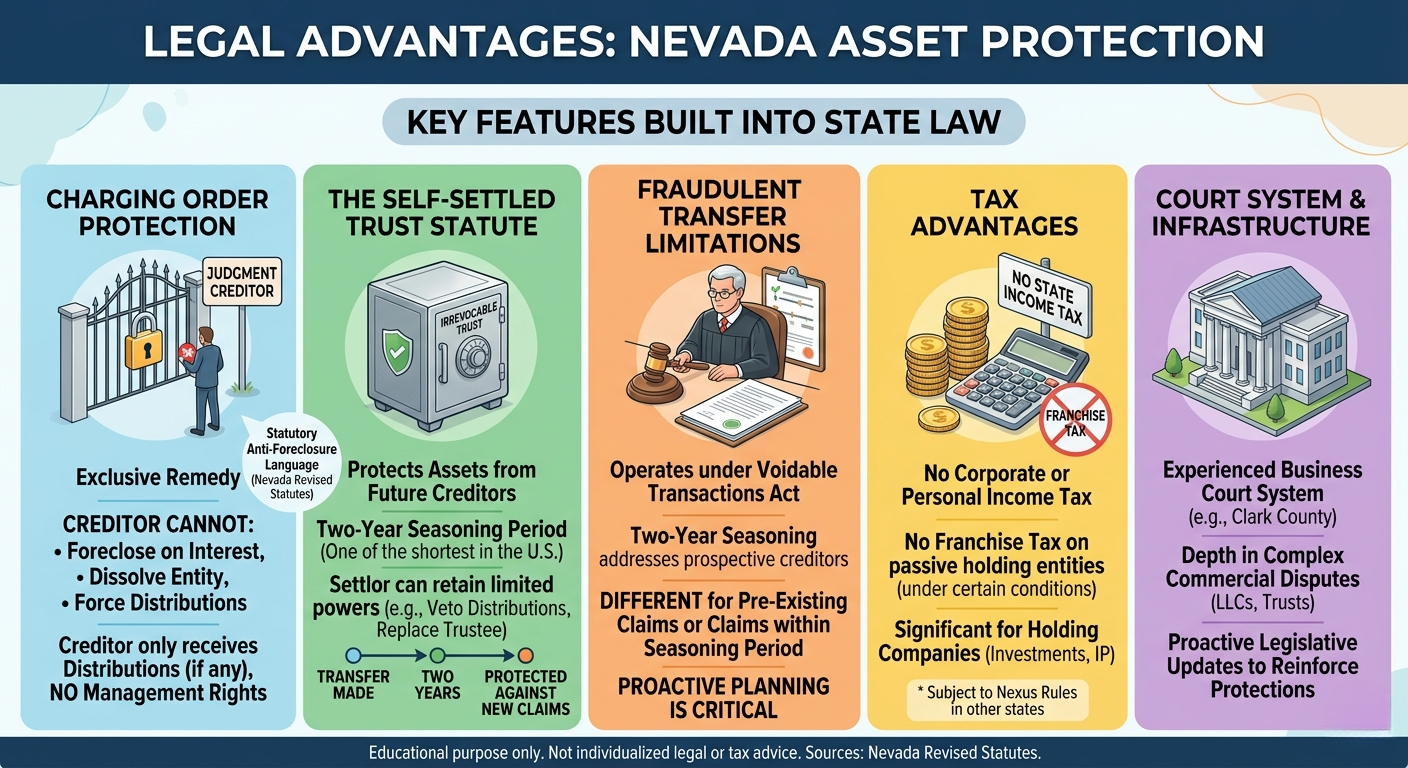
Nevada’s charging order provisions for LLCs and corporations are among the most explicit in the country. Under Nevada law, a charging order is the exclusive remedy available to a judgment creditor seeking to reach a member’s interest in an LLC. This means the creditor cannot petition for foreclosure on the interest, seek an order dissolving the entity, or demand that the entity make distributions.
The charging order gives the creditor the right to receive any distributions that the debtor member would otherwise receive, but it does not grant the creditor any management rights or the right to compel the entity to take any action. For a well-structured entity with multiple members, this is a significant limitation on what a creditor can accomplish.
Nevada has reinforced this protection by including anti-foreclosure language in its statutes that explicitly prevents a court from ordering the foreclosure of a charging-order lien or the appointment of a receiver over the entity. This goes further than many other states and provides a stronger statutory foundation for the protection.
The Self Settled Trust Statute
Nevada Revised Statutes Chapter 166 governs spendthrift trusts in the state, including self-settled trusts. The statute allows a person to transfer assets to an irrevocable trust, name a qualified Nevada trustee, retain the ability to receive discretionary distributions, and have those assets protected from claims by creditors who arise after the seasoning period has passed.
The current seasoning period under Nevada law is two years from the date of the transfer, or six months from the date a creditor discovers or reasonably should have discovered the transfer, whichever is later. This is one of the shorter periods among DAPT states and is a genuine practical advantage.
The statute also allows the settlor to retain certain powers without destroying the protection. A settlor can retain a testamentary power of appointment, the ability to veto distributions, and the right to remove and replace the trustee under specified conditions. These retained powers give the settlor meaningful involvement in the trust without compromising the creditor protection, provided the structure is properly documented and administered.
Fraudulent Transfer Limitations
Nevada’s asset protection tools operate within the constraints of fraudulent transfer law, and it is important to be clear about that. Nevada has adopted a version of the Uniform Voidable Transactions Act, which allows creditors to challenge transfers made with intent to hinder, delay, or defraud, as well as transfers made when the debtor was insolvent or that rendered the debtor insolvent.
For DAPT planning, the two-year seasoning period is specifically designed to address prospective creditors. Transfers that are challenged by creditors whose claims arose before the transfer, or whose claims arose within the seasoning period, are in a different position than transfers that have fully seasoned against creditors who arose afterward. Proactive planning, well before any claim exists or is foreseeable, is what makes these structures function as intended.
No State Income Tax and No Franchise Tax on Passive Entities
Nevada imposes no corporate or personal income tax. For entities that are properly structured and do not have nexus in high-tax states, this eliminates a layer of taxation that would otherwise apply. Nevada also has no franchise tax on passive holding entities under certain conditions, making it useful as a holding-company jurisdiction for individuals managing investments or intellectual property.
The tax analysis for any Nevada structure must account for where the beneficial owners reside, where the entity conducts business, and whether other states have a basis to assert tax jurisdiction. Nevada’s tax advantages are real, but they are not unlimited, and proper tax planning, alongside asset protection work, is essential.
Court System and Legal Infrastructure
Nevada’s business court system in Clark County has gained significant experience in complex commercial disputes, including cases involving LLCs, trusts, and creditor claims. That depth of practice means the legal infrastructure to administer and litigate these structures exists within the state, a practical advantage compared to jurisdictions where these issues arise less frequently.
Nevada has also been proactive in updating its statutes to address issues that have arisen in litigation and to reinforce the protections its legislature intended to provide. That ongoing legislative engagement is a sign of a jurisdiction that takes its role in this area seriously, and that will continue to be a relevant venue for this kind of planning.
Disclosure: The information in this article reflects general structural principles and practical observations from consulting experience and is provided for educational purposes only. It should not be interpreted as individualized legal or tax advice.