
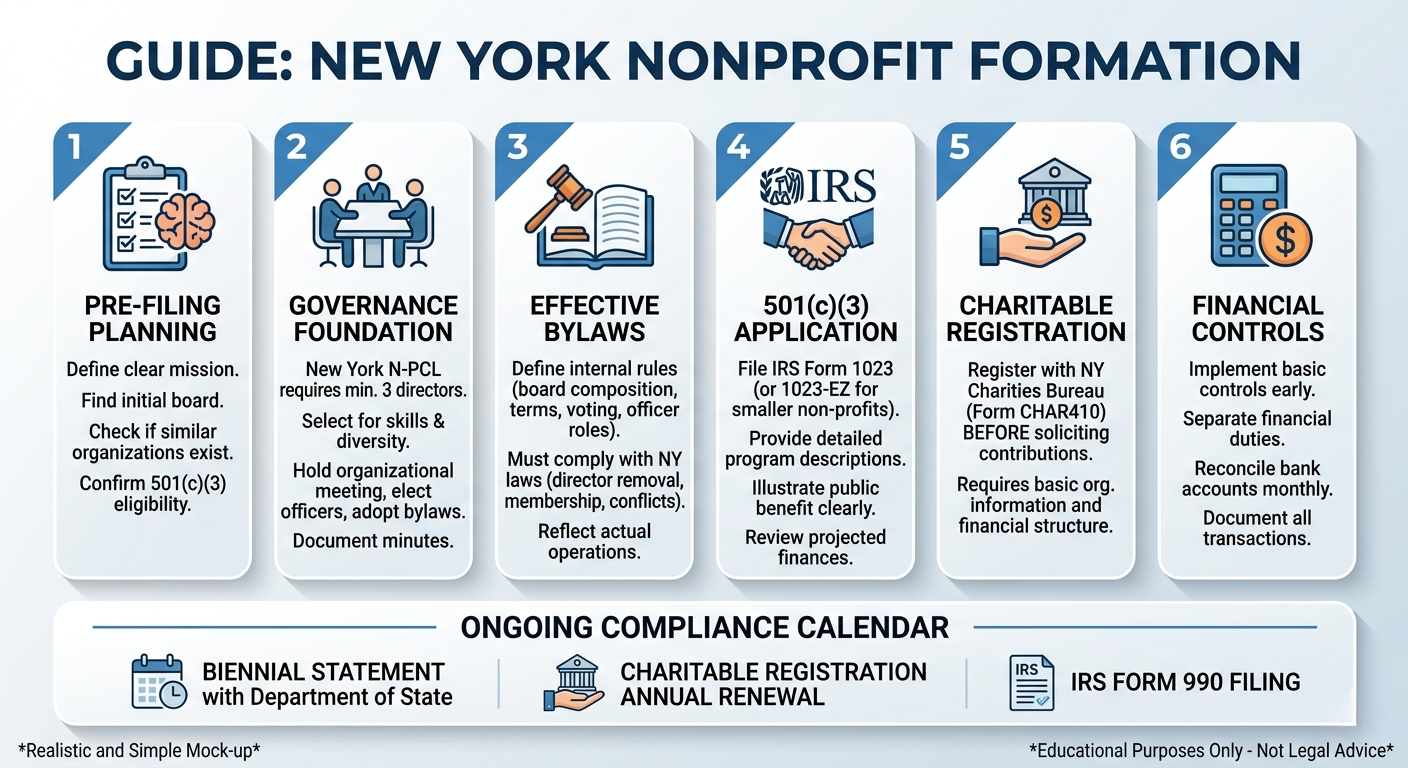

Guide: NY Nonprofit Formation
This guide is intended for founders and board members who are forming a nonprofit corporation in New York or are in the early stages of considering it. It covers the key decisions, the main process steps, and the governance considerations that determine whether a new organization gets off to a solid start or spends its first years correcting problems that could have been avoided.
New York is not the simplest state in which to form a nonprofit. The regulatory framework is detailed, the Attorney General’s oversight role is active, and the compliance obligations are ongoing and consequential. None of that should discourage a well-conceived mission. It should encourage anyone pursuing that mission to approach the formation process with appropriate seriousness.
Before You File Anything
The most important work in forming a New York nonprofit happens before the certificate of incorporation is drafted. This is the planning phase, which involves working through questions that shape every document and decision that follow.
What is the organization’s mission, stated with enough specificity to be meaningful but enough flexibility to allow for growth? Who are the initial board members, and do they have the experience, the networks, and the capacity to govern a new organization responsibly? Is the organization’s intended program activity something that qualifies for 501(c)(3) status, or is a different exemption category more appropriate? How will the organization be funded initially, and is there a realistic path to financial sustainability? These questions do not have to be answered perfectly before anything moves forward, but they need to be thought through seriously.
It is also worth verifying that a similar organization does not already exist and that the new entity is genuinely additive to the landscape of organizations serving the intended purpose. Funders and regulators are both more receptive to organizations that have thought carefully about their unique contribution than to those that have simply replicated an existing model without differentiation.
The Governance Foundation
The board of directors is the governing body of a New York nonprofit corporation, and its composition and conduct determine much of the organization’s long-term health. New York’s N-PCL requires a minimum of three directors for most nonprofit corporations. Beyond that minimum, the right board size depends on the organization’s stage, its programs, and the skills and experience needed to govern it effectively.
Early board members should be selected for what they bring to the organization, not simply for their willingness to be listed on a form. A board that includes people with financial expertise, legal experience, programmatic knowledge, and community connections is better positioned to guide a new organization than one assembled primarily from personal relationships. Diversity of perspective and experience on the board also reduces the risk of blind spots in organizational decision-making.
The initial board meeting, typically called the organizational meeting, is where the board adopts the bylaws, elects’ officers, authorizes the opening of bank accounts, and takes the other foundational actions necessary to get the organization operational. This meeting should be documented in formal minutes, which become part of the organization’s permanent records.
Bylaws That Actually Work
Bylaws govern how the organization functions internally, and the best bylaws are those that reflect how the organization actually intends to operate. They should address board composition and terms; the process for electing and removing directors; quorum and voting requirements; officer roles and responsibilities; the process for calling and conducting meetings; committee structure, if relevant; and the process for amending the bylaws themselves.
New York has specific requirements under the N-PCL that bylaws must comply with, including provisions on director removal, member rights in membership corporations, and conflict-of-interest procedures. Bylaws that conflict with the N-PCL or that are so generic they do not reflect the organization’s actual governance create problems over time. Investing in well-drafted bylaws at the outset is considerably less expensive than amending poorly drafted ones after the organization has been operating for several years.
The 501(c)(3) Application
For most public benefit nonprofits, applying for 501(c)(3) status is a near-immediate priority after incorporation. The application is filed on IRS Form 1023 or, for eligible smaller organizations, Form 1023-EZ. The full Form 1023 requires a detailed narrative description of each program activity, projected or actual financial statements, information about governance and compensation practices, and answers to questions about relationships with related organizations and foreign activities.
The quality of the program narrative matters more than many applicants expect. The IRS reviewer is evaluating whether the organization’s activities are genuinely charitable under the Internal Revenue Code, and a vague or incomplete description of its programs can result in requests for additional information that significantly extend processing time. Taking the time to describe programs clearly, specifically, and in terms of the public benefit they provide is worth the effort.
Processing times for Form 1023 have varied considerably in recent years. Organizations that qualify for the expedited review process or file Form 1023-EZ generally receive determinations more quickly. Most organizations can and do begin operations before receiving the determination letter, but they should communicate clearly with donors about the status of their exemption application during that period.
Charitable Registration and Ongoing Compliance
Before the organization solicits any contributions in New York, it must be registered with the Charities Bureau. The initial registration is filed on Form CHAR410 and requires basic information about the organization, its governance, and its financial structure. After registration, annual renewals are due each year, along with the financial disclosures described in the compliance requirements article.
Building a compliance calendar from the very beginning is one of the most practical things a new nonprofit can do. This calendar should include the biennial statement deadline with the Department of State, the annual charitable registration renewal deadline, the IRS Form 990 filing deadline, and any other recurring obligations relevant to the organization’s activities. Assigning clear responsibility for each filing and building in enough lead time to prepare the required documents avoids the last-minute scrambles that result in missed deadlines.
Financial Controls from Day One
New organizations sometimes defer implementing financial controls, treating them as something to address once they are larger. That approach creates risk, both in terms of actual financial exposure and in the organization’s ability to withstand scrutiny from auditors, grantors, and regulators as it eventually grows. Basic controls include separating financial duties so that the person who authorizes expenditures is not the same person who signs checks; maintaining dual-signature requirements above a certain dollar threshold; reconciling bank accounts monthly; and ensuring that all financial transactions are documented with appropriate supporting records.
The Charities Bureau and the IRS both pay attention to financial management practices in the organizations they oversee. An organization that demonstrates sound financial controls from its early days is in a stronger position as it grows into revenue thresholds that trigger enhanced reporting requirements or pursues larger grants that require demonstrated organizational capacity.
Getting It Right from the Start
Forming a nonprofit in New York correctly requires more initial effort than forming one in many other states. The regulatory framework is detailed, the oversight is real, and the compliance obligations are ongoing. But the organizations that approach this process seriously and invest in proper governance and sound financial practices from the beginning tend to build the institutional credibility that allows them to grow their programs and attract the support they need.
New York is also a state with an extraordinary concentration of philanthropic resources, institutional funders, and civic infrastructure. Organizations that are properly formed and operated compliantly are better positioned to access those resources than those scrambling to catch up on formation and compliance issues while also trying to run programs. The upfront investment in doing this right pays off over time.
Disclosure: The information in this article reflects general structural principles and practical observations from consulting experience and is provided for educational purposes only. It should not be interpreted as individualized legal or tax advice.