
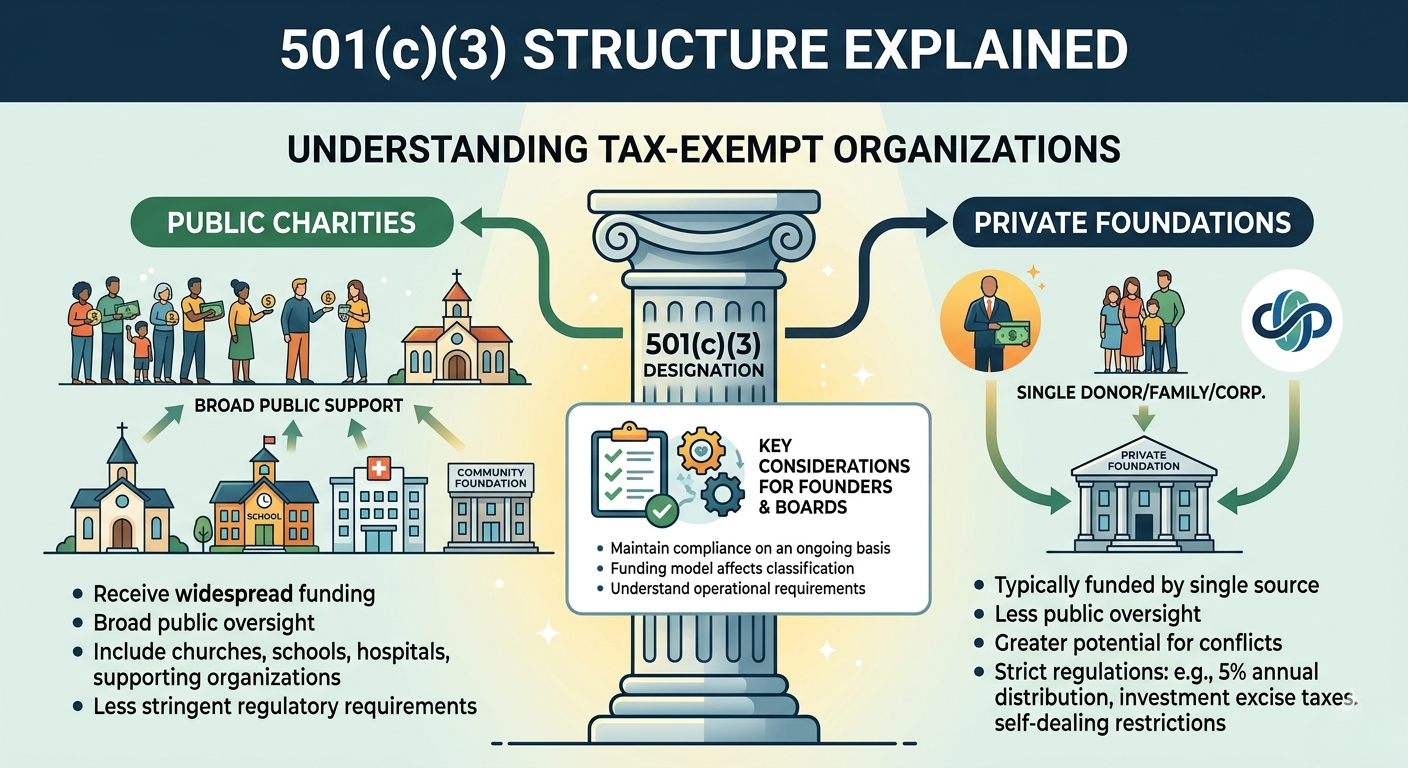

501(c)(3) Structure Explained
The 501(c)(3) designation is probably the most recognized tax-exempt category under the Internal Revenue Code, but it is also one of the most misunderstood. People often think of it as simply a status you apply for and receive. In practice, it represents a specific structural and operational framework that your organization must maintain on an ongoing basis, not just at the time of application.
Understanding how 501(c)(3) organizations are structured helps founders make better decisions at the formation stage and helps boards and executives stay in compliance over the life of the organization.
The Two Categories: Public Charity and Private Foundation
Every 501(c)(3) organization is classified as either a public charity or a private foundation. This distinction matters significantly for how the organization operates, which excise taxes may apply, and the disclosure obligations it carries.
Public charities are generally organizations that receive broad public support, either through donations from many contributors or through fee-based services related to their exempt purpose. Churches, schools, hospitals, and community foundations are common examples. The IRS also recognizes what are called supporting organizations, which operate to benefit other public charities and qualify as public charities themselves under specific criteria.
Private foundations, by contrast, are typically funded by a single donor, family, or corporation. They are subject to more stringent regulatory requirements, including an annual distribution requirement of at least 5% of investment assets, excise taxes on investment income, and restrictions on self-dealing. These rules exist because private foundations have less public oversight than public charities and carry greater potential for conflicts of interest.
Most new nonprofits intend to qualify as public charities, and they typically do so by passing either a public support test or by operating as a church, school, or hospital. If you are applying for 501(c)(3) status, understanding which category you expect to fall into will shape how you build your funding model and structure your programs.
Operational Standards: The Private Benefit and Inurement Rules
501(c)(3) organizations are prohibited from allowing their net earnings to inure to the benefit of private shareholders or individuals. This is the inurement prohibition, which applies to insiders of the organization, including directors, officers, key employees, and people who have substantial influence over the organization’s affairs.
There is also a broader private benefit prohibition that applies to all 501(c)(3) organizations. It prohibits the organization from operating in a way that serves private interests more than incidentally. If a significant portion of your activities benefits specific individuals or private entities rather than the public, you are at risk of running into this limitation even if no formal inurement is involved.
These rules have real operational implications. Compensation arrangements with founders or key personnel need to be reasonable and documented. Contracts with related parties need to be reviewed carefully. Business transactions that could benefit insiders need to go through your conflict of interest process. The IRS has enforcement tools, including intermediate sanctions that impose excise taxes on excess benefit transactions, so this is an area where sloppy governance creates real financial exposure.
Political Activity Restrictions
501(c)(3) organizations are absolutely prohibited from participating in or intervening in political campaigns on behalf of or in opposition to candidates for public office. This is not a gray area. Endorsing candidates, making campaign contributions, or producing materials that support or oppose a specific candidate are all prohibited activities that can result in loss of tax-exempt status.
Lobbying is a different matter. 501(c)(3) organizations can engage in some lobbying, meaning direct attempts to influence legislation, if it does not constitute a substantial part of the organization’s activities. Public charities can elect to use a safe harbor test under Section 501(h) that defines lobbying limits in dollar terms rather than the more subjective substantial-part standard. Private foundations, however, face a different and more restrictive set of rules regarding lobbying expenditures.
Unrelated Business Income
Operating as a 501(c)(3) does not mean all your revenue is tax-free. Income from activities that are regularly carried out and not substantially related to your exempt purpose is subject to Unrelated Business Income Tax, commonly called UBIT. Common examples include advertising revenue, income from fee-based services that do not further the exempt purpose, and certain investment income for private foundations.
UBIT does not jeopardize your exempt status by itself, but it does create a tax obligation, and if unrelated business activities start to dominate your operations, you may face questions about whether you are operating primarily for an exempt purpose. Keeping your revenue mix aligned with your mission is both good practice and good tax planning.
Annual Reporting Requirements
501(c)(3) organizations are required to file an annual information return with the IRS. Most organizations file Form 990, a publicly available document that discloses information about the organization’s finances, governance, programs, and key personnel. Smaller organizations may file the 990-EZ or the 990-N, depending on their revenue levels.
The 990 is not just a compliance form; it is read by donors, watchdog organizations, and journalists. The quality of your disclosures, the accuracy of your program descriptions, and the consistency of your financial reporting all reflect on the organization. Filing late or filing an inaccurate return creates unnecessary risk and reflects poorly on your governance.
The 501(c)(3) framework is coherent and well-developed. Understanding it fully at the outset allows you to build an organization that operates confidently within it rather than working around it after the fact.
Disclosure: The information in this article reflects general structural principles and practical observations from consulting experience and is provided for educational purposes only. It should not be interpreted as individualized legal or tax advice.
Expand your knowledge of asset protection, business planning, taxation, and private trusts. Explore the available books on Amazon.