
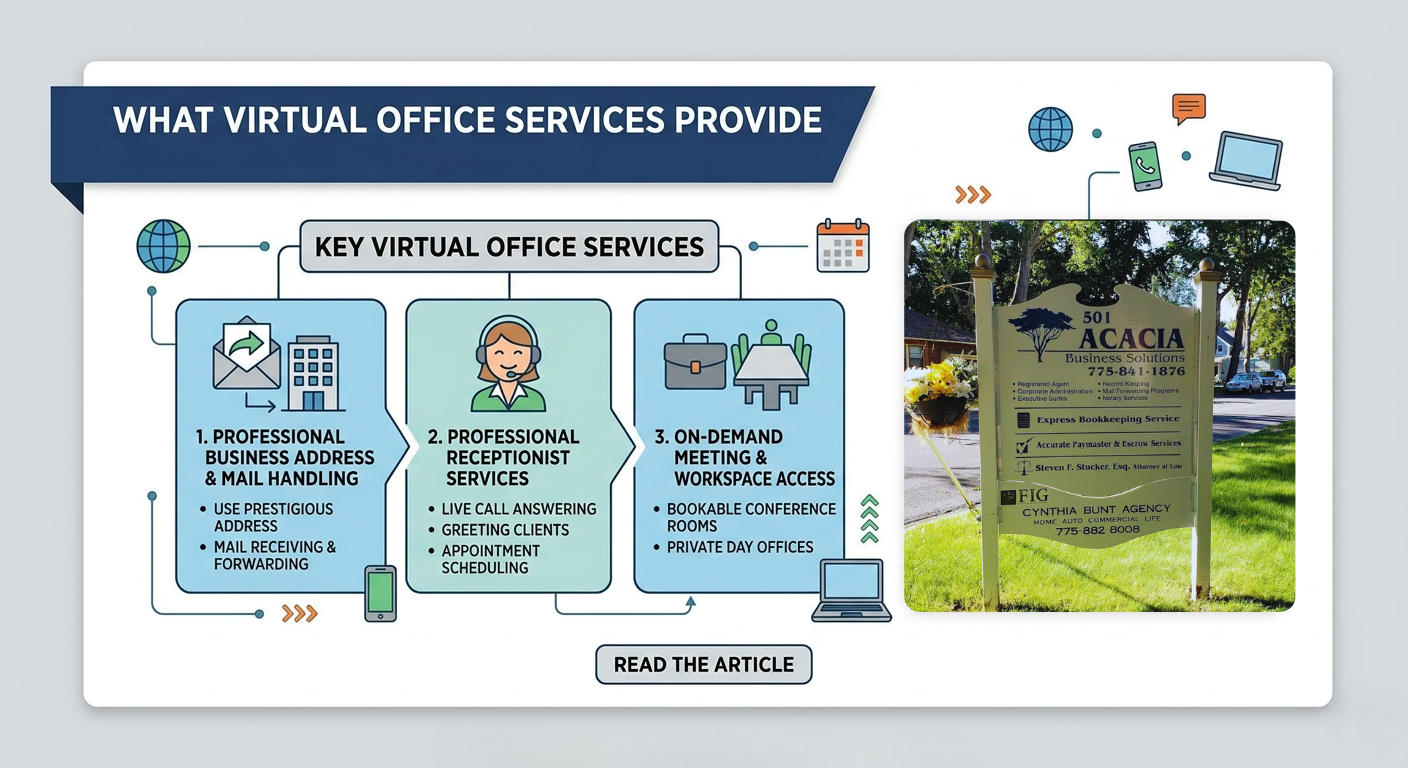

What Virtual Office Services Provide
By Michael Freeman | Acacia Business Solutions
The term virtual office gets used loosely, and that looseness has created some confusion about what these services include. For some people, it suggests a simple mail forwarding arrangement. For others, it implies a technology platform for remote teams. In practice, a properly structured virtual office service provides a defined set of business infrastructure functions that enable a company to maintain a professional presence and meet legal and operational requirements without committing to a dedicated physical space.
Understanding what is included, and what is not, helps business owners decide whether a virtual office arrangement fits their situation and how to use it effectively.
A Business Address That Is Not Your Home
The most fundamental element of virtual office service is a professional business address. For a sole proprietor or small business owner working from home, a home address is technically sufficient for most purposes, but it creates several real problems. It appears on public business registrations, marketing materials, websites, invoices, and contracts. It becomes searchable in connection with your business name. Depending on your city or county zoning rules, operating a business from a residential address may create compliance issues, particularly if you receive clients or business visitors there.
A virtual office address is typically a commercial street address in a professional building or business district. It is not a post office box, which matters because many state agencies, financial institutions, and licensing bodies will not accept a PO box as a principal business address. A genuine street address in a recognized business location serves those purposes and projects a more established professional image than a residential address.
The address can be used on business cards, websites, marketing materials, and in many cases on state business registrations. However, the rules regarding the use of a virtual address for registered agent purposes vary by state and should be confirmed in each jurisdiction.
Mail Receipt and Handling
Mail handling is the operational core of most virtual office arrangements. The service provider receives physical mail and packages at the business address on your behalf. From there, handling options typically include mail forwarding to a designated address, scanning and electronic delivery, secure holding for pickup, and, in some cases shredding of unwanted items.
The specifics matter. Forwarding frequency, scanning turnaround time, and how packages above a certain size are handled all affect the service’s day-to-day usefulness. A virtual office service that batches forwarding once a week may not be adequate for a business that regularly receives time-sensitive correspondence. Clarifying these details before committing to a provider is worth the time.
Some providers also offer phone services as part of a virtual office package, including a local or toll-free phone number, live receptionist call answering, and call forwarding to your personal or business number. These services extend the concept of a professional presence beyond a mailing address and into how clients and contacts experience reaching your business.
Meeting Space Access
Many virtual office providers offer access to conference rooms and private offices on as-needed, reservation basis. This is one of the more practical aspects of the arrangement for businesses that occasionally need to meet with clients, conduct interviews, or hold internal meetings in a professional setting without maintaining a full-time office.
The availability and quality of meeting space vary considerably between providers. Some virtual office companies operate their own facilities with well-equipped conference rooms available on hourly or daily rates. Others provide access through shared workspace networks that may span multiple cities. If in-person meeting capability is important to your business, evaluate this aspect of the service as carefully as the address and mail components.
What Virtual Office Services Do Not Provide
It is equally useful to be clear about what virtual office services do not include. A virtual office address is generally not a substitute for a registered agent service, though some providers offer both, although Acacia Business Solutions includes registered agent service with the purchase of Virtual Office Service. Registered agent service involves specific legal obligations and requirements that differ from a general business address service, and conflating the two can create compliance gaps.
A virtual office may or may not establish legal residency or domicile for the business in the relevant state, check with Acacia to determine if all necessary requirements have been made. Simply maintaining a business address in a state does not make the business a resident of that state for tax purposes or satisfy nexus requirements, typically having stationary, business cards, phone number with appropriate prefix will help meet the requirements, most important is that it is a real address and business location not just a P.O. Box or PMB.
Understanding the scope of what is included in a virtual office arrangement allows you to use it for what it is genuinely well-suited to and to fill any remaining gaps with separate, appropriate services.
Disclosure: The information in this article reflects general structural principles and practical observations from consulting experience and is provided for educational purposes only. It should not be interpreted as individualized legal or tax advice.
Expand your knowledge of asset protection, business planning, taxation, and private trusts. Explore the available books on Amazon.