
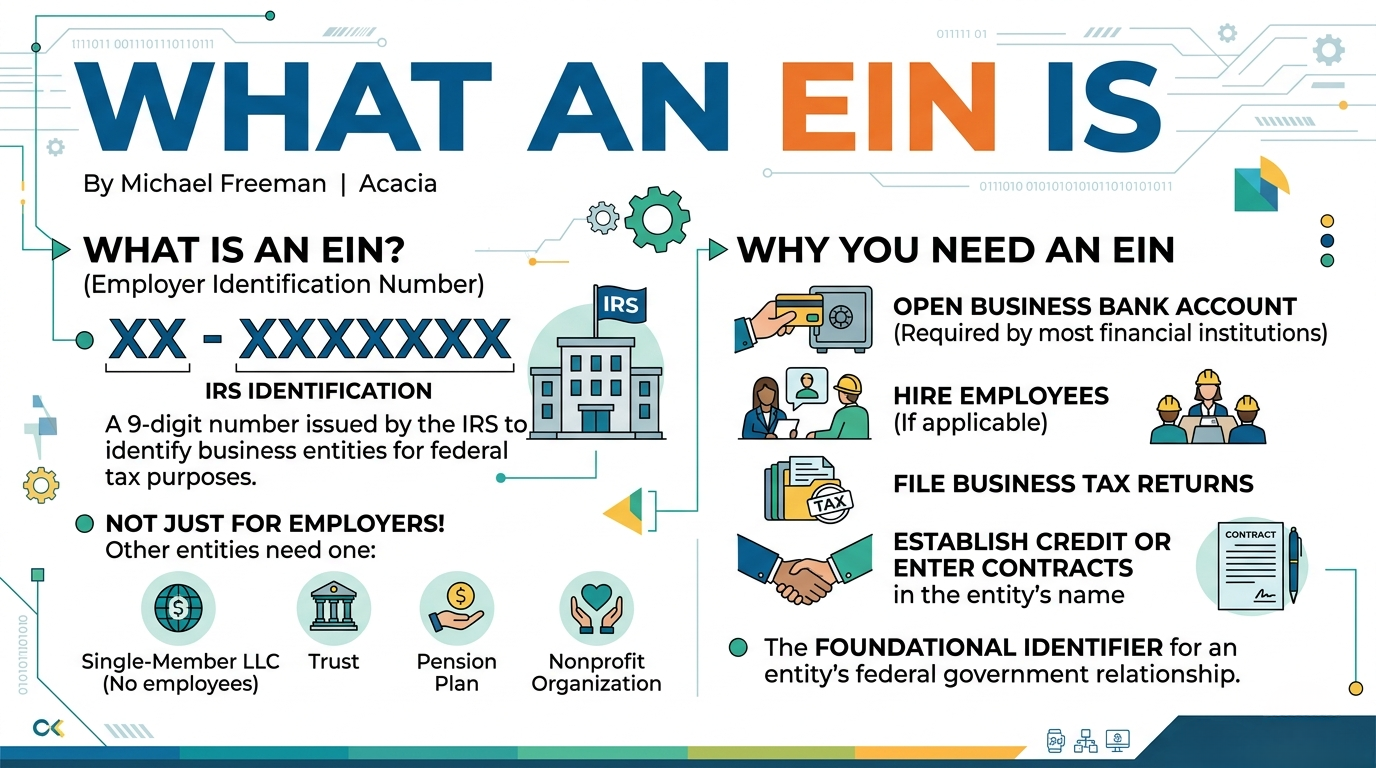

What an EIN Is
By Michael Freeman | Acacia
An Employer Identification Number, commonly called an EIN, is a nine-digit number issued by the Internal Revenue Service to identify a business entity for federal tax purposes. Despite the name, having employees is not a requirement to obtain one. A single-member LLC with no employees, a trust, a pension plan, and a nonprofit organization can each hold an EIN. The number simply tells the IRS which entity it is dealing with when tax filings, payments, or account registrations are involved.
For anyone forming a business entity, obtaining an EIN is one of the first practical steps after formation. It is required to open a business bank account with most financial institutions, hire employees (if applicable), file business tax returns, and, in many cases, establish credit or enter contracts in the entity’s name. It is the foundational identifier for the entity’s relationship with the federal government.
How It Differs from a Social Security Number
An EIN functions for a business entity in much the same way as a Social Security Number functions for an individual. Both are federal tax identification numbers, are required for certain filings, and appear on forms such as the W-9, which is used to certify taxpayer identification numbers for payments.
For business owners, separating business activity from personal tax identity is a practical reason to obtain an EIN, even when it is not strictly required. A sole proprietor operating without any formal entity can use their SSN for business purposes, but doing so creates unnecessary personal exposure and complicates the paper trail. Using an EIN for the business, even for a single-member LLC that is treated as a disregarded entity for tax purposes, keeps the identity of the business distinct from the owner’s personal identity.
Who Issues EINs and How the Process Works
EINs are issued exclusively by the IRS. The application (Form SS-4) can be submitted online, by fax, or by mail. Online applications through the IRS website provide an EIN immediately upon completion, assuming the application is accepted. Fax applications generally receive a response within four business days; mail applications can take several weeks.
The online application is limited to entities whose responsible party has a valid Social Security Number or Individual Taxpayer Identification Number. Foreign nationals forming U.S. entities without a U.S. tax identification number must apply by fax or mail. This is a meaningful distinction for international clients forming U.S. LLCs or corporations, as the timeline and process differ from those for domestic applicants.
One EIN is assigned per responsible party per day through the online system. For someone forming multiple entities simultaneously, this can slow the process. Formation services that assist with EIN applications handle this regularly and can sequence applications appropriately.
EINs for Different Entity Types
Each legal entity requires its own EIN. A parent LLC and a subsidiary LLC are separate entities, and each holds its own number. A trust holds a separate EIN from the grantor’s personal return. A solo 401 (k) plan has its own EIN, distinct from both the sponsoring business and the owner’s personal return. Understanding this is important for anyone managing a multi-entity structure, because each EIN corresponds to a separate tax filing obligation, a separate bank account requirement, and a separate compliance track.
For disregarded entities, specifically single-member LLCs that have not elected to be taxed as a corporation, the income flows through to the owner’s personal return. The LLC still has its own EIN for banking and identification purposes, but the EIN is not used to file a separate entity-level income tax return under normal circumstances.
Acacia assists clients with EIN applications as part of entity formation and structuring services. For additional context on entity compliance and formation, MichaelIoane.com provides further detail.
The information in this article reflects general structural principles and practical observations from consulting experience and is provided for educational purposes only. It should not be interpreted as individualized legal or tax advice.
Expand your knowledge of asset protection, business planning, taxation, and private trusts. Explore the available books on Amazon.