
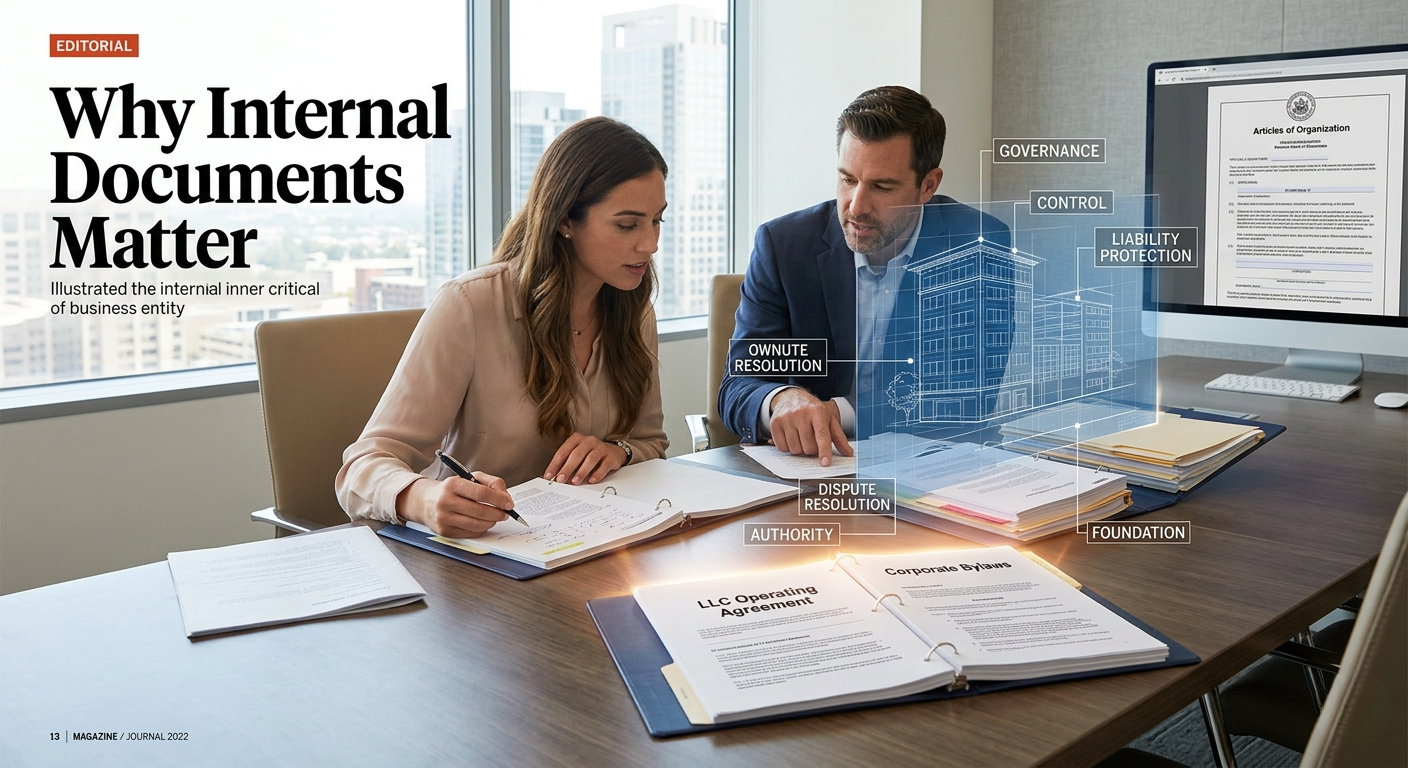

Why Internal Documents Matter
By Michael Freeman | Acacia
Filing articles of organization or articles of incorporation creates the legal shell of a business entity. What most people do not fully appreciate at the time of formation is that the internal documents- the operating agreement for an LLC or the bylaws for a corporation- are where the actual governance of that entity lives. The state filing gets the entity on record. The internal documents determine how it operates, who controls it, and what happens when things get complicated.
This distinction matters more than it appears to at the beginning. When the entity is new, and relationships are smooth, the operating agreement or bylaws can feel like administrative paperwork. When a dispute arises between members, an owner wants to exit, a bank or investor asks for documentation of authority, or a court is evaluating whether the entity’s liability protection should hold, those documents become the foundation of every argument that follows.
The Operating Agreement as the LLC’s Constitution
Every LLC is governed by its operating agreement. In states that do not require a written operating agreement (most states allow oral or implied agreements), a poorly documented or entirely absent agreement creates a governance vacuum that state default rules fill. Those default rules are not necessarily aligned with what the members actually want. Profit distributions defaulting to equal splits regardless of capital contribution, voting rights that do not reflect economic stakes, and dissolution triggers that no one anticipated are all examples of what state defaults can impose when the internal document is absent or silent.
A well-drafted operating agreement addresses membership interests and how they are calculated, capital contributions and what happens when additional capital is needed, profit and loss allocation among members, manager authority versus member authority (in a manager-managed structure), voting thresholds for major decisions, transfer restrictions on membership interests, buy-sell provisions in the event a member wants to exit or dies, and procedures for dissolution. Not every agreement needs to address all of these in exhaustive detail, but each one represents a potential point of conflict if left unaddressed.
Bylaws and Corporate Governance
For corporations, bylaws serve the equivalent function. They govern how the board of directors is constituted, how directors are elected and removed, what authority officers hold, how meetings are called and conducted, what constitutes a quorum, how shares are issued and transferred, and what procedures govern major corporate decisions.
Corporations also commonly use shareholder agreements alongside bylaws to address issues specific to ownership, particularly in closely held companies where shareholders are also involved in management. A shareholder agreement can address transfer restrictions, rights of first refusal, drag-along and tag-along rights in the event of a sale, and valuation mechanisms for buyouts. These are not typically covered in the bylaws themselves, which tend to be more procedural.
Why Banks, Investors, and Courts All Ask for These Documents
Banks request operating agreements and bylaws as part of account opening for a straightforward reason: they need to know who has authority to bind the entity. An account opened without confirming signatory authority, or by someone who does not have documented authority to do so, creates legal and compliance exposure for the institution. The internal governance document is the authoritative source for that determination.
Investors, particularly institutional investors or anyone conducting meaningful due diligence before committing capital, will review the operating agreement or bylaws as part of their process. What they are looking for includes clarity of ownership, how decisions are made, what protective provisions exist (or do not exist) for minority stakeholders, and whether the governance structure is consistent with how the entity has represented itself.
Courts evaluating liability protection, disputes between members, or claims against the entity will look to the internal documents to understand the agreed-upon rules. An entity that has no meaningful governance documents, or that has documents that were never properly executed or that contradict how the entity actually operated, presents a much weaker case for enforcing the rights and protections those documents are supposed to provide.
Acacia works with clients on entity formation, including proper governance documentation from the outset. For additional commentary on structuring and compliance, MichaelIoane.com covers these topics in practical depth.
The information in this article reflects general structural principles and practical observations from consulting experience and is provided for educational purposes only. It should not be interpreted as individualized legal or tax advice.
Expand your knowledge of asset protection, business planning, taxation, and private trusts. Explore the available books on Amazon.