

Structuring Control Agreements
By Michael Freeman | Acacia
One of the more consequential decisions in forming a business entity is how control is structured within the internal governance documents. This is particularly relevant for multi-member LLCs and closely held corporations where ownership and management are not the same, or where different stakeholders have varying levels of involvement and interests in the business’s outcome.
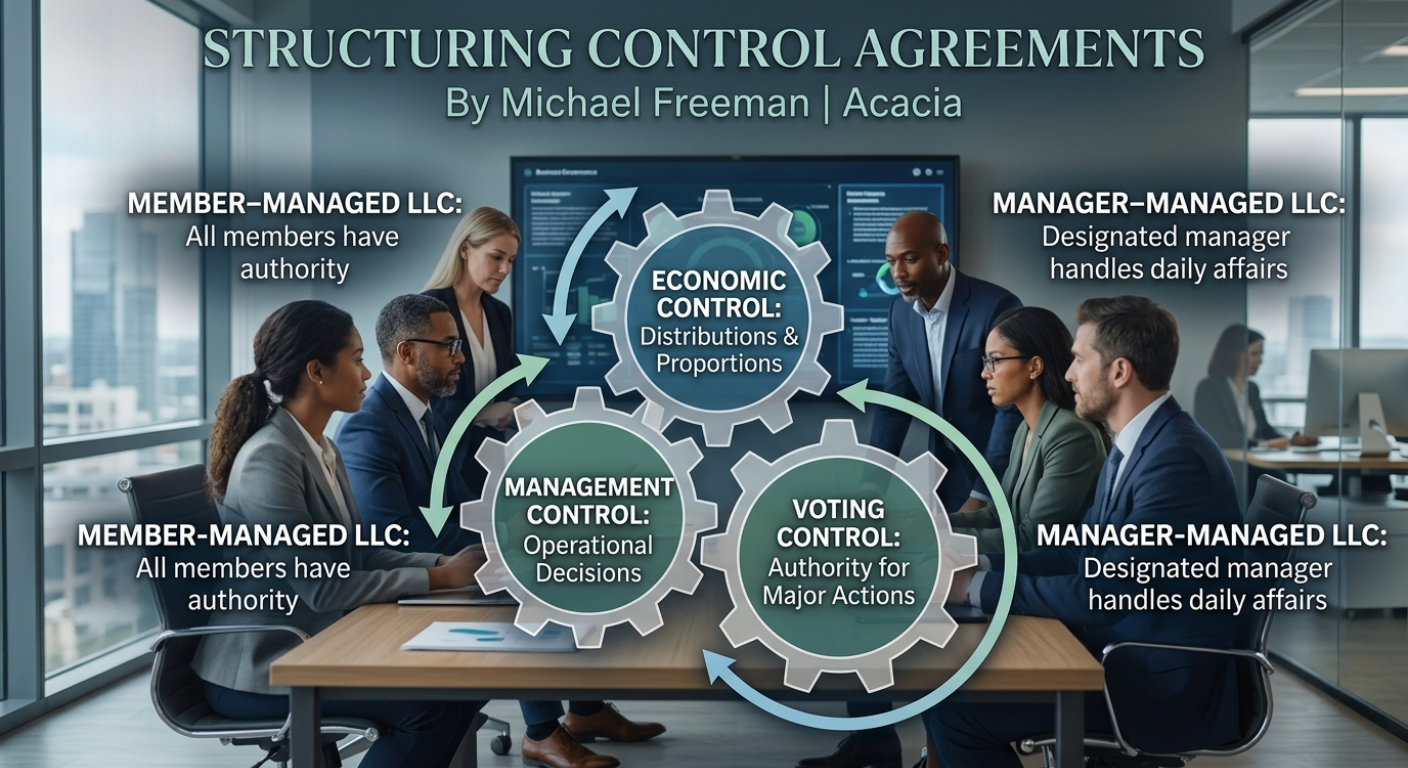
Control, in the governance sense, has multiple dimensions. There is economic control, meaning who receives distributions and in what proportion. There is management control, meaning who makes operational decisions on a day-to-day basis. And there is voting control, meaning who has the authority to approve major decisions, admit new members, authorize transfers of ownership interests, or approve a sale of the business. These three dimensions do not have to be aligned in the same proportions, and in many structures, deliberately separating them serves all parties’ interests better than treating them as identical.
Member-Managed vs Manager-Managed LLCs
The default structure for most LLCs is member-managed, meaning all members have authority to act on behalf of the entity. For a single-member LLC, this is effectively irrelevant because there is only one person involved. In a two-member or multi-member LLC, a member-managed structure means each member has agency, which can create complications if members disagree or if one member takes action the other did not authorize.
A manager-managed structure designates one or more managers to handle day-to-day affairs and make operational decisions. Members of a manager-managed LLC are more like passive investors; they retain voting rights on fundamental matters but lack general authority to bind the entity in the ordinary course of business. This structure is common in real estate LLCs, where there is an active operator (the manager) and passive investors (the members), and in holding company structures, where operational management is intended to be centralized.
The operating agreement must clearly specify which structure applies, who the manager (s) are, how managers are appointed and removed, what authority managers have without member approval, and which decisions require member consent regardless of the manager’s authority. Ambiguity in any of these points creates governance risk.
Voting Rights and Decision Thresholds
State law provides default voting rules for LLCs and corporations, but those defaults are almost never the right answer for a specific business. Default LLC rules in many states provide for voting proportional to ownership percentage; others provide for one vote per member regardless of economic interest. Neither default is appropriate for every situation, and operating agreements can and should modify these defaults to reflect the actual agreement among the parties.
For major decisions, supermajority approval thresholds are common and appropriate. Decisions to admit new members, approve a merger or acquisition, authorize a significant debt obligation, dissolve the company, or amend the operating agreement itself are often subject to a 75 percent or unanimous approval requirement rather than a simple majority. These thresholds protect minority members from having fundamental changes imposed on them by a majority that do not reflect the minority’s legitimate interests, and they protect the integrity of the original agreement among all members.
For corporations, similar logic applies to shareholder votes on major transactions, board elections, and amendments to the articles or bylaws. A well-structured shareholders’ agreement will also include protective provisions that grant certain shareholders veto rights over specific categories of decisions, a common arrangement in venture-backed companies and private equity structures.
Transfer Restrictions and Buy-Sell Provisions
Perhaps the most practically important governance provisions in any multi-owner entity are those that govern what happens when an owner wants to leave or cannot continue. Transfer restrictions limit a member’s or shareholder’s ability to sell or transfer their interest without the consent of the other owners or the entity itself. Without these provisions, a member could theoretically sell their interest to an unknown third party, bringing someone into the ownership group without the remaining owners’ consent.
Buy-sell provisions establish the mechanism for an owner exit. The most common structures include right of first refusal (the departing member must offer their interest to the remaining members or the entity before selling to a third party), buyout triggers (death, disability, bankruptcy, or voluntary departure of a member), and valuation mechanisms for determining the price. The valuation mechanism is where buy-sell provisions most often break down in practice; an agreement that requires a buyout at fair market value but does not specify how fair market value is determined, or that requires the parties to agree on value, is likely to produce a dispute.
A well-drafted buy-sell provision specifies the trigger events, the order of priority for who can buy (the entity, then the remaining members, then third parties), the valuation method (fixed formula, appraisal by a named methodology, or a shotgun provision), the timeline for completing the transaction, and the payment terms. These provisions are negotiated in formation, when relationships are good, and everyone expects the business to succeed. Getting them right at that stage is considerably easier than negotiating them during an actual exit under adversarial conditions.
Acacia assists clients in structuring entity governance documents that reflect the parties’ actual agreement rather than default to state law. For more on control structures and entity governance, MichaelIoane.com provides additional consulting perspective.
The information in this article reflects general structural principles and practical observations from consulting experience and is provided for educational purposes only. It should not be interpreted as individualized legal or tax advice.
Expand your knowledge of asset protection, business planning, taxation, and private trusts. Explore the available books on Amazon.