

The Ultimate Guide to Advanced LLC Structuring
For many business owners, a single LLC works in the early years. As revenue grows, assets accumulate, and risk exposure rises, that single entity can seem a liability. This is the point where Advanced LLC Structuring becomes worth understanding, not as a luxury, but as a practical tool.
It helps owners tailor liability, taxes, and governance to fit current needs. This accessibility is available to many serious businesses, not just large corporations. By planning now, you can scale more smoothly and protect assets as you grow. Consulting with an attorney or advisor can guide effective steps.
This guide explains what multi-entity LLC structures are.
Moreover, it contrasts holding companies with operating companies.
It explains when layering entities supports asset protection, a core element of Advanced LLC Structuring.
Advanced LLC Structuring for Multi-Entity LLC Structures
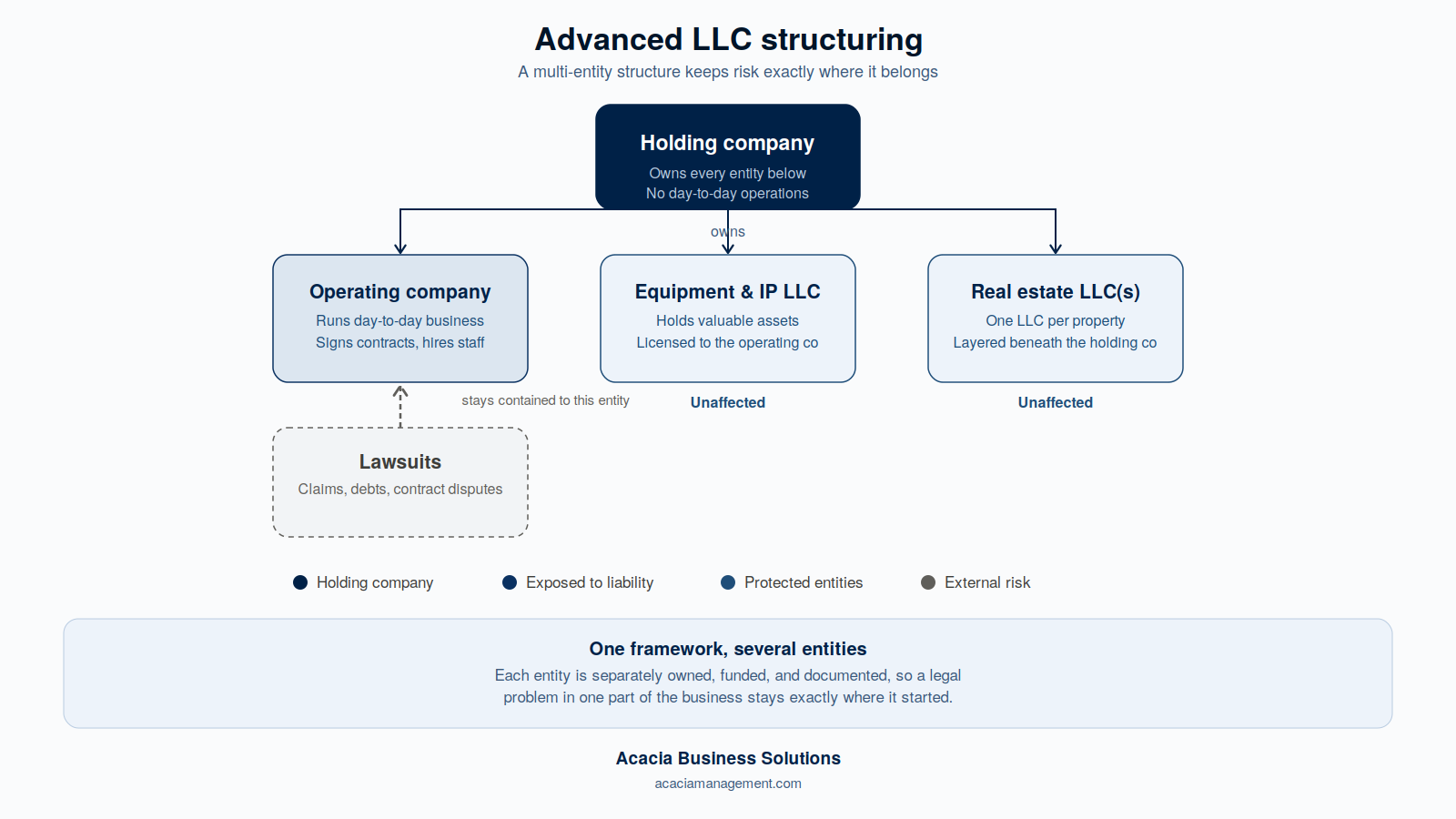
A multi-entity structure uses more than one LLC to organize different parts of a business.
Moreover, one LLC should not hold real estate, equipment, intellectual property, and daily operations all at once.
Each of these pieces sits in its own entity.
If one part of the business runs into legal trouble, that trouble stays contained there.
Rather than spreading to assets that have nothing to do with the underlying issue, it remains isolated.
This approach is common in Advanced LLC Structuring for real estate investors with multiple properties.
Additionally, it benefits owners with valuable equipment or intellectual property, and firms operating in multiple lines of business or states.
Holding Company vs Operating Company
A core piece of Advanced LLC Structuring is the relationship between a holding company and an operating company. Next, the operating company runs the business day to day, signing contracts and hiring employees. It also interacts with customers and carries the highest liability exposure. In contrast, a holding company does not conduct business operations. It exists to own valuable assets, such as property and equipment. It also holds ownership interests in the operating company.
Because the holding company stays out of daily operations, it is far less likely to be pulled into a lawsuit.
Moreover, the assets inside the holding company are generally protected when the entities are properly maintained as genuinely separate businesses.
When to Layer LLCs
Layering LLCs creates a hierarchy where one entity owns another. The owned entity may own a third. This is not necessary for every business. However, it becomes valuable in specific situations. For example, owning multiple properties. It can pair high-risk operations with valuable assets. It also supports running several distinct business lines. Additionally, it brings outside investors into one part of a business without exposing the whole operation.
Layering does add complexity, since each entity requires its own formation, bank account, records, and operating agreement. Moreover, for many growing businesses, that added structure is a reasonable trade-off for the protection it provides.
Asset Protection and Risk Separation
The purpose behind all of this is risk separation.
Every business activity carries some level of legal exposure.
Moreover, the goal is to keep that exposure contained within the part of the business where it originates.
This is why real estate investors often place each property in a separate LLC.
Moreover, business owners frequently keep valuable equipment or intellectual property outside the operating company entirely.
None of this works automatically.
Entities must be maintained correctly with separate finances, accurate records, and clear agreements that define operation.
Moreover, without that discipline, courts can disregard the separation between entities.
Designing a Structure That Fits Your Business
There is no single template that works for every business.
Moreover, the right structure depends on assets involved, and the level of risk in daily operations.
Advanced LLC Structuring is not about complexity for its own sake.
It is about building a framework that lets a business grow while keeping risk exactly where it belongs.
Let Acacia Business Solutions Guide the Process
Figuring out the right structure for your business does not have to be something you sort out alone.
Acacia Business Solutions works with business owners and investors to design and maintain entity structures.
Additionally, they hold up from formation through ongoing compliance.
Start with our LLC formation services to put a solid foundation in place.
Additionally, a properly drafted operating agreement supports this, or talk with our team about a full asset protection review.
Visit Acacia Business Solutions to schedule a consultation.
Start building a structure designed to protect what you have worked hard to build.
Expand your knowledge of asset protection, business planning, taxation, and private trusts. Explore the available books on Amazon.