

Ultimate Guide to Irrevocable and Revocable Trusts
Initially, the Irrevocable vs Revocable Trust Strategy guides an early decision: choosing between a revocable trust.
Additionally, the Irrevocable vs Revocable Trust Strategy guides that choice.
Moreover, the two serve very different purposes.
As a result, understanding the difference is the foundation for any advanced trust structuring that follows.
What Is a Revocable Trust?
The grantor can change or cancel the revocable trust, sometimes called a living trust.
Additionally, the grantor may exercise control.
They may modify assets.
They may dissolve the trust if circumstances change.
The grantor typically keeps full control and can add or remove property. Additionally, it is part of the Irrevocable vs Revocable Trust Strategy.
Because the grantor retains control, the revocable trust is treated as owning the assets.
Consequently, this reflects the grantor’s continued ownership.
Additionally, this makes a revocable trust useful for avoiding probate and organizing an estate plan.
However, it does not provide meaningful asset protection. It offers no asset protection.
What Is an Irrevocable Trust?
You cannot easily change or cancel an irrevocable trust once it is created. A grantor generally gives up direct ownership and control when placing assets into an irrevocable trust. A trustee, not the grantor, manages the trust according to its terms.
This loss of control is exactly what gives an irrevocable trust its strength.
Moreover, because the grantor no longer owns or controls the assets, the trust is stronger.
This makes the assets harder for creditors, lawsuits, or judgments to reach.
This is why irrevocable trusts sit at the center of most serious asset protection trust strategies.
Comparing the Two Side by Side
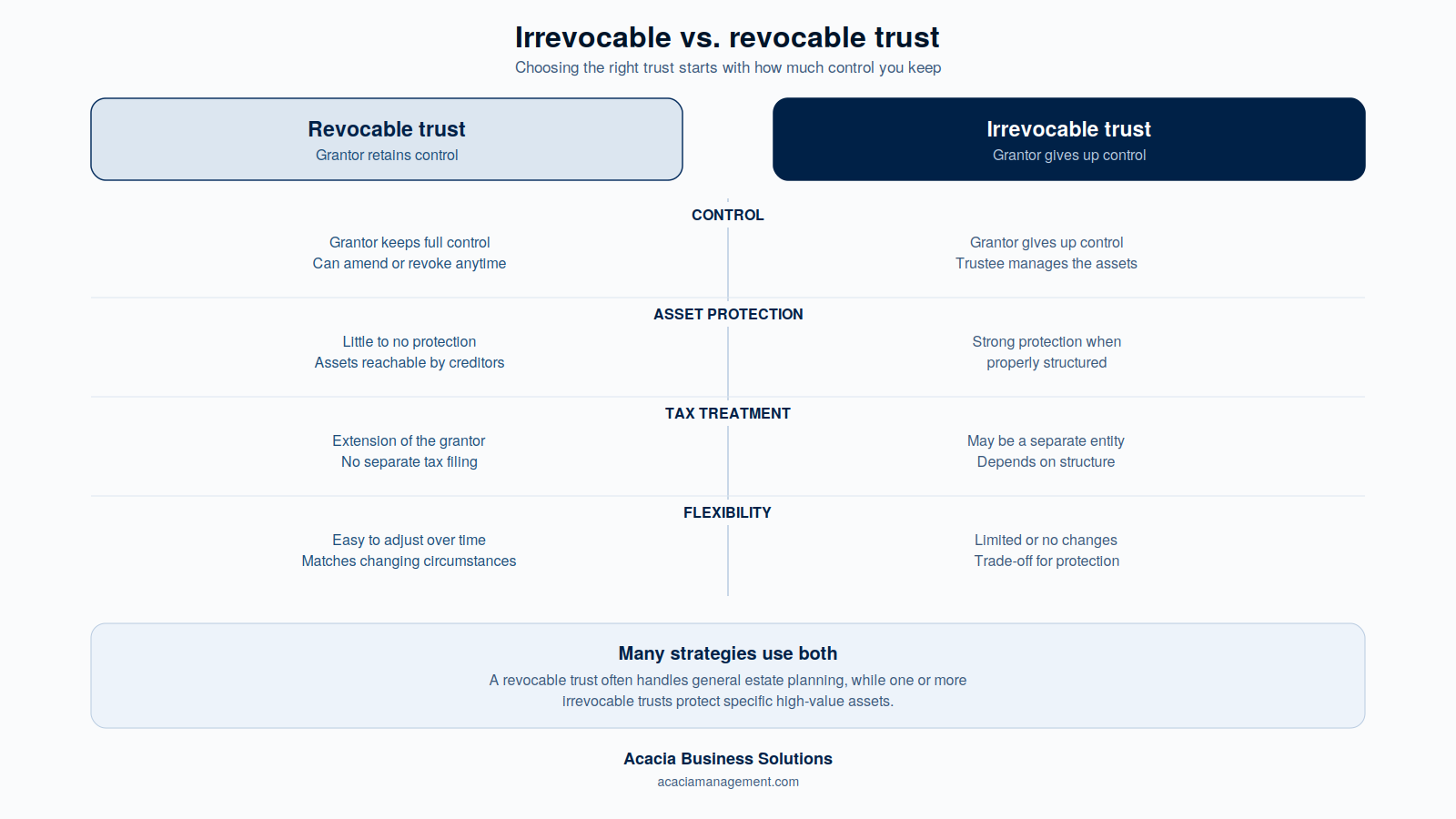
Additionally, a revocable trust lets the grantor retain control and make changes at any time.
In contrast, an irrevocable trust requires the grantor to give up that control.
Changes are typically limited or unavailable.
This distinction illustrates the Irrevocable vs Revocable Trust Strategy.
However, asset protection is limited.
A revocable trust offers little to no protection from creditors. The grantor still effectively owns the assets.
An irrevocable trust, when properly structured, can offer strong protection. Moreover, the grantor no longer holds direct ownership.
Additionally, tax treatment applies.
Additionally, revocable trusts are usually treated as an addition to the grantor for tax purposes.
Additionally, no separate tax filing is needed.
Moreover, irrevocable trusts may be treated as separate entities for tax purposes, depending on their structure.
Additionally, this can affect income tax and estate tax outcomes.
Moreover, flexibility matters in estate planning.
Additionally, revocable trusts are far easier to adjust as life events occur.
So, Irrevocable trusts trade that flexibility for stronger legal protection.
Choosing the Right Strategy
However, neither structure is always better.
For example, a revocable trust helps arrange an estate.
However, it avoids probate and keeps flexibility.
An Irrevocable vs Revocable Trust Strategy applies when the goal is protecting assets from creditors and lawsuits.
Additionally, it covers long-term care costs.
Additionally, it may also support estate tax planning by removing assets from a taxable estate.
Additionally, many complex trusts use both.
Moreover, a revocable trust might handle general estate planning.
One or more irrevocable trusts are used specifically to protect high-value assets or business interests from risk.
Building a Trust Strategy Around Your Goals
Moreover, under the Irrevocable vs Revocable Trust Strategy, the right choice depends on your goals and assets.
Additionally, it hinges on how much control you are willing to give up for protection.
Under the Irrevocable vs Revocable Trust Strategy, making this choice correctly at the start helps later steps. Additionally, that includes choosing a trustee and stacking trusts.
Let Acacia Business Solutions Guide Your Trust Strategy
Deciding between a revocable trust and an irrevocable trust is not a decision to make without guidance.
Additionally, Acacia Business Solutions works with individuals and business owners.
Additionally, they design trust strategies that match goals such as estate planning. Additionally, they align each plan with specific objectives and risk considerations.
Begin with our trust formation services.
Furthermore, speak with our team about an asset protection review.
Additionally, this will help you see how a trust strategy fits your plan.
Additionally, visit Acacia Business Solutions to schedule a consultation.
Additionally, this helps you take the next step toward keeping what you have built.
Expand your knowledge of asset protection, business planning, taxation, and private trusts. Explore the available books on Amazon.