
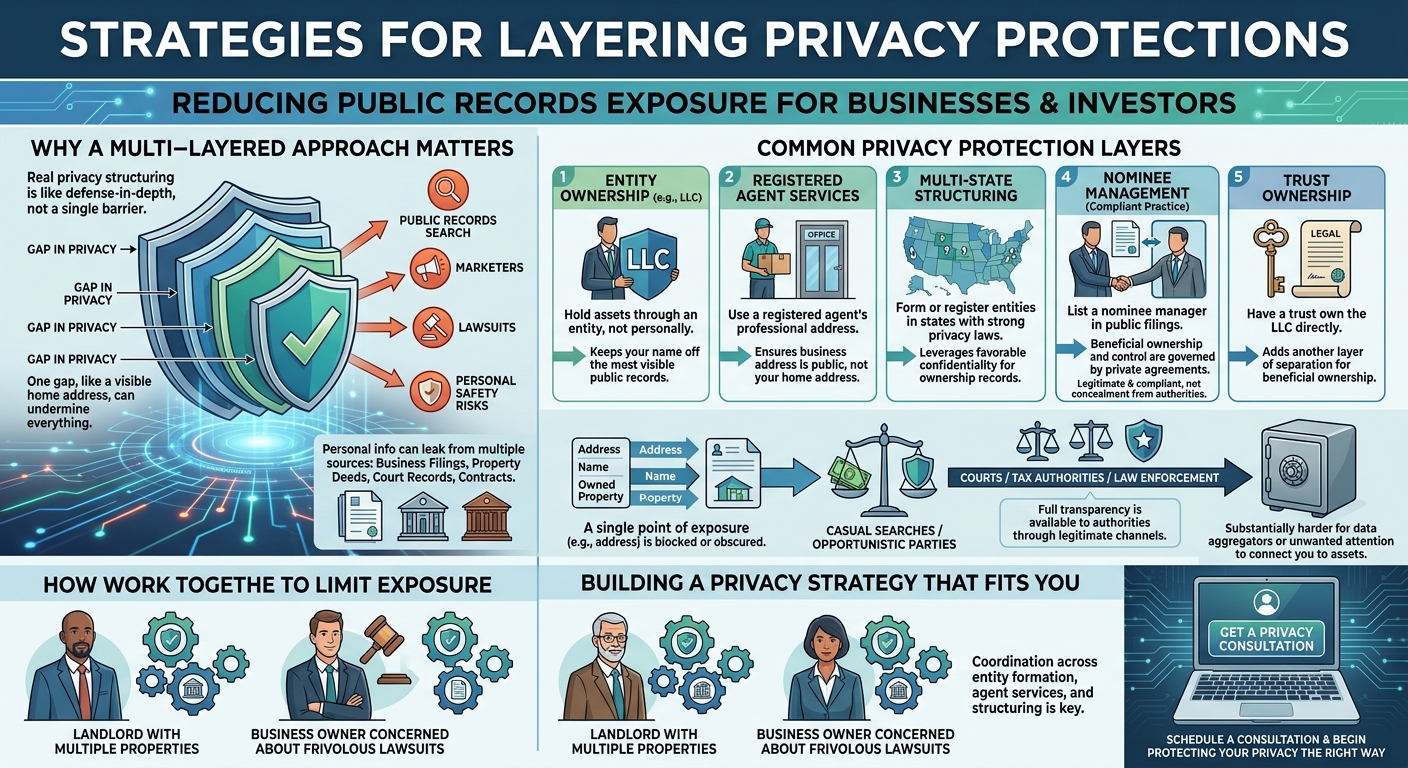

How to Layer Privacy Protections Effectively
A single privacy measure, such as using a registered agent, can help, but it rarely tells the whole story. Real privacy structuring, like asset protection itself, works best as a layered privacy strategy, where multiple protections work together to reduce exposure from several different directions at once.
Why One Layer Is Rarely Enough
Personal information can end up in public records through several separate channels: business formation filings, property deeds, court records, and even everyday contracts. A structure that addresses only one of these channels, such as forming an LLC without also addressing how property is titled or how the entity is registered, can still leave significant gaps in privacy.
Layering privacy protections means addressing each of these channels intentionally, so that no single gap undermines the overall goal.
Common Layers in a Privacy Strategy
Entity ownership. Holding property and business interests through an LLC, rather than a personal name, is typically the first layer, keeping an individual’s name off the most visible public records.
Registered agent services. Using a registered agent ensures that a business address, rather than a personal address, appears in state filings, adding a second layer of separation between an individual and their public footprint.
Multi state structuring. Some states offer stronger confidentiality protections for LLC ownership information than others. Forming or registering entities in states with favorable privacy laws can add a further layer of protection.
Nominee management. In appropriate situations, a nominee manager or officer can appear in public filings, while beneficial ownership and actual control are governed by private agreements between the parties. This is a well established, compliant practice, not a way to avoid legal responsibility.
Trust ownership. In some structures, an LLC itself is owned by a trust rather than directly by an individual, adding another layer of separation between a person’s name and the public record of who ultimately owns and controls an asset.
How the Layers Work Together
Each layer in a privacy strategy addresses a different point of exposure. Entity ownership handles property and business filings. Registered agent services handle the address associated with those filings. Jurisdiction selection strengthens confidentiality protections around ownership records. Nominee management and trust ownership add further separation for beneficial ownership itself.
Used together, these layers make it substantially harder for a casual search, a data aggregator, or an opportunistic party to connect an individual to specific assets or business interests, while still leaving full transparency available to courts, tax authorities, and law enforcement through legitimate legal channels.
Building a Layered Strategy That Fits Your Situation
Not every individual or business needs every layer of privacy protection. The right combination depends on the type of assets involved, the level of public exposure an owner already has, and their specific privacy and safety concerns. A landlord with multiple rental properties, for example, may need a different combination of layers than a business owner concerned primarily about frivolous lawsuits.
Let Acacia Business Solutions Build Your Privacy Strategy
Layering privacy protections correctly takes coordination across entity formation, registered agent services, and ownership structuring. Acacia Business Solutions helps clients build a privacy strategy suited to their specific situation, addressing exposure from every angle rather than relying on a single fix.
Learn more about our nominee services or speak with our team about a complete asset protection review. Visit Acacia Business Solutions to schedule a consultation and start building a layered privacy strategy today.
Expand your knowledge of asset protection, business planning, taxation, and private trusts. Explore the available books on Amazon.