

Essential Tips to Keep Your 501(c)(3) Status Active
The IRS does not simply approve an exemption and stop monitoring the organization. Tax-exempt status is a privilege tied to continuous compliance with the Internal Revenue Code. The agency continues to review activities, governance, and financial reporting to verify ongoing eligibility, and organizations should expect periodic reviews, filings, and inquiries to ensure ongoing adherence.
Organizations are expected to: follow reporting rules, keep accurate records, and operate in accordance with the Internal Revenue Code and state laws to demonstrate ongoing compliance; Maintaining 501(c)(3) status requires consistent adherence to governance standards, transparent finances, and timely responses to IRS requests.
- Operate exclusively for exempt purposes, such as charitable, educational, religious, or scientific activities
- Avoid private inurement, meaning no individual should improperly benefit from the nonprofit’s income or assets
- Limit lobbying activity and avoid political campaign involvement entirely
- File required returns on time every year
Failing any of these requirements can trigger IRS scrutiny, and repeated or serious violations can lead to automatic revocation.
The Core Requirements for Staying Compliant
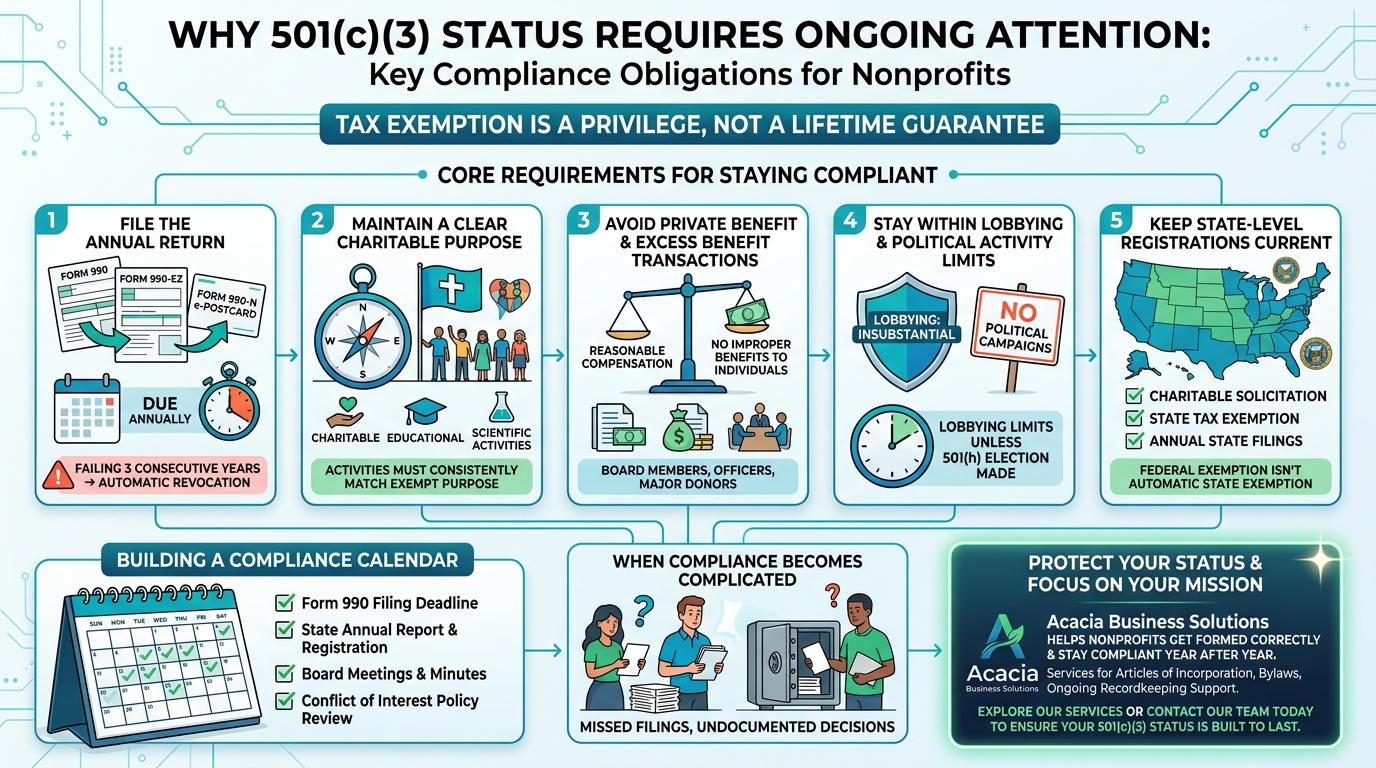
1. File the Annual Return
Nearly every tax-exempt organization must file a version of Form 990 annually. This includes the full Form 990, the shorter Form 990 EZ. The Form 990 N e Postcard is for smaller nonprofits.
Missing three consecutive years of filings results in automatic revocation of exempt status, with no advance warning issued.
2. Maintain a Clear Charitable Purpose
An organization’s activities should consistently match the exempt purpose stated in its original Form 1023 or 1023 EZ application. When a mission or program shifts significantly, the board should document the change and evaluate whether the governing documents, or even the IRS determination letter, require an update.
3. Avoid Private Benefit and Excess Benefit Transactions
Compensation, contracts, and transactions involving board members, officers, or major donors should be reasonable and well documented. The IRS applies intermediate sanctions to excess benefit transactions, and repeated abuse can jeopardize the entire exemption.
4. Stay Within Lobbying and Political Activity Limits
501(c)(3) organizations may not participate in political campaigns for or against candidates, and lobbying activity must remain insubstantial, unless the organization has made a valid 501(h) election.
5. Keep State Level Registrations Current
Federal exemption does not automatically cover state charitable solicitation registration, state tax exemption, or annual state filings. Many nonprofits lose good standing not because of IRS issues, but because they miss a state level renewal.
Building a Compliance Calendar
Organizations that maintain exempt status the longest are the ones that treat compliance as a routine matter rather than an emergency. A basic annual calendar should track the following:
- Form 990 filing deadline, due the fifteenth day of the fifth month after the fiscal year ends
- State annual report and charitable registration renewal dates
- Board meeting and minutes schedule
- Conflict of interest policy review and disclosure collection
When Compliance Becomes Complicated
Many nonprofits are led by mission-driven staff and volunteers, not compliance specialists. Consequently, this is where issues begin, such as a missed filing or an undocumented board decision. Moreover, effective governance reduces risk and builds trust with donors and regulators.
Professional support for formation and governance reduces this risk. It supports maintaining 501(c)(3) status and helps the organization stay mission-driven. This professional help covers formation, governance documents, and ongoing filings. With these supports, boards can focus on strategy while staying compliant.
Protect the tax-exempt status your organization worked hard to earn. Acacia Business Solutions helps nonprofits get formed correctly from the start and stay compliant year after year, including Articles of Incorporation, bylaws, and ongoing record-keeping support. Explore our nonprofit formation and compliance services or contact our team today to ensure your 501(c)(3) status is built to last.
Expand your knowledge of asset protection, business planning, taxation, and private trusts. Explore the available books on Amazon.