
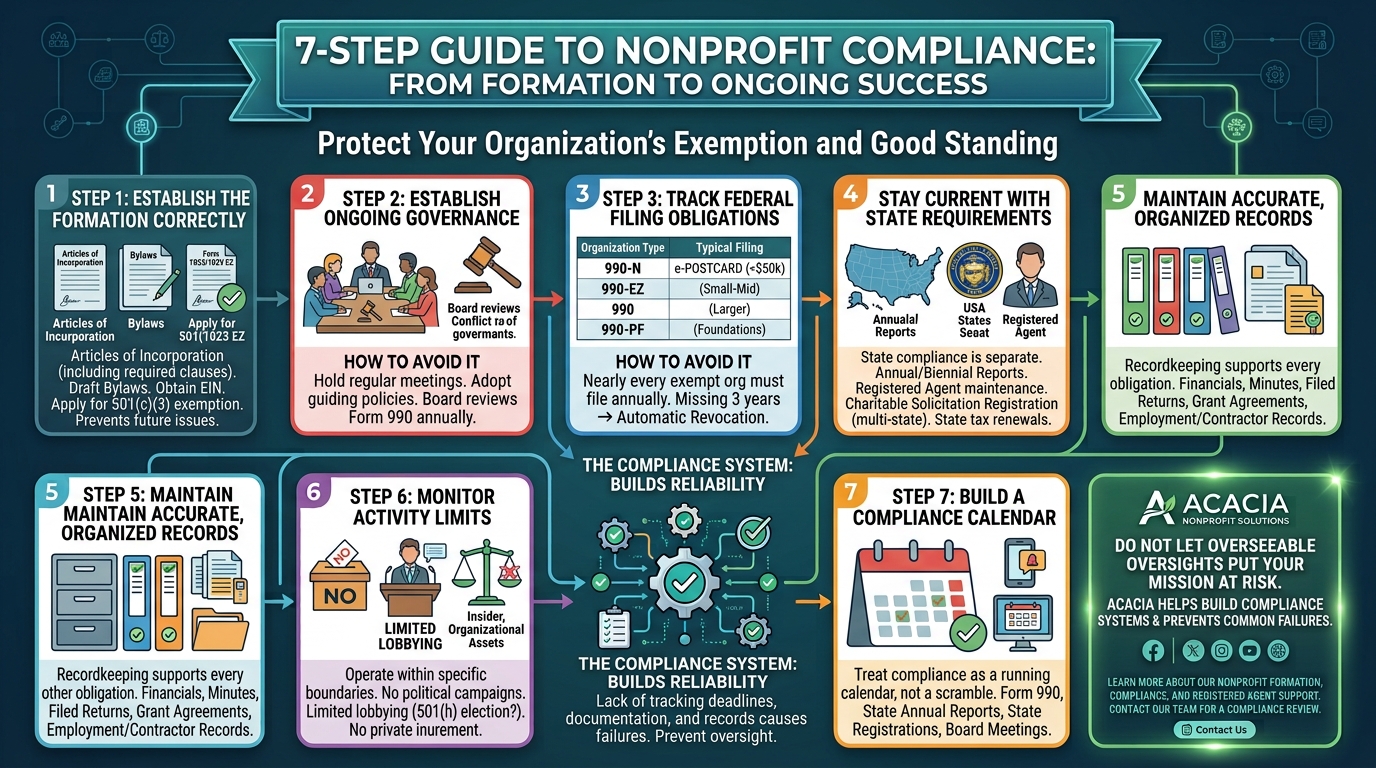

Essential Guide to Nonprofit Compliance
The nonprofit compliance guide: Formation Essentials
Compliance begins before a nonprofit accepts a donation.
The Articles of Incorporation, initial bylaws, and IRS exemption application establish the legal framework.
Whether Form 1023 or Form 1023 EZ, they establish the operational framework.
Everything else builds on this foundation.
Mistakes at this stage, such as vague purpose clauses or missing required provisions, create long-term issues.
Inconsistencies between the state filing and federal application also generate compliance risks.
Key formation tasks:
- File Articles of Incorporation with the state, including IRS required dissolution and purpose clauses
- Draft bylaws that reflect how the board will operate
- Obtain a federal EIN
- Apply for 501(c)(3) exemption and, if needed, state tax exemption
Step 2: Establish Ongoing Governance
Board governance and nonprofit compliance guide
Once formed, the board becomes the engine of compliance.
Additionally, regular meetings, documented minutes, and policies guide decision making, especially on conflicts of interest and compensation. Key governance tasks include oversight of finances, disclosures, and policy development.
- Hold and document regular board meetings
- Adopt conflict of interest, whistle blower, and document retention policies
- Review and approve Form 990 before it is filed each year
Step 3: Track Federal Filing Obligations
Nearly every tax-exempt organization must file an annual return with the IRS.
Organization Type Typical Filing
Very small nonprofits, under $50,000 gross receipts Form 990 N, e Postcard
Small to mid-sized nonprofits Form 990 EZ
Larger nonprofits Form 990
Private foundations Form 990 PF
If filings are missing for three consecutive years, the organization risks automatic revocation of exempt status. Step 4: Stay current with state requirements. Additionally, state compliance operates on a separate track from federal requirements and includes the following.
- Annual or biennial corporate reports to maintain good standing
- Registered agent maintenance so the nonprofit can legally receive state correspondence
- Charitable solicitation registration in every state where the organization actively fundraisers
- State tax exemption renewals, where applicable
Step 5: Maintain Accurate, Organized Records
Record keeping supports every other compliance obligation. An organization should maintain the
following: - Financial records, including bank statements, receipts, and donation records
- Board minutes and governance documents
- Copies of all filed returns and state reports
- Grant agreements and restricted fund documentation
- Employment and contractor records
Step 6: Monitor Activity Limits
However, 501(c)(3) organizations must operate within specific boundaries.
- No political campaign involvement. This is an absolute prohibition, not a matter of degree.
- Limited lobbying activity, unless a 501(h) election has been made to allow expanded limits.
- No private inurement. Organizational assets and income cannot improperly benefit insiders.
Step 7: Build a Compliance Calendar
The most reliable way to remain compliant is to stop treating it as a once-a-year scramble. A running
calendar should track the following: - Form 990 due date, five months and fifteen days after fiscal year ends.
- State annual report and registered agent renewal dates
- Charitable registration renewal dates by state
- Board meeting schedule and policy review dates
When to Bring Professional Support
Many nonprofits, especially smaller and volunteer led organizations, do not have dedicated compliance
staff. This is not a weakness. It is simply a reality of running a mission driven organization. Partnering
with a firm that specializes in nonprofit formation, and ongoing compliance ensures filings, records, and
governance documents remain accurate without pulling the team away from the work that matters
most.
Ready to build a compliant nonprofit from the ground up, or clean up an existing one? Acacia Business
Solutions offers complete nonprofit formation and compliance services, including bylaws, EIN
applications, and ongoing record keeping support. Contact our team today to ensure every step of your
compliance journey is covered.
Expand your knowledge of asset protection, business planning, taxation, and private trusts. Explore the available books on Amazon.