

How to Master Record-Keeping for Essential Compliance
What Corporate Record Keeping Actually Covers
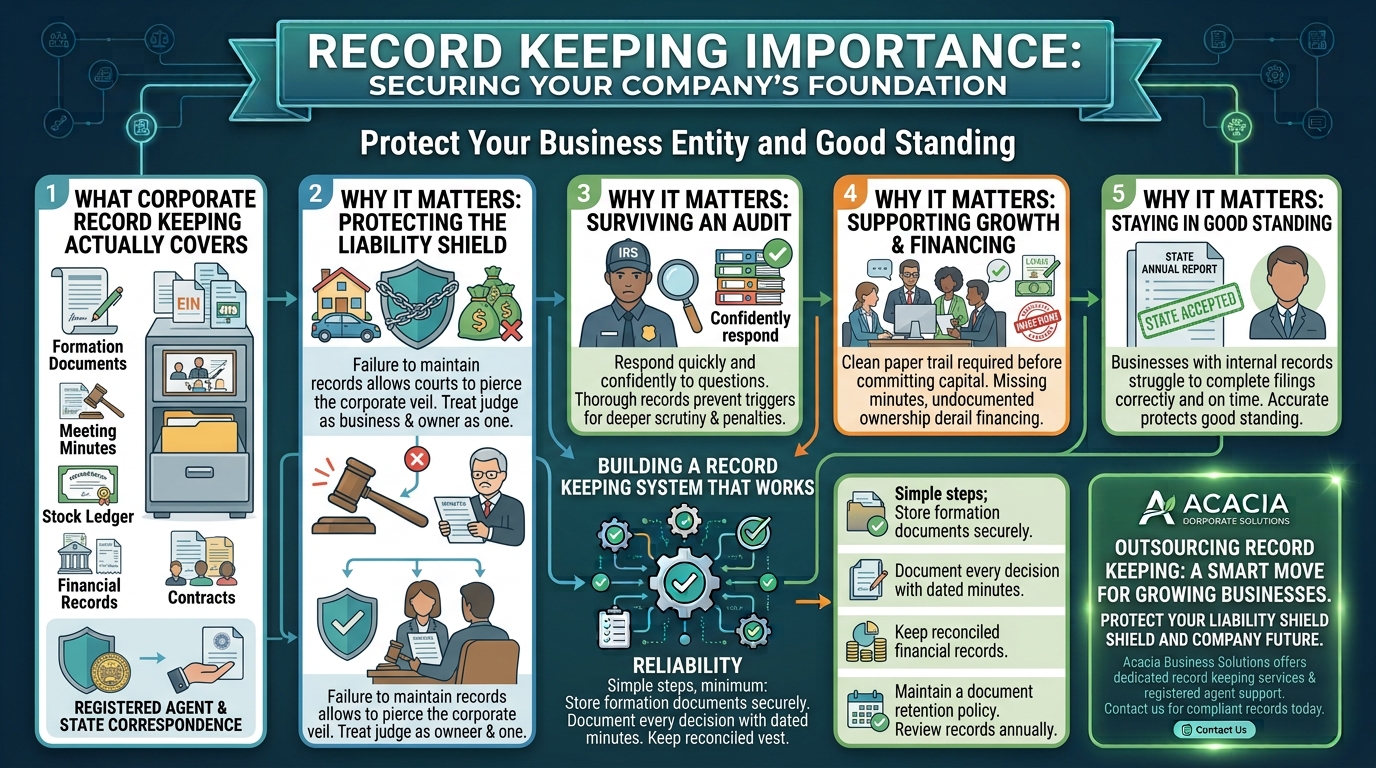
Record keeping is not limited to bookkeeping. For a corporation or LLC, it includes the following:
- Formation documents, such as Articles of Incorporation or Organization, bylaws or operating
agreement, and EIN confirmation - Meeting minutes and resolutions documenting major decisions made by the board, shareholders,
or members - Stock ledgers or membership records showing who owns what percentage of the company
- Financial records, including bank statements, receipts, invoices, and payroll records
- Contracts and agreements with vendors, clients, employees, and partners
- Correspondence from the registered agent and state agencies
Why It Matters: Protecting the Liability Shield
One of the primary reasons owners form a corporation or LLC is to separate personal assets from
business liabilities. That protection is not automatic. Courts can pierce the corporate veil when a
business fails to maintain basic corporate formalities, including proper records. If a company is sued and
cannot produce meeting minutes, resolutions, or evidence that it operated as a separate legal entity, a
judge may treat the business and its owner as one and the same.
Why It Matters: Surviving an Audit
Whether the IRS, a state tax agency, or a potential investor conducting due diligence is involved,
thorough records allow a business to respond quickly and confidently to questions. Disorganized or
missing records do not simply slow the process. They can trigger deeper scrutiny and larger penalties.
Why It Matters: Supporting Growth and Financing
Banks, investors, and potential buyers all expect a clean paper trail before committing capital. Missing
minutes, undocumented ownership changes, or inconsistent financial records can delay or completely
derail a loan, investment round, or acquisition.
Why It Matters: Staying In Good Standing
Many state annual report filings require accurate, up to date information about officers, members, and
the registered agent. Businesses that do not maintain organized internal records often struggle to
complete these filings correctly and on time, which can put good standing at risk.
Building a Record Keeping System That Works
A strong system does not need to be complicated. At minimum, every business should do the following:
- Store formation documents and amendments in one accessible, secure location
- Document every board or member decision with dated minutes or resolutions
- Keep financial records organized and reconciled on a regular schedule
- Maintain a document retention policy so nothing is discarded prematurely
- Review records annually alongside the state report filing
Outsourcing Record Keeping: A Smart Move for Growing Businesses
For many business owners, record keeping is often the first compliance task to slip once operations
become busy. Outsourcing it to a firm that specializes in corporate administration ensures records stay
organized, accessible, and audit ready without adding to the owner’s workload.
Protect your liability shield and your business’s future with organized, professional record keeping.
Acacia Business Solutions offers dedicated record keeping services alongside registered agent support to
keep your corporate documentation complete and compliant. Contact us to get your records in order
today.
Expand your knowledge of asset protection, business planning, taxation, and private trusts. Explore the available books on Amazon.