
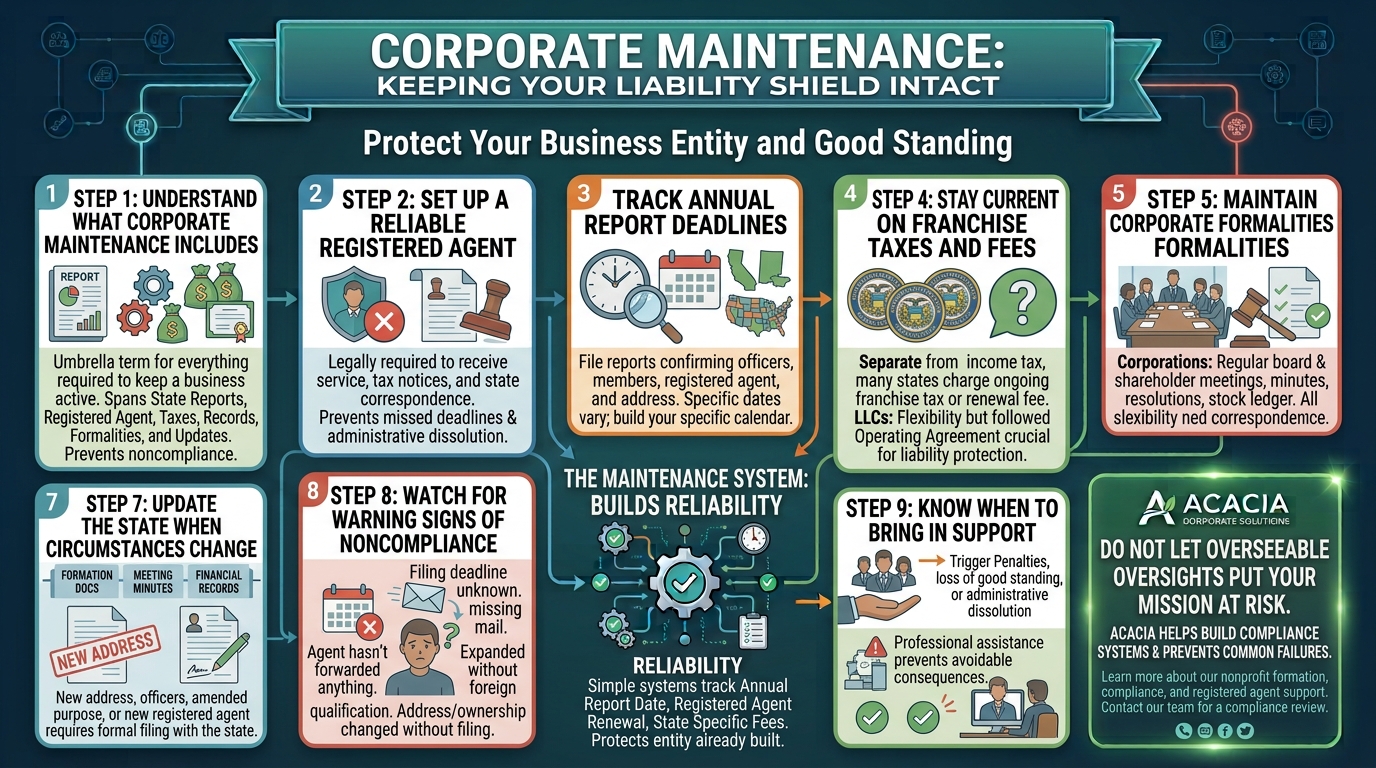

Essential Guide to Efficient Corporate Maintenance
Step 1: Understand what corporate maintenance includes. The corporate maintenance guide defines it as the umbrella term for keeping a business entity legallyactive and protecting liability. Additionally, it spans the following areas.
- State annual or biennial report filings
- Registered agent maintenance
- Franchise taxes and renewal fees
- Recordkeeping and corporate formalities
- Business license and permit renewals
- Updating the state on structural or ownership changes
Step 2: Set Up a Reliable Registered Agent
Every corporation and LLC is legally required to maintain a registered agent in each state where it is
formed or registered to do business. This agent receives processing service, tax notices, and state
correspondence on the business’s behalf. A missed or unreliable registered agent is one of the leading
causes of missed deadlines, and ultimately, administrative dissolution.
Step 3: Track Annual Report Deadlines
Nearly every state requires an annual or biennial report confirming a business’s officers, members,
registered agent, and address are current. Deadlines vary widely by state and entity type, so a calendar
The plan should be built specifically for where the business is registered rather than a generic nationwide date. Registration requirements vary by state, so tailoring your steps to your filings helps ensure accuracy. Align your timetable with the jurisdictions where you operate and maintain records accordingly.
Step 4: Stay current on franchise taxes and fees. Many states charge an ongoing franchise tax or renewal fee for the right to exist as a registered entity. These fees are easy to overlook, particularly for businesses registered in multiple states. This requires regular checks of state filings and renewal dates.
Step 5: Maintain corporate formalities. For corporations, this means the following: keep corporate records updated, hold regular board meetings, approve major actions, and file required reports on time. Regular compliance helps protect limited liability and maintain good standing with states.
- Holding regular board and shareholder meetings
- Documenting decisions through minutes and resolutions
- Keeping a stock ledger current
For LLCs, formalities are more flexible but maintaining and actually following an operating agreement
still matters for liability protection.
Step 6: Keep Organized Records
Recordkeeping ties every other maintenance task together. A business should maintain the following: - Formation documents and any amendments
- Meeting minutes and resolutions
- Financial records and tax filings
- Contracts, leases, and vendor agreements
- All state and registered agent correspondence
Step 7: Update the State When Circumstances Change
Any material change, such as a new address, new officers or members, an amended purpose, or a new
registered agent, typically requires a formal filing with the state, not simply an internal record update.
Failing to file these updates can create gaps between what the state has on record and how the business
operates.
Step 8: Watch for Warning Signs of Noncompliance - The next filing deadline is unknown
- The registered agent has not forwarded anything in over a year
- The business has expanded into a new state without registering there through foreign
qualifications. - The business address or ownership has changed without a corresponding state filing
Step 9: Know When to Bring in Support
Corporate maintenance is straightforward in concept but easy to lose track of amid the daily demands of running a business. Moreover, a single missed deadline can trigger penalties, loss of good standing, or administrative dissolution. These consequences are almost always avoidable with the right systems in place. A corporate maintenance guide helps you manage deadlines and stay compliant. Corporate Maintenance Checklist Task Frequency Annual or biennial state report Yearly or every two years, depending on the state Registered agent renewal Ongoing, annual Franchise tax or state fee payment Annual Board or member meeting and minutes At least annually Record review and organization Annual Business license renewals Varies by license Take corporate maintenance off your plate for good. Acacia Business Solutions offers full service registered agent services and record keeping services across all 50 states, so your entity stays compliant without constant deadline tracking. Explore our complete range of corporate formation and compliance solutions, or contact our team to set up a maintenance plan tailored to your business.
Expand your knowledge of asset protection, business planning, taxation, and private trusts. Explore the available books on Amazon.