

When to Dissolve an Entity
Your company stopped operating. Your obligations did not.
Every year, thousands of owners walk away from LLCs and corporations believing the problem ends when the last invoice is paid. It rarely does. The state still expects annual reports. Tax authorities still expect returns. Registered agents still bill. If those obligations pile up unnoticed, the owner often discovers the consequences at the worst moment, such as during a loan application, a business sale, or the formation of a new company.
Knowing when to close an entity, and closing it deliberately, is one of the most valuable decisions an owner can make. This article walks through the signs that indicate it may be time to close, the alternatives worth considering first, the tax timing issues that affect the decision, and the questions that separate a rushed closure from a well planned one.
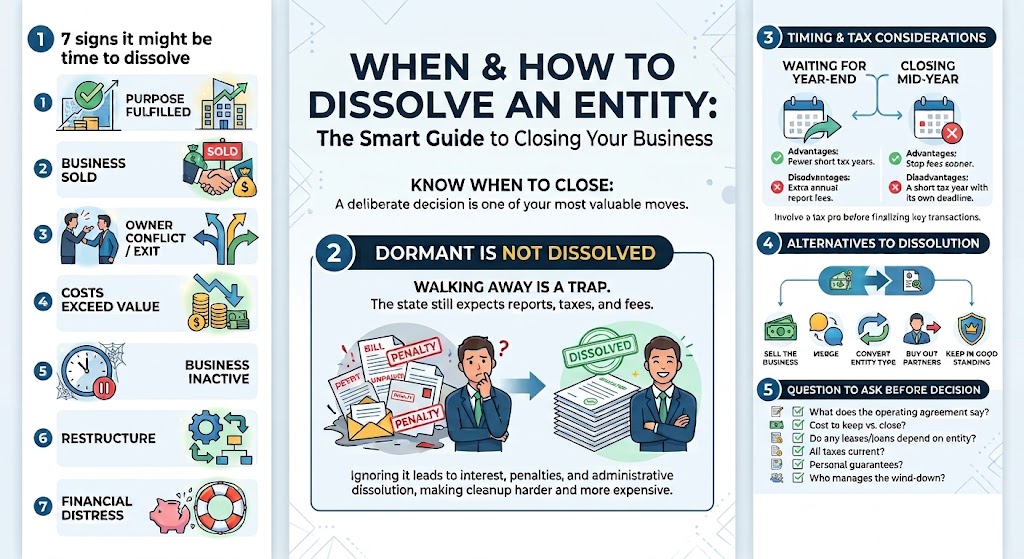
Seven Signs It May Be Time to Dissolve
- The purpose has been fulfilled. Many entities are created for one project, property, or venture. A holding company that sold its last property, or a project company whose contract has ended, has finished its job. Continuing to maintain it past that point adds cost with no corresponding benefit.
- The business was sold. After an asset sale, the original entity is often an empty shell. It may still carry tax accounts, contract obligations, and liabilities from before the sale, and it still owes annual filings even though it no longer operates.
- Owners are exiting or in conflict. Retirement, disagreement, or deadlock between members can make dissolution cleaner than a forced buyout, especially when the operating agreement provides a clear exit path. In multi member situations, dissolution can sometimes be less contentious and less expensive than years of litigation over control.
- Costs exceed value. Annual reports, franchise taxes, minimum taxes, and registered agent fees continue whether or not the company earns revenue. In states with a fixed annual minimum tax, an unused entity can quietly cost several hundred dollars every year, plus penalties and interest if filings are missed. Over a five or ten year period of inactivity, those costs add up to a meaningful sum for no business purpose.
- The business is inactive. No revenue and no operations for twelve months or more is a strong signal. Inactivity rarely resolves itself, and the longer an entity sits dormant, the more likely it is that a filing deadline gets missed.
- A restructure makes the entity redundant. Mergers, conversions, and the creation of a new holding company structure often leave an older entity behind with no remaining purpose. When a business reorganizes for tax or liability reasons, the prior entity should usually be formally retired rather than left to linger.
- Financial distress. When a company cannot pay its debts, an orderly wind down, often with legal counsel, is safer than letting the entity drift. Insolvency introduces specific rules about the order in which creditors must be paid, so this scenario benefits the most from professional guidance.
Dormant Is Not Dissolved
This is the most misunderstood point in business closure. A dormant LLC is still a legal entity. In most states it still owes annual reports and fees. If those go unpaid, the state may administratively dissolve or revoke the entity. That is not a clean closure. Tax accounts can remain open, debts can stay unresolved, and the question of who is responsible for what can resurface years later, often at the worst possible moment.
An administrative dissolution also creates practical problems down the line. Many states require reinstatement, back fees, and back filings before an owner can voluntarily dissolve and finish the job properly. In effect, ignoring the entity does not avoid the paperwork. It simply postpones it, adds interest and penalties, and adds a reinstatement step that a timely, voluntary dissolution would have avoided entirely.
Timing and Tax Considerations
The timing of a dissolution has tax consequences that are easy to overlook. Closing mid year, rather than waiting for year end, means a short tax year with its own filing deadline. Selling assets before closing can trigger gain or loss that needs to be reported on the final return. Owners who are also winding down payroll need to time final wage payments and payroll tax deposits correctly to avoid penalties. Because these details vary by entity type and by state, it is worth involving a tax professional before, not after, key transactions and filings are finalized.
A Real World Scenario
A consultant stops taking clients and lets his LLC lapse without filing anything. Two years later he applies for a mortgage, and the lender pulls records showing a revoked entity with an open state tax balance. The approval stalls while he pays back fees and reinstates the company, only to then dissolve it correctly. A short, planned dissolution two years earlier, at a fraction of the cost, would have avoided the delay entirely and kept his personal financial plans on schedule.
Alternatives to Weigh Before You Dissolve
- Sell the business or its assets, which can return cash to owners instead of simply closing the doors
- Merge the entity into another company you already own, consolidating filings and reducing ongoing costs
- Convert to a different entity type that better fits your current tax position, rather than closing and reforming from scratch
- Buy out a departing owner so the company continues under the remaining members
- Keep the entity in good standing if it holds licenses, contracts, or a brand that would be difficult or costly to replace
Questions To Answer Before You Decide
- What does the operating agreement say about voting thresholds, notice, and exit terms
- What will it cost to keep the entity for another year, compared with the cost of closing it
- Do any leases, permits, loans, or contracts depend on this entity remaining active
- Do any personal guarantees exist that will outlive the entity once it is dissolved
- Are all taxes current, including payroll and sales tax, so the state will accept a dissolution filing
- Who will manage the wind down, and who has authority to sign the final documents
Frequently Asked Questions
Q: Can I dissolve an LLC that has debts?
Yes, but debts must be handled properly. Creditors are paid before owners receive distributions, and owners who reverse that order can face claims to return the money.
Q: How long does dissolution take?
A simple entity with no employees can close in a few weeks. Entities with payroll, tax clearance requirements, or creditor claim periods can take several months from start to finish.
Q: Does dissolving cancel my EIN?
No. The IRS does not cancel EINs. Closing the IRS business account ends active filing obligations once final returns are filed, but the number itself stays associated with the entity permanently.
Q: Should I just stop paying state fees and let the entity lapse?
No. Unpaid fees lead to penalties and administrative dissolution, which usually creates a bigger and more expensive cleanup than a voluntary closure handled at the right time.
Q: What if the entity owns real estate or other titled assets?
Those assets need to be sold, distributed, or otherwise transferred out of the entity’s name before dissolution is complete, and the transfer itself may have its own tax and recording requirements.
A company should end by decision, not by neglect. Timing, sequencing, and documentation are what separate a clean exit from a lingering liability, and a little planning at the right moment saves far more time and money than dealing with the consequences later.
Unsure whether to keep, restructure, or close? Acacia Management can review your situation, compare your options, and recommend the cleanest path. Contact our team today to discuss business dissolution services.
Expand your knowledge of asset protection, business planning, taxation, and private trusts. Explore the available books on Amazon.