
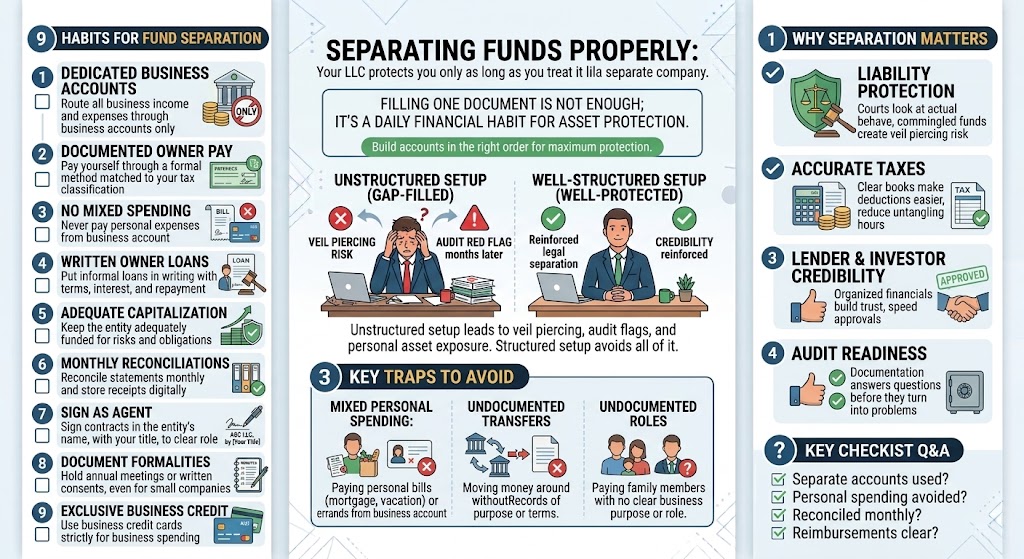

Separating Funds Properly
Your LLC protects you only as long as you treat it like a separate company.
Forming an LLC or corporation creates a legal wall between you and the business. Your finances have to show that wall exists. When owners pay personal bills from the business account, deposit client payments into personal accounts, or move money around without records, a court may decide the entity is just an extension of its owner. That risk is known as piercing the corporate veil, and when it happens, personal assets can become reachable by business creditors, which defeats the entire purpose of forming the entity in the first place.
Why Separation Matters
- Liability protection. Courts look at how owners actually behave, not just what the formation documents say. Commingled funds and ignored formalities are commonly cited when a creditor argues an entity should be disregarded.
- Accurate taxes. Clear books make deductions easier to support and reduce the hours an accountant spends untangling transactions at filing time, which also reduces professional fees.
- Lender and investor credibility. Banks and investors read statements closely before extending credit or capital. Clean records signal a well run business and can meaningfully speed up approvals.
- Audit readiness. Documentation answers questions before they turn into problems, whether the question comes from a tax authority, a lender, or a potential buyer during due diligence.
Nine Habits That Keep Funds Separate
- Run all business income and expenses through business accounts only, with no exceptions for small or convenient purchases
- Pay yourself through a documented method, matched to your tax classification, rather than an informal or inconsistent pattern
- Never pay personal expenses from the business account, and avoid paying business expenses from a personal account without a clear reimbursement record
- Put owner loans in writing, with terms, an interest rate, and a repayment plan, even when the loan is informal in spirit
BANKING AND FINANCIAL STRUCTURING
- Keep the entity adequately funded for the risks and obligations it takes on, rather than operating on a shoestring that a court could later view as undercapitalization
- Reconcile every month and store receipts digitally so nothing gets lost or forgotten
- Sign contracts in the entity’s name, with your title, so it is clear you are acting on the entity’s behalf and not personally
- Hold annual meetings or adopt written consents where required, and keep the records even for a small, informal company
- Use business credit cards for business spending only, and resist the temptation to use them for personal purchases even temporarily
Examples Of Commingling To Avoid
- Depositing client payments into a personal account instead of the business account ● Paying a personal mortgage or a family vacation from the business account
- Using the business debit card for groceries or other personal errands
- Moving money between accounts without any documentation of the purpose or terms ● Paying family members from the company with no clear business purpose or role
What The Courts Tend To Look At
Every state has its own test, but the same themes appear repeatedly: whether the entity was adequately capitalized for its activities, whether corporate or LLC formalities were followed, whether funds were mixed between the owner and the entity, and whether the entity was used to commit fraud or an injustice against a third party. Good financial habits address the first three of these factors directly, which is why they matter so much in practice, not just in theory.
What If You Have Already Mixed Funds
Stop the practice now and document what happened as clearly as you can. Then work with your accountant to correct the books by reclassifying transactions as draws, contributions, loans, or reimbursements, depending on what actually occurred. Prompt cleanup is far better than leaving the problem for a future dispute or audit, and it also demonstrates good faith if the issue is ever questioned.
A Simple Monthly Routine
- Download or sync all statements from every account
- Categorize every transaction as it comes in, rather than waiting until tax time
ACACIA MANAGEMENT • CLUSTER 40: BANKING AND FINANCIAL STRUCTURING
- Match receipts to expenses so nothing is left unsupported
- Reconcile balances against the bank’s records
- Review owner draws, transfers, and loans for the month
- Move the planned tax reserve amount into its dedicated account
Frequently Asked Questions
Q: Is one small personal purchase a problem?
An isolated, documented mistake is far less serious than a pattern. Correct it promptly by reimbursing the business or recording it properly, and move on.
Q: Do single member LLCs need to worry about this?
Yes. Because the owner and the entity are so closely tied in a single member LLC, these structures are common targets for veil piercing arguments, so the habits above matter just as much, if not more.
Q: Does having an operating agreement help?
It helps establish that the entity has its own rules and formalities, especially for multi member LLCs, and it gives you something concrete to point to when demonstrating that the entity was properly run.
Protect your personal assets. Acacia Management helps you design a financial structure that supports both compliance and protection, from account setup to owner pay methods. Contact our team for a consultation.
Expand your knowledge of asset protection, business planning, taxation, and private trusts. Explore the available books on Amazon.