
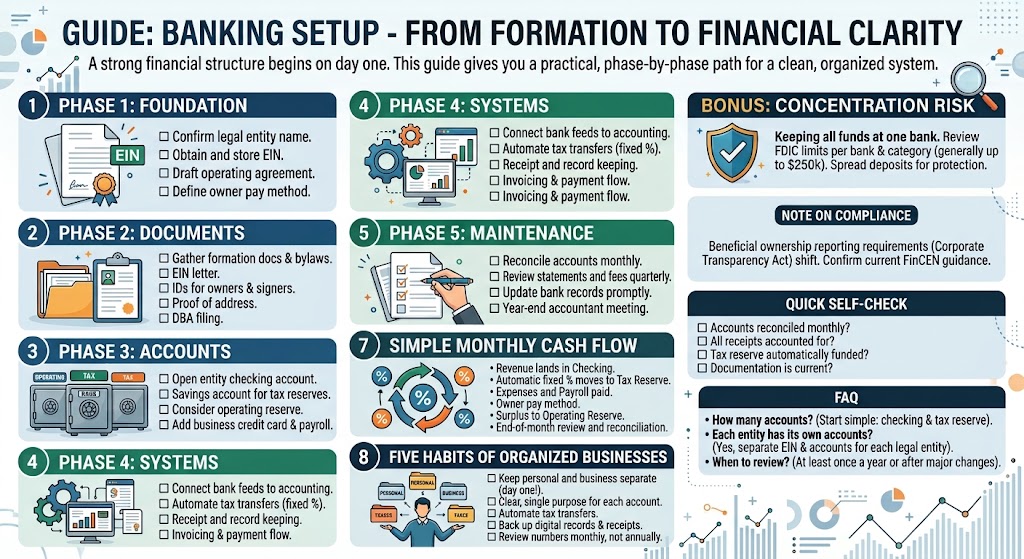

Guide: Banking Setup
From formation to financial clarity in five phases.
Strong financial structure begins on day one, and it pays off every tax season. This guide gives you a practical path from formation to a clean, organized system, broken into phases you can work through in order and revisit periodically as the business grows.
Phase 1: Foundation
Everything else depends on getting these items right, so treat this phase as non negotiable even under time pressure.
☐ Confirm formation and the exact legal entity name
☐ Obtain the EIN directly from the IRS or through a transparent EIN service
☐ Store the EIN confirmation letter securely, in more than one location
☐ Draft or update the operating agreement
☐ Confirm your tax classification and how owners will be paid
Phase 2: Documents
Gather everything before you apply or visit a branch, since incomplete documentation is the most common cause of delay.
☐ Formation documents
☐ Operating agreement or bylaws
☐ EIN confirmation letter
☐ Government issued ID for each owner and signer
☐ Proof of business address
☐ DBA filing, if you use an assumed name
Phase 3: Accounts
Match the structure to how the business actually operates, not to a generic template.
☐ Open business checking in the entity’s exact name
☐ Open a savings account for tax reserves
☐ Consider an operating reserve account for slow periods
☐ Add a business credit card
☐ Add a payroll account if hiring
☐ Confirm signers and account permissions are correct and current
Phase 4: Systems
Systems turn good intentions into daily habits that hold up over time.
☐ Set a written owner pay method
☐ Connect bank feeds to accounting software
☐ Set aside a fixed percentage of revenue for taxes
☐ Create a receipt and record keeping routine
☐ Set up invoicing and payment processing
☐ Decide who has authority to approve payments
Phase 5: Maintenance
☐ Reconcile accounts monthly, without exception
☐ Review statements and fees each quarter
☐ Update the bank after any ownership, signer, or address change
☐ Review tax reserve balances before each estimated tax deadline
☐ Meet with your accountant before year end
☐ Confirm annual state filings are complete
Sample Account Structure
- Operating checking for daily income and expenses
- Tax reserve savings for income, sales, and payroll taxes
- Operating reserve as a cushion for slow months
- Payroll account for wages and payroll taxes
- Business credit card for business expenses only
A Simple Monthly Cash Flow
Revenue lands in operating checking. A fixed percentage moves automatically to the tax reserve. Expenses and payroll are paid from operating. Owner pay is taken by the documented method chosen in Phase 4. Any surplus builds the operating reserve. Everything is reconciled and reviewed at the end of the month before the cycle repeats.
Five Habits That Separate Organized Businesses From Stressed Ones
- Keep personal and business finances separate from day one, without exception
- Give every account a clear, single purpose rather than letting functions blend together
- Automate transfers to your tax reserve as income arrives, rather than relying on willpower later
- Keep digital copies of statements and receipts, backed up outside of any single device
- Review your numbers monthly, not once a year when the accountant asks for them
Frequently Asked Questions
Q: How many accounts does a small business need?
Many businesses start with just checking and a tax reserve, then add accounts as complexity grows, such as when payroll or a credit card becomes necessary.
Q: Should each entity have its own accounts?
Yes. Each legal entity should have its own accounts and its own EIN, with any intercompany transfers clearly documented rather than assumed.
Q: When should I review my setup?
At least once a year, and after any major change such as hiring your first employee, adding an owner, expanding to a new state, or completing a restructure.
CALL TO ACTION: Build it right the first time. Acacia Management helps with EIN services, banking readiness, and financial structuring that supports your growth. Contact our team today to schedule a consultation.
Expand your knowledge of asset protection, business planning, taxation, and private trusts. Explore the available books on Amazon.