
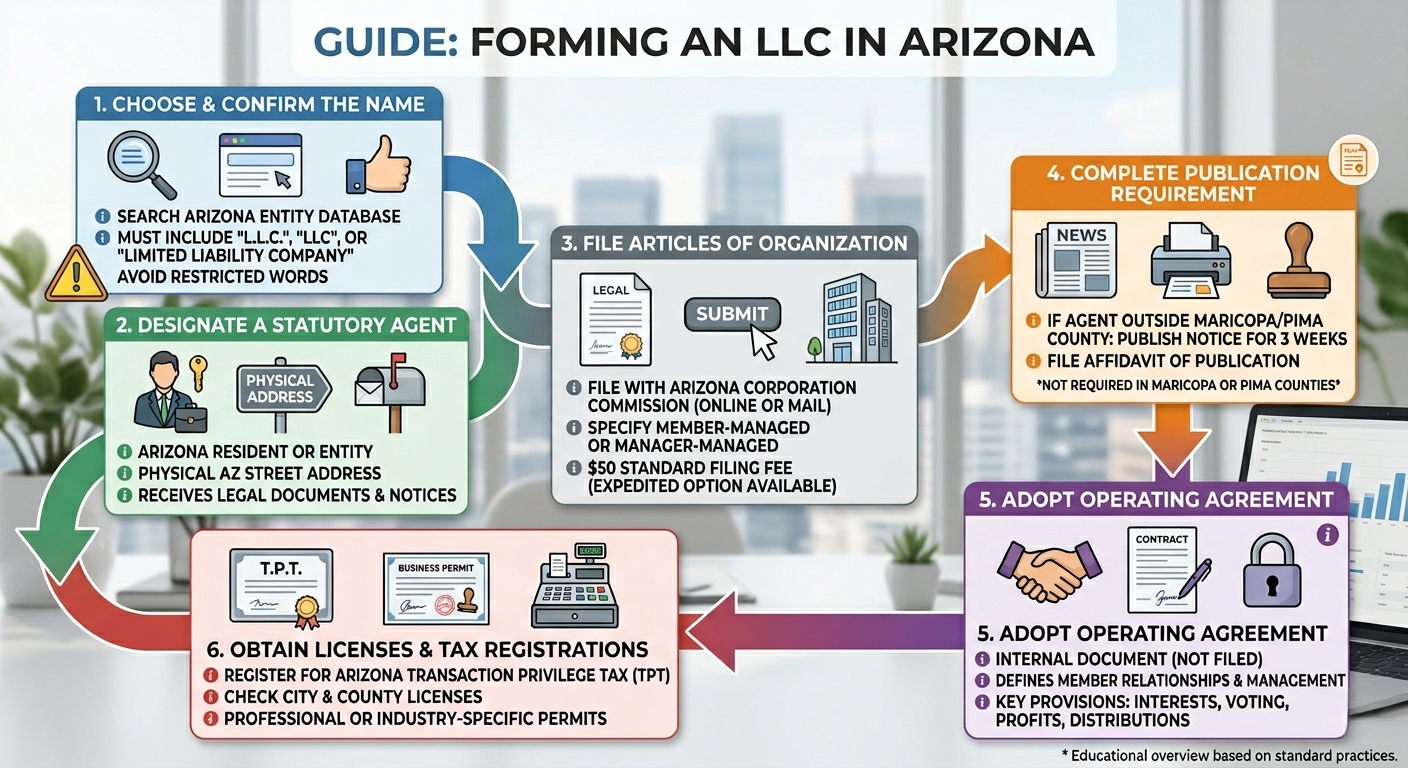

Common Errors in Arizona LLC Formation
The formation process for an Arizona LLC is not especially complicated, but there are mistakes that arise frequently enough to warrant direct attention. Some of these errors create immediate practical problems; others create vulnerabilities that only become apparent when something goes wrong later. Understanding what they are, and why they happen, helps people avoid them.
Missing the Publication Requirement
The publication requirement is the most commonly overlooked step in Arizona LLC formation, particularly for people who have formed LLCs in other states and assume the process is the same everywhere. Most states do not have a publication requirement, so people accustomed to forming entities elsewhere simply do not think to look for it.
In Arizona, failure to complete publication within 60 days after the Articles are approved can put the LLC’s status in jeopardy. The Arizona Corporation Commission can administratively dissolve an LLC that has not satisfied the publication requirement. An LLC that has been administratively dissolved continues to exist as an entity for certain limited purposes, but it cannot conduct business in the ordinary sense, and the dissolution creates complications that require effort and additional filings to correct.
The fix is straightforward: publish the notice, file the affidavit, and do it within the required window. But catching this after the fact, once the deadline has passed, requires working with the Commission to reinstate the entity, which takes time and incurs additional fees.
Incorrect Management Structure Selection
The Articles of Organization require a statement indicating whether the LLC is member-managed or manager-managed. This is a decision that many people make without fully understanding what it means, and choosing incorrectly creates operational problems.
In a member-managed LLC, every member has the authority to act on behalf of the entity and to bind it in contracts and transactions. If there are multiple members, this means any one of them can obligate the LLC unless the operating agreement restricts that authority. In a manager-managed LLC, only the designated managers have that authority. Members who are not also managers do not have the right to act on behalf of the entity.
The right choice depends on the actual situation. In practice, a single-member LLC is almost always member-managed. A multi-member LLC where all members are active in the business is often member-managed as well. A multi-member LLC with passive investors alongside active operators is frequently manager-managed, with the active operators designated as managers. Getting this right at formation and ensuring the operating agreement is consistent with the choice made in the Articles is important.
Operating Without an Operating Agreement
The absence of a written operating agreement is not a formation error in the technical sense, because Arizona does not require one. But it is a significant practical error that creates avoidable risk.
Without an operating agreement, the relationship among members is governed entirely by the Arizona Revised Uniform Limited Liability Company Act’s default rules. Some of those defaults are reasonable for many situations. Others are not what the members would have chosen if they had thought about it. For example, the default rule under Arizona law for profit and loss allocation in a multi-member LLC is equal allocation regardless of the members’ capital contributions. If one member contributed 80 percent of the capital and the other contributed 20 percent, allocating profits equally may not be what they intended, but that is what the statute requires absent an agreement to the contrary.
Single-member LLCs are not immune to this issue. A single-member LLC with no operating agreement has less documentation to support the separation between the member and the entity. That separation matters for liability protection and, in some contexts, for tax purposes. A brief but properly drafted operating agreement for a single member LLC takes relatively little time to prepare and provides meaningful protection.
Commingling Personal and Business Finances
This error is not specific to Arizona, but it is common enough and consequential enough to address directly. An LLC provides limited liability protection for its members, meaning that a member’s personal assets are generally not reachable by the LLC’s creditors. That protection depends on the LLC being treated as a genuinely separate legal entity.
When a member uses the LLC’s bank account for personal expenses, deposits personal income into the LLC’s account, pays business expenses from personal accounts without reimbursement, or otherwise blurs the financial boundary between themselves and the entity, they create the conditions for a court to conclude that the LLC and the member are not truly separate. That conclusion, sometimes called piercing the corporate veil, eliminates the liability protection the LLC was formed to provide.
The practical steps to avoid this are simple: open a separate business bank account for the LLC as soon as the entity is formed, run all business income through that account, pay business expenses from that account, and document any transfers between the business and personal accounts as either capital contributions, loans, or distributions as appropriate.
Failing to Update the Statutory Agent
When an LLC’s statutory agent changes, whether because the agent resigns, moves, or the owner switches to a different provider, the Arizona Corporation Commission’s records must be updated. An LLC with an incorrect or inactive statutory agent is not in good standing. Service of legal process at the wrong address, or inability to serve process at all because the agent no longer accepts service for the entity, creates complications in litigation that could have been avoided with a routine update filing.
The update is a simple filing, and the fee is modest. Making it standard practice to review the statutory agent information annually, or whenever a change occurs, helps prevent this from becoming a problem.
Not Revisiting the Structure as the Business Evolves
The operating agreement and the overall structure that made sense when an LLC was formed may not fit the business five years later. New members may have joined. The business may have expanded into new lines of activity or new geographic markets. The original management structure may no longer reflect how decisions are actually being made. Key provisions about what happens when a member exits, dies, or becomes incapacitated may never have been addressed.
An LLC that operates on outdated documents is carrying unnecessary risk. Periodic review of the operating agreement, the entity structure, and the relationship between the structure and the current business reality is a sound practice. It is considerably less expensive to update documents proactively than to resolve disputes that arise because the governing documents do not address what actually happened.
Disclosure: The information in this article reflects general structural principles and practical observations from consulting experience and is provided for educational purposes only. It should not be interpreted as individualized legal or tax advice.