

Compliance Across States: What Multi-State Businesses Actually Owe
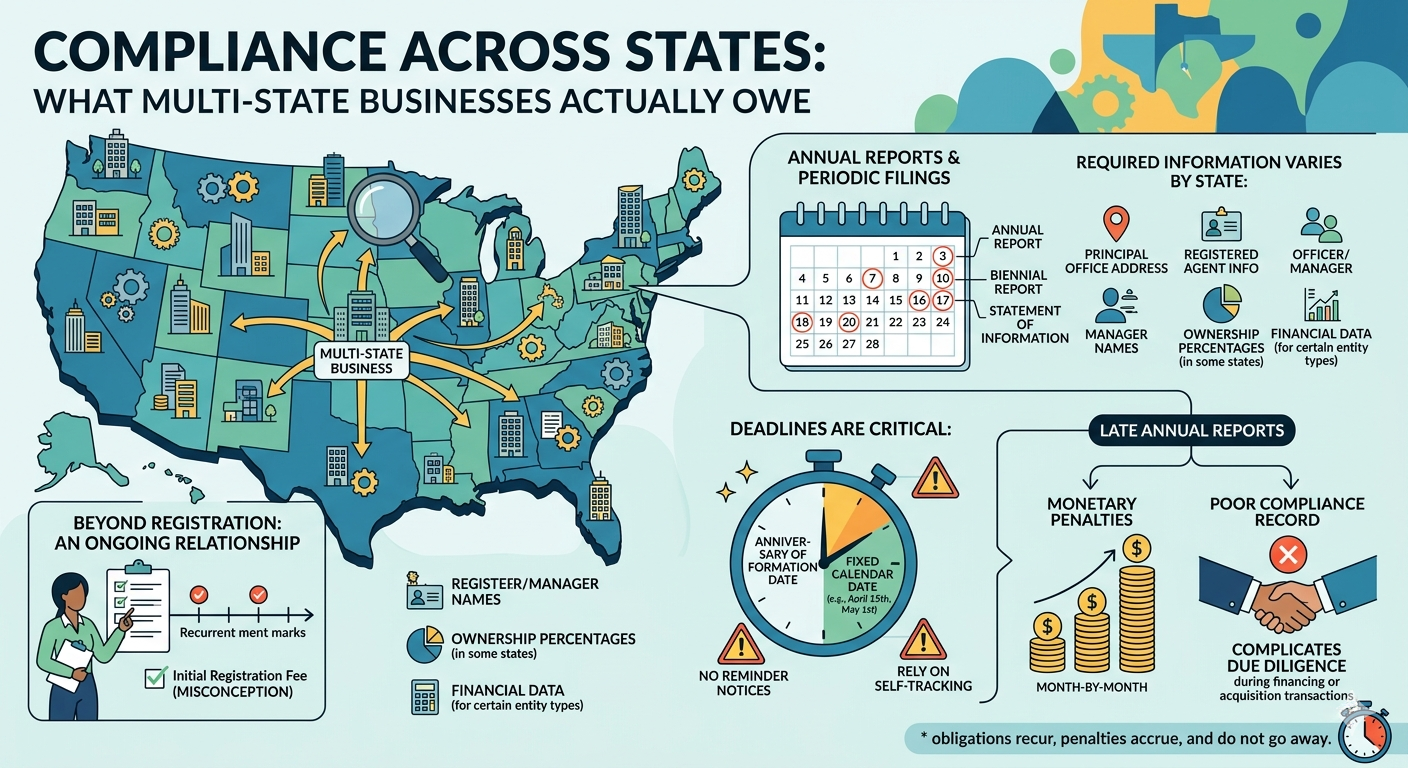
One of the more common misconceptions among business owners expanding into new states is that once they have filed the foreign qualification paperwork and paid the initial registration fee, they have done what is required. That initial registration is the beginning of an ongoing compliance relationship with each state, not a one-time transaction. The obligations that follow registration are real; they recur on their own schedules and do not go away because the business owner was unaware of them.
This article covers the substantive compliance obligations that multi-state businesses carry in each state in which they operate, what those obligations entail, and what happens when they are not met.
Annual Reports and Periodic Filings
Most states require registered business entities, both domestic and foreign to file periodic information reports with the Secretary of State’s office. These reports go by different names in different states, including annual reports, biennial reports, statements of information, and periodic reports, but they serve the same basic function: confirming that the entity’s registration information is current and that the entity is actively operating.
The information required in these filings varies by state but typically includes the entity’s current principal office address, the registered agent’s name and address, the names of officers or managers, and basic information about the entity’s structure. Some states require more detailed information, including ownership percentages or financial data for certain entity types.
Deadlines are the critical variable. Annual report deadlines vary by state and, in many states, also by entity type. Some states use the anniversary of the entity’s formation or qualification date as the annual report deadline; others use a fixed calendar date for all entities. States also differ in whether they send reminder notices to the registered agent, and how far in advance those notices arrive. A business cannot rely on receiving timely notice from every state; it needs to track its own deadlines independently.
Late annual reports trigger late fees in virtually every state. The fee amounts vary, but they accumulate with each passing month of delinquency in many states. Beyond the monetary penalty, a history of late filings reflects poorly on the entity’s compliance record and can complicate due diligence in financing and acquisition transactions.
State Franchise Taxes and Annual Fees
In addition to, or sometimes combined with, the annual report filing requirement, most states impose some form of annual fee or franchise tax on entities registered to do business there. The structure and amount of these fees and taxes vary considerably across states.
Delaware is known for its franchise tax, which applies to all Delaware corporations and can be calculated under two methods, the authorized shares method and the assumed par value capital method, with results that can vary dramatically depending on the entity’s capitalization structure. Many Delaware corporations inadvertently pay much higher franchise taxes than necessary by defaulting to the authorized shares method, even though the assumed par value capital method would yield a significantly lower tax. Understanding which calculation method applies to a specific entity’s situation is a meaningful compliance consideration for Delaware-incorporated businesses.
California imposes an annual minimum franchise tax on LLCs operating in the state, in addition to its LLC fee based on gross receipts from California sources. New York has its own biennial filing requirement and fee structure. Each state’s fee and tax structure needs to be understood and budgeted for as part of the cost of operating in that state.
Registered Agent Maintenance
Every state requires a registered business entity to maintain a registered agent with a physical address in the state. This requirement continues for as long as the entity is registered there. If the registered agent changes, the entity must file a change of registered agent with the Secretary of State before the change takes effect; the prior agent remains the agent of record until the change is officially filed and accepted.
The registered agent requirement is not simply a compliance checkbox. As discussed elsewhere in this series, the registered agent is the legally designated recipient for service of process and official state communications. A registered agent arrangement that is not functioning properly, because the agent has moved, is not monitoring the address, or is not promptly forwarding received documents, creates real legal exposure for the entity it represents.
For multi-state businesses using a professional registered agent service, confirm that the service covers all states of registration and that its notification and forwarding procedures meet the business’s needs for timely communication of official documents. A professional service that handles registered agent functions in all fifty states provides a consistent approach and a single point of accountability, which is considerably easier to manage than assembling separate agents in each state.
Good Standing Maintenance
The cumulative effect of meeting all ongoing compliance obligations, including filing annual reports on time, paying required fees and taxes, and maintaining a registered agent, is that the entity remains in good standing in each state of registration. Good standing is a condition, not a filing; it results from continuous compliance rather than from any specific action.
A certificate of good standing, issued by the Secretary of State on request, confirms that the entity is current on its obligations as of the date of the certificate. These certificates are frequently required in business transactions: lenders require them before closing loans, landlords request them before executing leases, government agencies require them before issuing permits, and parties to significant contracts sometimes request them as part of counterparty due diligence.
A certificate of good standing has a practical shelf life; it reflects the entity’s status as of the date it was issued, not necessarily its status when presented. For transactions where good standing is critical, the certificate should be obtained as close in time to the transaction as practicable.
Withdrawal When Operations Cease
When a business ceases operations in a foreign state, it is obligated to formally withdraw its foreign qualification registration rather than simply cease operations. Continuing to be registered without withdrawing means that annual report and fee obligations continue to accrue, even if the business is no longer conducting any activities in that state.
The withdrawal process requires filing a certificate of withdrawal or similar document with the Secretary of State, confirming that the entity is no longer doing business in the state and that all required filings and fees are current. Some states require evidence of tax clearance before accepting a withdrawal filing. The process is straightforward when the entity is in good standing; it becomes more complicated and costly if there are outstanding fees, penalties, or unfiled reports that must be resolved first.
Monitoring the entity’s registration status in each state where it is qualified and filing timely withdrawals when operations in a state cease are part of responsible multi-state compliance management. Letting registrations linger in states where the business no longer operates is a common and avoidable source of unnecessary compliance costs.
The Role of Compliance Services
The compliance obligations described in this article are manageable, but they require consistent attention across multiple states with varying requirements and deadlines. For businesses registered in more than a few states, managing this in-house without a dedicated system or staff resource is genuinely difficult. The risk of missed deadlines, overlooked fee obligations, and compliance gaps increases with each additional state of registration.
A corporate compliance service that specializes in multi-state entity maintenance provides systematic tracking of filing deadlines, handles annual report filings as they come due, manages registered agent relationships, and alerts the business to upcoming obligations well in advance. The cost of such a service is modest compared with the cost of addressing compliance failures, maintaining attorney time spent on routine filings, or discovering compliance gaps during a transaction.
Disclosure: The information in this article reflects general structural principles and practical observations from consulting experience and is provided for educational purposes only. It should not be interpreted as individualized legal or tax advice.
Expand your knowledge of asset protection, business planning, taxation, and private trusts. Explore the available books on Amazon.