

Forming a Nonprofit in New York
The mechanics of forming a nonprofit corporation in New York are manageable, but they require attention to detail and a realistic understanding of the timeline involved. This is not a process that can be completed in a few days, and organizations that underestimate the complexity or the time required often find themselves either delayed in launching their programs or operating out of compliance before they fully realize it.
What follows is a practical explanation of the formation process, from the initial decision about structure through the key milestones that mark a properly organized New York nonprofit.
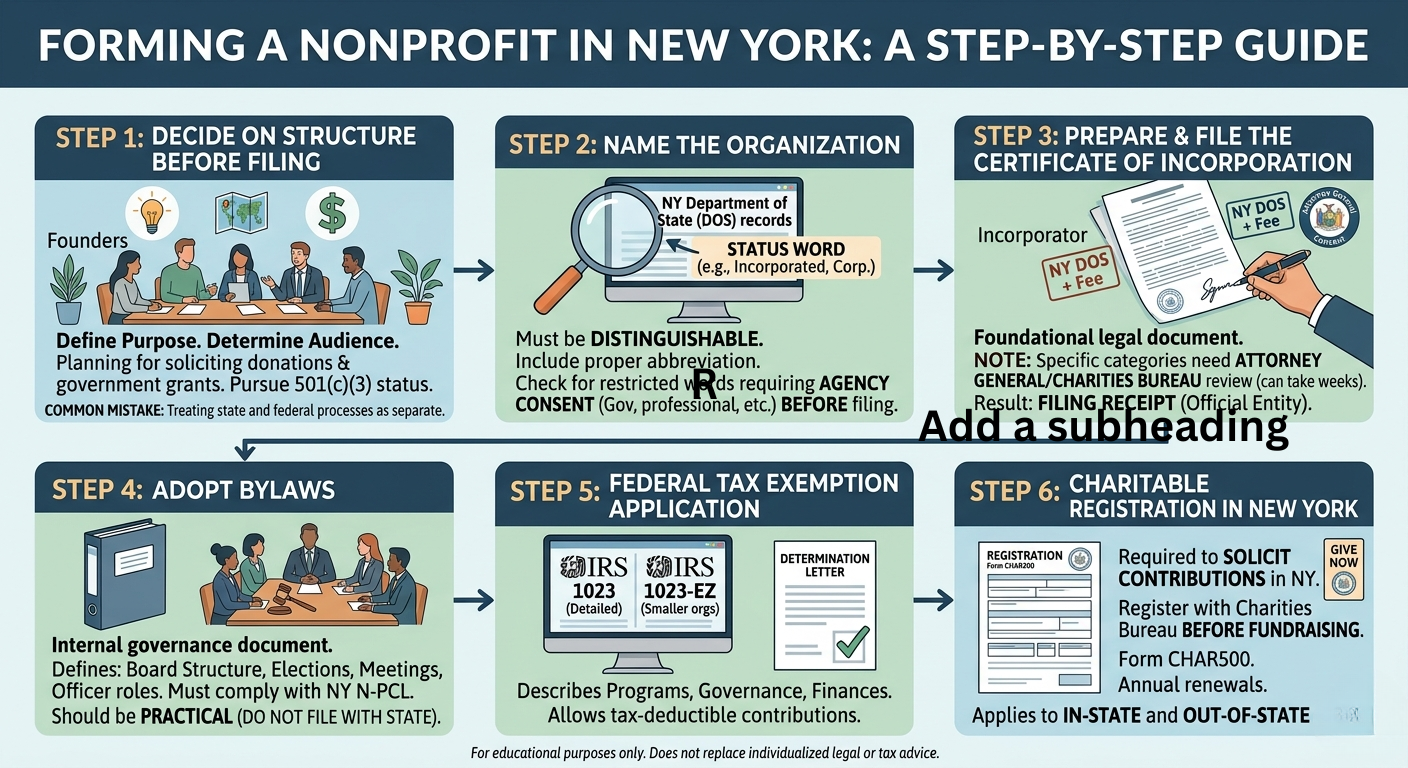
Deciding on Structure Before Filing
Before anything is filed, the founders of a new organization should work through some fundamental questions. What is the primary purpose of the organization? Who will it serve? Will it solicit donations from the public? Will it apply for government grants? Does it need to hire employees? The answers to these questions shape not only the legal structure but also the governance documents and the federal tax exemption strategy.
Most organizations formed for charitable, educational, or scientific purposes will pursue 501(c)(3) status with the IRS. That determination affects what the certificate of incorporation must say, how the bylaws should be structured, and what the organization’s financial practices need to look like from the very beginning. Treating the state formation and the federal exemption application as two entirely separate processes, rather than as parts of a single coordinated effort, is one of the more common mistakes new organizations make.
Naming the Organization
The name of a New York nonprofit corporation must be distinguishable from the names of other entities already on file with the Department of State. A name search through the Department of State’s records before filing is a practical first step. The name must include a word or abbreviation that indicates corporate status, such as “Incorporated,” “Corporation,” or their standard abbreviations.
Some words require specific approval before they can be used in a nonprofit name. Words that imply a connection to government, financial services, or certain professional activities may require consent from a relevant state agency before the Department of State will accept the certificate. Checking for restricted words early in the naming process avoids having to revise the certificate after it has been drafted.
Preparing and Filing the Certificate of Incorporation
The certificate of incorporation is the foundational legal document of the corporation. It must be signed by the incorporator, who may be an individual or an entity, and filed with the New York Department of State along with the applicable filing fee.
For nonprofit corporations in categories that require Attorney General consent, the process involves submitting the proposed certificate to the Charities Bureau for review before the filing with the Department of State can proceed. The Charities Bureau reviews the document to confirm that the purpose and structure are appropriate for a charitable organization operating in New York. This step can take several weeks, depending on the Bureau’s current workload and whether any questions arise about the proposed organization.
Once the certificate is accepted and the filing is complete, the Department of State issues a filing receipt that confirms the corporation’s existence. From that date, the corporation is a legal entity in New York, capable of entering into contracts, opening bank accounts, and beginning operations.
Adopting Bylaws
The bylaws are the internal governance document of the corporation. They define how the board of directors is constituted, how directors are elected and removed, how meetings are called and conducted, how officers are appointed, and how decisions are made. The bylaws do not need to be filed with the state, but they are a binding internal document that governs how the organization functions.
New York’s N-PCL sets minimum requirements for nonprofit governance, and the bylaws must be consistent with them. They should also be practical, meaning that they reflect how the organization actually intends to operate rather than being a generic template that does not fit the organization’s real structure. Bylaws that are overly rigid or do not align with operational reality create friction over time and sometimes require amendment at inconvenient times.
Federal Tax Exemption Application
For organizations seeking 501(c)(3) status, the IRS application is filed on Form 1023, or for smaller organizations that meet the eligibility criteria, on Form 1023-EZ. The full Form 1023 is a detailed document that requires the organization to describe its programs, governance, finances, and relationships with any related organizations. The IRS reviews these applications and may request additional information before making a determination.
The determination letter from the IRS, confirming 501(c)(3) status, is what allows the organization to receive tax-deductible contributions and to represent itself to donors and grantors as a tax-exempt charitable organization. Some organizations begin operating before the determination letter is received, which is permissible, but donors should be advised that deductibility is contingent on the IRS’s favorable determination.
Charitable Registration in New York
New York requires charitable organizations that solicit contributions within the state to register with the Charities Bureau before beginning fundraising. The registration is filed on Form CHAR500 and must be renewed annually, along with financial disclosure filings. Organizations with annual gross revenues above certain thresholds are required to file audited financial statements as part of their annual renewal.
The registration requirement applies broadly and is not limited to organizations based in New York. Out-of-state organizations that solicit New York residents are generally required to register as well. The Charities Bureau monitors compliance with the registration requirement, and operating without registration when required creates unnecessary legal exposure.
Disclosure: The information in this article reflects general structural principles and practical observations from consulting experience and is provided for educational purposes only. It should not be interpreted as individualized legal or tax advice.