
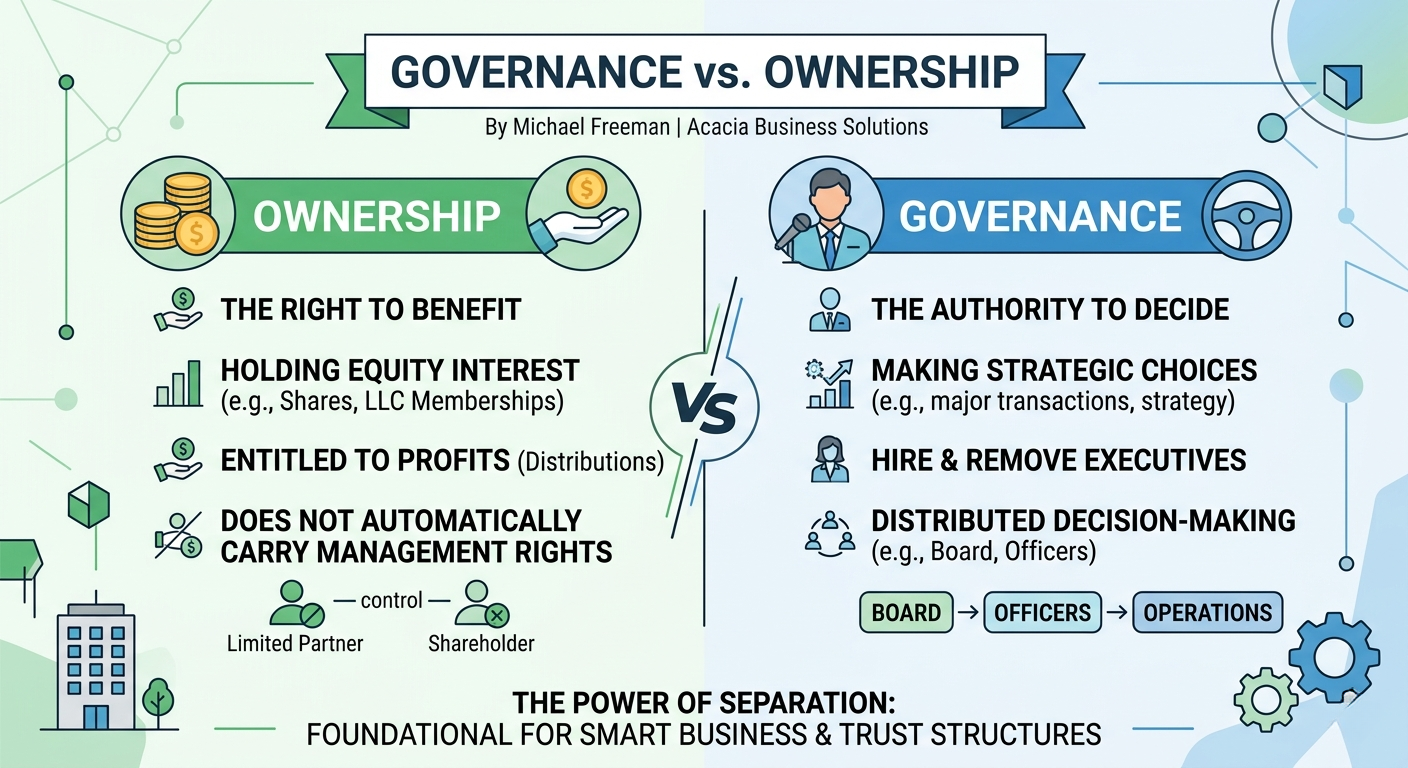

Governance vs Ownership: Understanding the Distinction
By Michael Freeman | Acacia Business Solutions
One of the most persistent sources of confusion in business structuring is the relationship between ownership and governance. People tend to assume they are the same thing, or at least that they move together naturally. In practice, they are distinct concepts, and the ability to deliberately separate them is one of the more powerful tools available in corporate and trust structuring.
Understanding how governance and ownership differ, and why that difference matters, is foundational to making informed decisions about how to structure a business, a holding arrangement, or an estate plan.
Ownership Defined
Ownership, in the legal sense, refers to the right to benefit from an asset. For a business entity, ownership typically means holding an equity interest: shares in a corporation, membership interests in an LLC, or a partnership interest. Owners are entitled to their proportionate share of distributions, and in a liquidation or sale, they are entitled to their share of the proceeds after debts are satisfied.
Ownership interests carry economic rights, but they do not automatically carry management rights. A shareholder in a corporation does not manage the corporation by virtue of holding shares. A limited partner in a limited partnership has no management authority; that is the defining characteristic of the limited partnership structure. Economic interest and government authority are legally distinct, even when they are held by the same person.
Governance Defined
Governance refers to the authority to make decisions about how an entity operates. In a corporation, governance authority is distributed across three levels: the shareholders, who elect the board of directors; the board, which sets policy and makes major decisions; and the officers, who manage day-to-day operations under the board’s direction. The governance structure determines who can authorize a major transaction, hire or remove an executive, change the business’s strategic direction, or approve a distribution.
In an LLC, governance can be structured more flexibly. A manager-managed LLC concentrates decision-making authority in one or more designated managers, who may or may not hold membership interests. A member-managed LLC gives all members a voice in governance, typically in proportion to their interests. The operating agreement governs how this works in practice, giving LLC structures considerable flexibility to separate economic and governance rights in ways that serve the specific needs of the parties involved.
In a trust structure, governance authority rests with the trustee. The trustee holds legal title to the trust assets and has the authority and obligation to manage them in accordance with the trust agreement and applicable law. The beneficiaries hold the beneficial interest; they are entitled to the economic benefit of the assets but do not control them, unless the trust agreement specifically grants them authority over certain decisions.
Why the Separation Matters
The ability to separate ownership from governance serves several legitimate purposes that come up regularly in structuring conversations.
In estate planning contexts, parents often want to transfer wealth to the next generation while retaining control over how assets are managed during their lifetimes or in the transition period. A family LLC or limited partnership can accomplish this by allowing the senior generation to transfer limited partnership interests or membership interests to children or a trust for their benefit, while retaining the general partner or managing member role, which carries governance authority. The economic benefit transfers; the control does not, at least not immediately.
In business partnerships, co-founders or investors may want to separate economic participation from operational control. A structure that gives certain investors a preferred economic return while concentrating governance in the hands of the operating partners is common in private equity and venture capital, and similar structures also appear in smaller business arrangements.
In asset protection planning, separating an entity’s governance from its economic interest can affect the remedies available to a creditor. In many states, a creditor of an LLC member is limited to a charging order against the member’s economic interest and cannot step into the member’s governance role. The practical effect is that the creditor receives a right to distributions if and when they are made, but has no ability to force distributions or participate in management. The value of this protection depends heavily on state law and the specific facts involved, and it should not be treated as an absolute shield, but it is a real structural consideration.
Common Misconceptions
The most common misconception is that whoever owns the most has the most control. In a simple corporation with no special share classes and no shareholders’ agreement, this is roughly true; majority shareholders elect the board, and the board controls the company. But the moment you introduce non-voting shares, different share classes with different governance rights, a shareholders’ agreement that restricts certain decisions, or a trust as the holding vehicle, the relationship between economic interest and governance authority becomes considerably more nuanced.
A person who holds a 70 percent economic interest in an LLC, but who is a non-managing member under the operating agreement, may have very limited governance rights despite holding the majority of the economic value. Conversely, a managing member with a 10 percent economic interest may have broad authority over day-to-day decisions and significant influence over major ones.
The governance documents control the actual distribution of authority. Reading and understanding those documents, rather than assuming that ownership percentage translates directly into control, is essential for anyone involved in a business structure that involves multiple parties.
Structuring Governance Intentionally
The most effective governance structures are designed intentionally rather than adopted by default. Default rules under state law provide a starting point, but they rarely reflect the specific needs and intentions of the parties. An operating agreement, shareholders’ agreement, or trust agreement that thoughtfully addresses how decisions are made, what requires unanimous consent versus majority approval, how disputes are resolved, and how governance rights transfer over time is a significantly more useful governance document than one that simply incorporates statutory defaults.
The investment in designing a governance structure that reflects the parties’ actual intentions and needs pays dividends over the life of the entity. Governance disputes are among the most disruptive and expensive problems that arise in business and family structures, and most of them trace back to ambiguity or silence in the governing documents rather than to genuinely irreconcilable disagreements.
Disclosure: The information in this article reflects general structural principles and practical observations from consulting experience and is provided for educational purposes only. It should not be interpreted as individualized legal or tax advice.
Expand your knowledge of asset protection, business planning, taxation, and private trusts. Explore the available books on Amazon.