
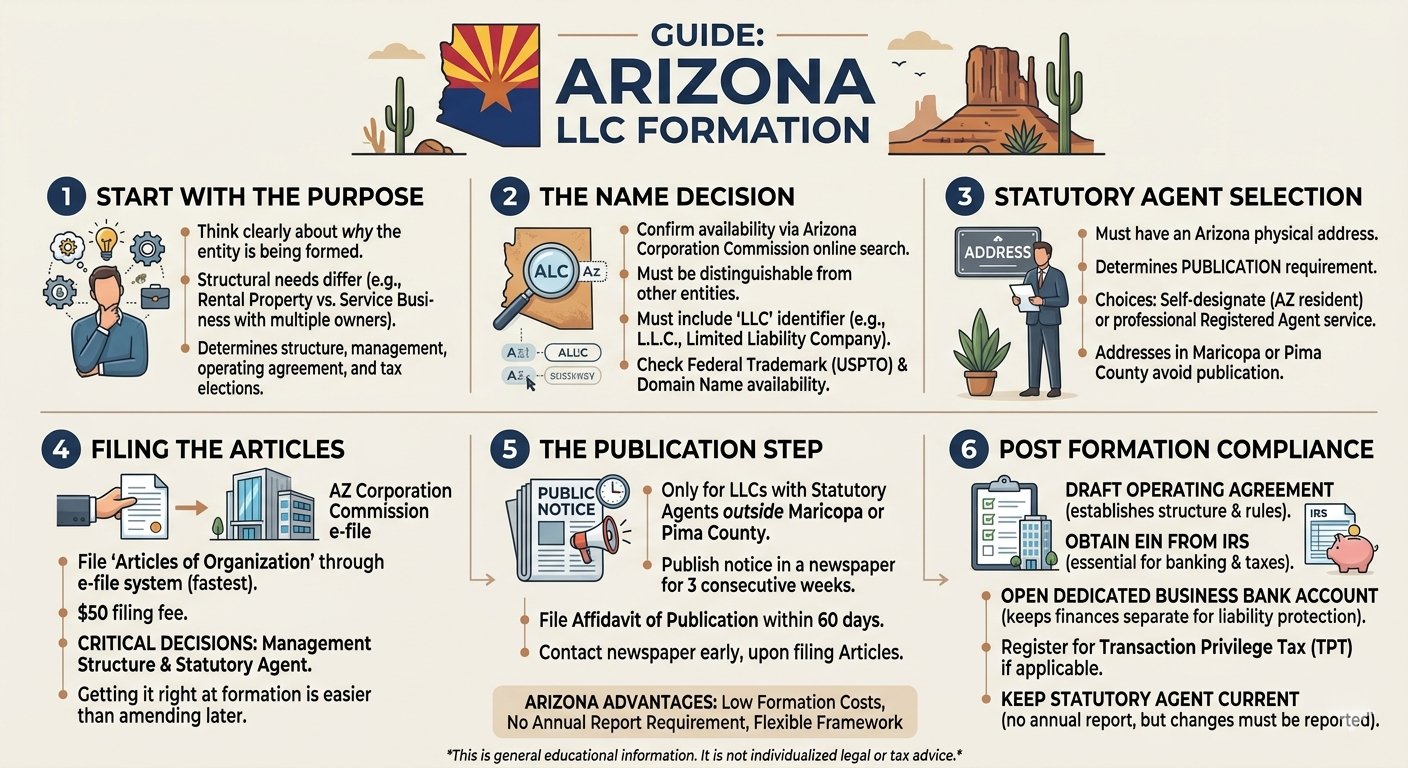

Guide: Arizona LLC Formation
This guide is for people who are forming an LLC in Arizona or are seriously considering it and want a clear picture of what the process entails. It covers the full sequence from the initial decision through the post-formation steps that are sometimes overlooked, with practical observations about what matters most at each stage.
Arizona is a reasonable state to form an LLC, and the process is manageable for most business owners who approach it with adequate preparation. The state’s relatively low formation costs, the absence of an annual report requirement, and a flexible statutory framework make it a practical choice for many types of businesses. The publication requirement and a few specific decisions about structure deserve more attention than people sometimes give them.
Start with the Purpose, Not the Paperwork
The most useful thing anyone forming an Arizona LLC can do before filing anything is to think clearly about why the entity is being formed and what it needs to accomplish. An LLC formed to hold a rental property has different structural needs than one formed to run a service business with multiple owners. An LLC being used as a holding entity for investments has different considerations than one that will employ people and sign commercial leases.
The answers to these questions determine whether an LLC is the right structure at all, what the management structure should look like, how the operating agreement should be drafted, and what tax elections, if any, make sense. Skipping this thinking and going straight to the filing because an LLC seems like the standard choice leads to structures that technically exist but do not serve the actual purpose well.
The Name Decision
Confirming name availability through the Arizona Corporation Commission’s online search is the first concrete step. The name must be distinguishable from existing entity names, must include the required LLC identifier, and should not include restricted words without the required approval.
Beyond the legal requirements, the name should be one the business can build a brand around, and that does not create confusion with existing businesses in the same market. A brief check of federal trademark registrations through the USPTO database and a check of domain name availability take only a few minutes and can prevent a rebranding exercise down the road.
Statutory Agent Selection
The statutory agent must be in place before the Articles of Organization are filed. For business owners who are Arizona residents and comfortable using a personal or business address as the statutory agent address, self-designation is an option. For those who prefer to keep a personal address out of the public record, or who are not Arizona residents, a professional registered agent service is the practical choice.
The statutory agent’s address appears in the public record and determines whether the publication requirement applies. If the statutory agent’s address is in Maricopa or Pima County, no publication is required. If the address is in any other Arizona county, the publication step is mandatory. This is a practical factor worth considering when choosing a registered agent service.
Filing the Articles
The Articles of Organization are a relatively short document, but two decisions in them deserve deliberate attention: the management structure designation and the statutory agent designation. Both have practical consequences that last as long as the entity exists and getting them right at formation is easier than amending them later.
Online filing through the Arizona Corporation Commission’s e-file system is the fastest option and typically results in faster processing than mail filings. The $50 filing fee is paid at the time of filing. If the formation is time sensitive, expedited processing options are available for an additional fee.
The Publication Step
After the Commission approves the Articles, the publication clock starts for LLCs whose statutory agent is outside Maricopa or Pima County. The notice must be published in a newspaper of general circulation in the county of the statutory agent’s address for three consecutive weeks. The newspaper will typically provide the affidavit of publication once the run is complete, and that affidavit must be filed with the Commission.
Building this step into the formation plan from the beginning, rather than discovering it after the Articles are approved, avoids the stress of working against the 60-day deadline. Contacting the newspaper and arranging the publication as soon as the Articles are filed, before the approval even comes through, is a sound approach.
The Operating Agreement
For a single-member LLC, the operating agreement is a document that establishes the entity’s structure, confirms the member, and sets out the basic governance rules. It does not need to be complicated, but it should be specific enough to demonstrate that the LLC is being operated as a genuine legal entity separate from the member.
For multi-member LLCs, the operating agreement governs the relationship among the members. It should address membership interests and how they are calculated, management authority and how decisions are made, how profits and losses are allocated, when and how distributions are made, what restrictions apply to the transfer of membership interests, what happens when a member wants to exit or is forced to exit for reasons such as death or incapacity, and how disputes are resolved.
The time to address these questions is at the beginning, when the members are aligned and optimistic about the venture. Trying to negotiate these provisions after a dispute has arisen, or when a member wants to exit on terms the others do not accept, is much harder and much more expensive than working through them at formation.
Post Formation Compliance
After the entity is formed and the operating agreement is in place, the remaining steps are primarily about compliance with tax and business licensing obligations. Obtaining an EIN from the IRS is typically the next step, followed by registering with the Arizona Department of Revenue for transaction privilege tax purposes if the business will be selling taxable goods or services in Arizona.
Opening a dedicated business bank account is a foundational step that should happen early. All business income and expenses should flow through that account, keeping the business’s financial records clearly separate from the members’ personal finances. This separation is not just an accounting preference; it is what supports the liability protection the LLC was formed to provide.
Arizona’s absence of an annual LLC report requirement simplifies the ongoing compliance calendar, but the statutory agent must be kept current, any material changes to the entity must be reported to the Commission, and the entity’s tax obligations must be met on schedule. Treating the LLC as a real legal entity from day one, with proper records and proper financial separation, is what makes the structure function as intended over time.
Disclosure: The information in this article reflects general structural principles and practical observations from consulting experience and is provided for educational purposes only. It should not be interpreted as individualized legal or tax advice.