

Guide: Business Structuring
Business structuring is the process of designing the legal entity framework through which a business or investment portfolio operates. Done well, it creates meaningful separation between different activities and assets, contains liability within appropriate boundaries, supports the owner’s estate and succession planning objectives, and provides a foundation that can accommodate growth and change over time. Done poorly or not at all, it leaves the owner personally exposed to liabilities that a proper structure would have contained.
This guide provides a practical framework for thinking through business structuring decisions, whether at the formation stage, during growth, or as part of a restructuring or succession planning process.
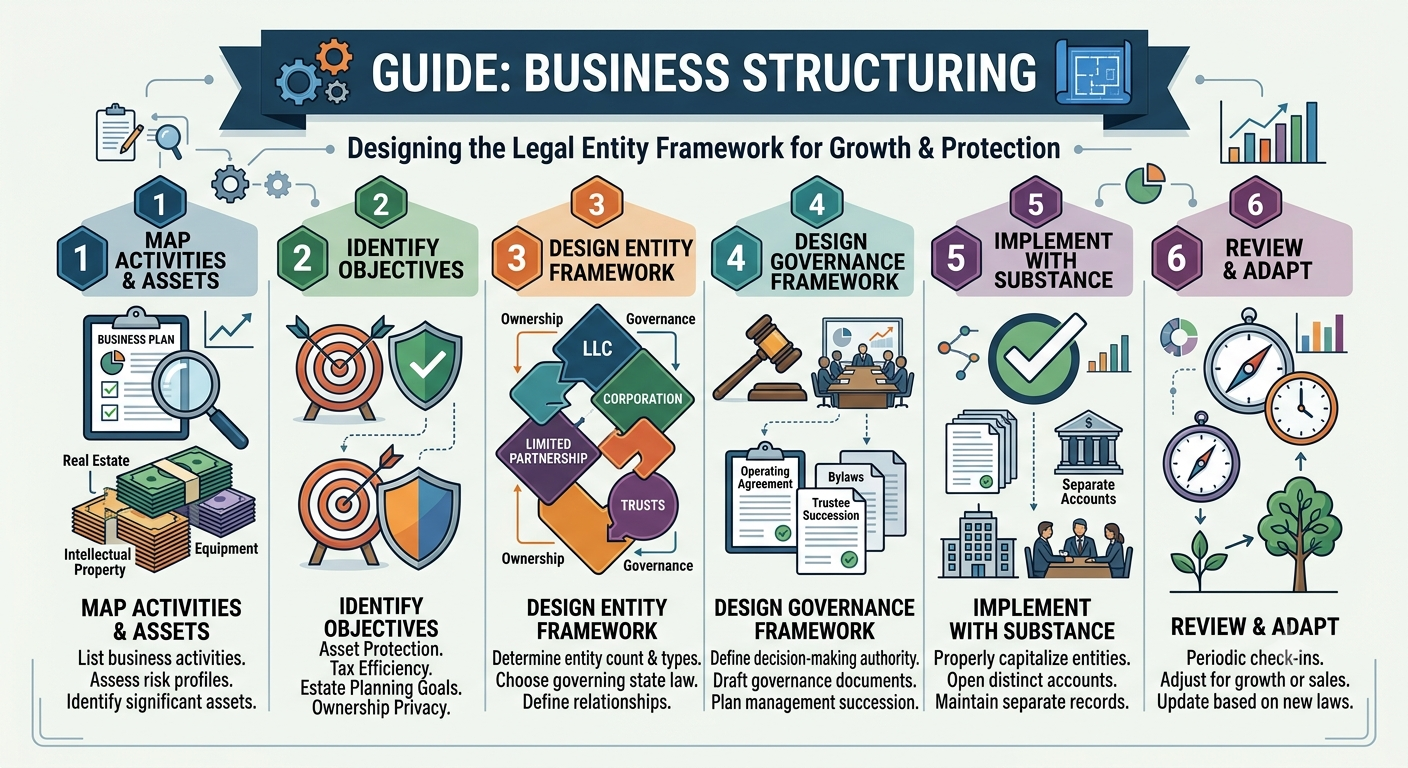
Step One: Map the Activities and Assets
The first step is to create a clear picture of what exists: which business activities are being conducted, which assets are owned, and how the two relate. This sounds straightforward, but many business owners have a less clear picture of this than they realize, particularly when a business has grown organically over time, with entities and arrangements added as needed rather than designed as a coherent whole.
List each distinct business activity and assess its liability profile. Which activities involve direct client service? Which products do they involve? Which involves the employment of significant numbers of people? Which are subject to industry-specific regulations? Which involve significant contract obligations or ongoing financial commitments? The risk profile of each activity informs how it should be structured.
List each significant asset and note where it is currently held. Real property, intellectual property, equipment, investment accounts, business goodwill, and interests in other entities are all assets that fit within a structure. Whether they are currently held where they belong, in terms of the structural goals, is one of the key questions the structuring process needs to answer.
Step Two: Identify the Structural Objectives
Different owners have different structural objectives, and the structure should explicitly reflect those objectives rather than importing them from a generic template. Common objectives include containing operating liability within the entities that generate it and protecting valuable assets from that liability; maintaining privacy of ownership where appropriate and legally permissible; integrating the business structure with estate planning goals so that assets transfer efficiently at death or incapacity; providing a governance framework that reflects actual intentions about control and succession; and creating a tax-efficient structure that does not generate unnecessary complexity or cost.
Not every objective applies in every situation, and some objectives involve tradeoffs with others. A structure optimized entirely for asset protection may not be the most tax efficient. A structure optimized for simplicity may not provide the separation of the business’s risk profile requires. Understanding which objectives are primary and which are secondary helps in designing a structure that makes coherent tradeoffs rather than one that tries to do everything and accomplishes nothing particularly well.
Step Three: Design the Entity Framework
With a clear picture of the activities, assets, and objectives, the entity framework can be designed. The design addresses: how many entities are needed; what type of entity is appropriate for each function; which state law governs each entity; what ownership structure is used; and how the entities relate to each other through intercompany arrangements, ownership interests, and governance.
Entity type selection involves several considerations. LLCs are widely used to operate businesses and hold entities because of their flexibility in governance design, default pass-through tax treatment, and charging order protection available under many states’ laws. Corporations are appropriate in contexts where outside investment is anticipated, where equity compensation using stock options is part of the compensation model, or where the entity needs to make an S corporation election. Limited partnerships are used in certain family wealth transfer and real estate structures. Trusts serve distinct functions that entities cannot replicate, including providing for beneficiaries, creating continuity through death without probate, and, in some structures, providing an additional layer of asset protection.
State selection matters more than people sometimes assume. The LLC laws, charging order protection statutes, trust laws, and tax treatment of entities vary meaningfully across states. Delaware, Nevada, Wyoming, and South Dakota are among the states that business and trust planners frequently consider for specific structural reasons. Using an entity formed in a particular state does not exempt it from the laws of the states where it does business; a foreign-registered entity doing business in California is subject to California’s LLC Act and tax requirements, regardless of where it was formed. State selection is a meaningful choice, but its benefits need to be weighed against the registration, compliance, and tax obligations it entails.
Step Four: Design the Governance Framework
The entity framework and the governance framework are related but distinct design questions. The entity framework determines which legal persons exist and how they relate to one another in terms of ownership and structure. The governance framework determines who makes decisions within and about those entities, on what terms, and through what process.
As discussed in the governance-focused articles in this series, governance documents need to be specific about decision-making authority, member or beneficiary rights, succession in management roles, and dispute resolution. A structure that is correctly designed at the entity level but governed by inadequate or ambiguous documents will lead to governance disputes that undermine its effectiveness.
For structures involving trusts, trustee selection and trustee succession planning are governance decisions of the highest importance. For structures involving LLCs with multiple members, the operating agreement’s treatment of major decisions, deadlock, and member exit is critical. These documents should be drafted with the same care as the structural design itself.
Step Five: Implement with Genuine Substance
A structure that exists on paper but not in substance provides little or no protection. Implementation requires properly capitalizing each entity; opening separate accounts for each entity; executing and performing intercompany agreements at commercially reasonable terms; maintaining separate governance records for each entity; filing required state reports and maintaining good standing in each jurisdiction; and consistently operating each entity as a genuine legal person separate from the others and from the owner personally.
The implementation phase is where many structures fall short. The entities are formed, the documents are signed, and then the parties return to operating informally, combining funds across entities, making decisions without documentation, and treating the structure as a paper arrangement rather than a genuine operational framework. Courts evaluate substance over form, and a structure that lacks substance will be treated accordingly.
Step Six: Review and Adapt Over Time
A structure that was appropriate at one stage of a business’s development may not be appropriate later. As the business grows, as asset values increase, as additional activities are added, as ownership changes through sale or transfer, and as laws change, the structure needs to be revisited and adjusted.
Triggers for a structural review include a significant increase in business revenue or asset values; the addition of new business activities with distinct risk profiles; a change in ownership, whether through a sale, a gift, or death; a significant personal event affecting the owner, such as marriage, divorce, or the birth of children; a change in applicable law that affects the tax or legal treatment of existing structures; and the expansion of the business into new states or countries.
A periodic review, conducted every few years even in the absence of a specific trigger, is worthwhile for any business structure of meaningful complexity. The review examines whether the existing structure still serves its intended purposes, whether required formalities are being observed, and whether any changes in circumstances or law suggest modifications. The cost of the review is consistently less than the cost of addressing structural problems that were allowed to develop without attention.
Working with Advisors
Business structuring involves legal, tax, and operational considerations that are interconnected. A legally sound structure needs to be evaluated for its tax consequences. A tax-efficient structure needs to be evaluated for its legal integrity. An operationally convenient structure needs to be evaluated for whether it maintains the separations and formalities that make it effective.
Working with advisors who understand all three dimensions, and who communicate with each other rather than providing advice in isolation, produces better outcomes than assembling a structure from the independent recommendations of a lawyer who does not understand the tax implications, a tax advisor who does not understand the legal requirements, and an accountant who is not aware of either set of considerations. The integration of legal, tax, and operational advice is part of what distinguishes effective business structuring from the assembly of entities that look right on paper but do not function as intended.
Disclosure: The information in this article reflects general structural principles and practical observations from consulting experience and is provided for educational purposes only. It should not be interpreted as individualized legal or tax advice.
Guide: Business Structuring
Business structuring is the process of designing the legal entity framework through which a business or investment portfolio operates. Done well, it creates meaningful separation between different activities and assets, contains liability within appropriate boundaries, supports the owner’s estate and succession planning objectives, and provides a foundation that can accommodate growth and change over time. Done poorly or not at all, it leaves the owner personally exposed to liabilities that a proper structure would have contained.
This guide provides a practical framework for thinking through business structuring decisions, whether at the formation stage, during growth, or as part of a restructuring or succession planning process.
Step One: Map the Activities and Assets
The first step is to create a clear picture of what exists: which business activities are being conducted, which assets are owned, and how the two relate. This sounds straightforward, but many business owners have a less clear picture of this than they realize, particularly when a business has grown organically over time, with entities and arrangements added as needed rather than designed as a coherent whole.
List each distinct business activity and assess its liability profile. Which activities involve direct client service? Which products do they involve? Which involves the employment of significant numbers of people? Which are subject to industry-specific regulations? Which involve significant contract obligations or ongoing financial commitments? The risk profile of each activity informs how it should be structured.
List each significant asset and note where it is currently held. Real property, intellectual property, equipment, investment accounts, business goodwill, and interests in other entities are all assets that fit within a structure. Whether they are currently held where they belong, in terms of the structural goals, is one of the key questions the structuring process needs to answer.
Step Two: Identify the Structural Objectives
Different owners have different structural objectives, and the structure should explicitly reflect those objectives rather than importing them from a generic template. Common objectives include containing operating liability within the entities that generate it and protecting valuable assets from that liability; maintaining privacy of ownership where appropriate and legally permissible; integrating the business structure with estate planning goals so that assets transfer efficiently at death or incapacity; providing a governance framework that reflects actual intentions about control and succession; and creating a tax-efficient structure that does not generate unnecessary complexity or cost.
Not every objective applies in every situation, and some objectives involve tradeoffs with others. A structure optimized entirely for asset protection may not be the most tax efficient. A structure optimized for simplicity may not provide the separation of the business’s risk profile requires. Understanding which objectives are primary and which are secondary helps in designing a structure that makes coherent tradeoffs rather than one that tries to do everything and accomplishes nothing particularly well.
Step Three: Design the Entity Framework
With a clear picture of the activities, assets, and objectives, the entity framework can be designed. The design addresses: how many entities are needed; what type of entity is appropriate for each function; which state law governs each entity; what ownership structure is used; and how the entities relate to each other through intercompany arrangements, ownership interests, and governance.
Entity type selection involves several considerations. LLCs are widely used to operate businesses and hold entities because of their flexibility in governance design, default pass-through tax treatment, and charging order protection available under many states’ laws. Corporations are appropriate in contexts where outside investment is anticipated, where equity compensation using stock options is part of the compensation model, or where the entity needs to make an S corporation election. Limited partnerships are used in certain family wealth transfer and real estate structures. Trusts serve distinct functions that entities cannot replicate, including providing for beneficiaries, creating continuity through death without probate, and, in some structures, providing an additional layer of asset protection.
State selection matters more than people sometimes assume. The LLC laws, charging order protection statutes, trust laws, and tax treatment of entities vary meaningfully across states. Delaware, Nevada, Wyoming, and South Dakota are among the states that business and trust planners frequently consider for specific structural reasons. Using an entity formed in a particular state does not exempt it from the laws of the states where it does business; a foreign-registered entity doing business in California is subject to California’s LLC Act and tax requirements, regardless of where it was formed. State selection is a meaningful choice, but its benefits need to be weighed against the registration, compliance, and tax obligations it entails.
Step Four: Design the Governance Framework
The entity framework and the governance framework are related but distinct design questions. The entity framework determines which legal persons exist and how they relate to one another in terms of ownership and structure. The governance framework determines who makes decisions within and about those entities, on what terms, and through what process.
As discussed in the governance-focused articles in this series, governance documents need to be specific about decision-making authority, member or beneficiary rights, succession in management roles, and dispute resolution. A structure that is correctly designed at the entity level but governed by inadequate or ambiguous documents will lead to governance disputes that undermine its effectiveness.
For structures involving trusts, trustee selection and trustee succession planning are governance decisions of the highest importance. For structures involving LLCs with multiple members, the operating agreement’s treatment of major decisions, deadlock, and member exit is critical. These documents should be drafted with the same care as the structural design itself.
Step Five: Implement with Genuine Substance
A structure that exists on paper but not in substance provides little or no protection. Implementation requires properly capitalizing each entity; opening separate accounts for each entity; executing and performing intercompany agreements at commercially reasonable terms; maintaining separate governance records for each entity; filing required state reports and maintaining good standing in each jurisdiction; and consistently operating each entity as a genuine legal person separate from the others and from the owner personally.
The implementation phase is where many structures fall short. The entities are formed, the documents are signed, and then the parties return to operating informally, combining funds across entities, making decisions without documentation, and treating the structure as a paper arrangement rather than a genuine operational framework. Courts evaluate substance over form, and a structure that lacks substance will be treated accordingly.
Step Six: Review and Adapt Over Time
A structure that was appropriate at one stage of a business’s development may not be appropriate later. As the business grows, as asset values increase, as additional activities are added, as ownership changes through sale or transfer, and as laws change, the structure needs to be revisited and adjusted.
Triggers for a structural review include a significant increase in business revenue or asset values; the addition of new business activities with distinct risk profiles; a change in ownership, whether through a sale, a gift, or death; a significant personal event affecting the owner, such as marriage, divorce, or the birth of children; a change in applicable law that affects the tax or legal treatment of existing structures; and the expansion of the business into new states or countries.
A periodic review, conducted every few years even in the absence of a specific trigger, is worthwhile for any business structure of meaningful complexity. The review examines whether the existing structure still serves its intended purposes, whether required formalities are being observed, and whether any changes in circumstances or law suggest modifications. The cost of the review is consistently less than the cost of addressing structural problems that were allowed to develop without attention.
Working with Advisors
Business structuring involves legal, tax, and operational considerations that are interconnected. A legally sound structure needs to be evaluated for its tax consequences. A tax-efficient structure needs to be evaluated for its legal integrity. An operationally convenient structure needs to be evaluated for whether it maintains the separations and formalities that make it effective.
Working with advisors who understand all three dimensions, and who communicate with each other rather than providing advice in isolation, produces better outcomes than assembling a structure from the independent recommendations of a lawyer who does not understand the tax implications, a tax advisor who does not understand the legal requirements, and an accountant who is not aware of either set of considerations. The integration of legal, tax, and operational advice is part of what distinguishes effective business structuring from the assembly of entities that look right on paper but do not function as intended.
Disclosure: The information in this article reflects general structural principles and practical observations from consulting experience and is provided for educational purposes only. It should not be interpreted as individualized legal or tax advice.
Expand your knowledge of asset protection, business planning, taxation, and private trusts. Explore the available books on Amazon.