
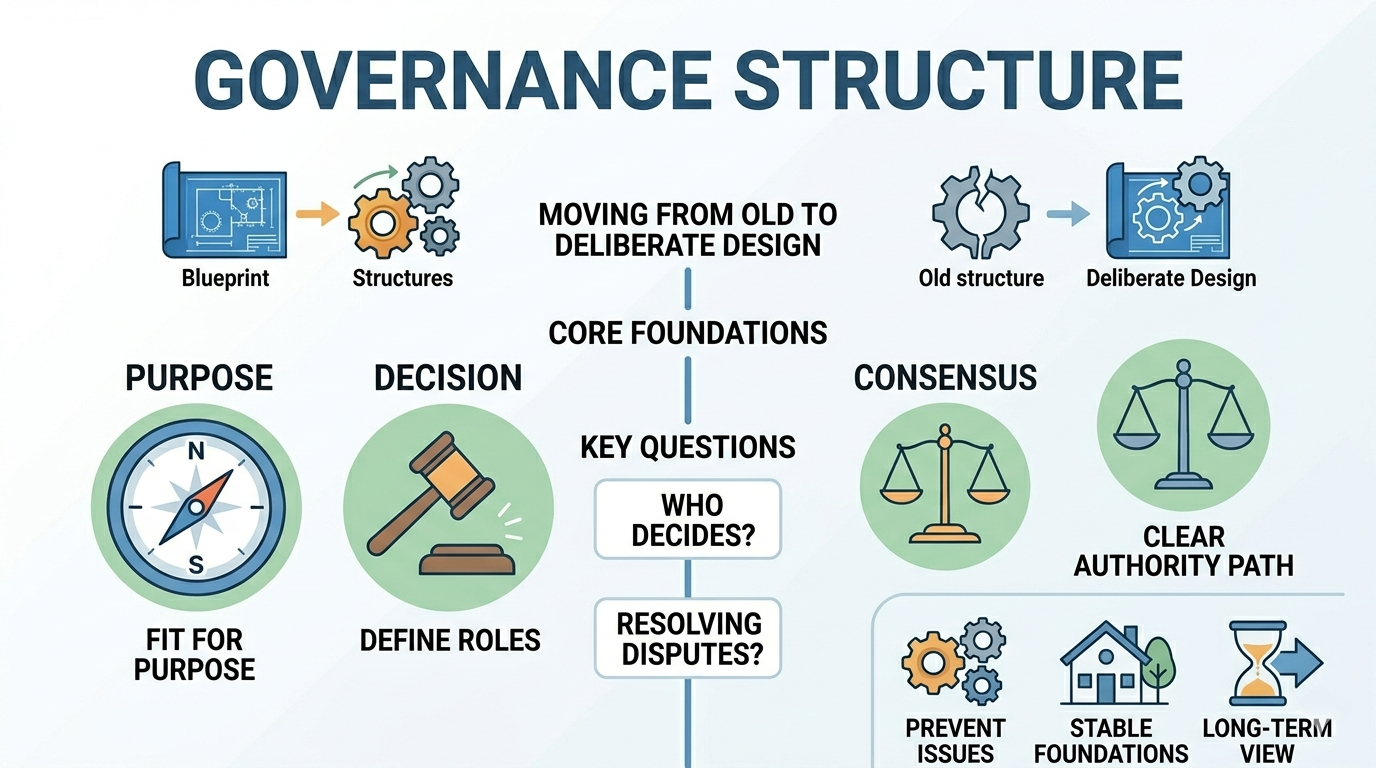

Guide: Governance Structure for Business and Holding Entities
Governance structure is one of those topics that tends to get less attention than it deserves in the formation process. Founders and advisors are focused on getting the entity in place, securing capital, starting operations, or completing a transaction. The governance documents get drafted, signed, and filed, and everyone moves on. The governance structure that was put in place, whether by design or by default, then governs the entity for years, often in ways the parties did not fully think through.
This guide is for people who want to think through governance structure more deliberately, whether at the formation stage, during a restructuring, or as part of a succession planning process. The goal is to provide a practical framework for designing a governance structure that reflects actual intentions and serves the entity’s needs over time.
Start with the Purpose of the Entity
The starting point for any governance design conversation is the entity’s purpose and the parties’ intentions. A single-member LLC that holds a rental property has different governance needs than a multi-member LLC operating an active business. A revocable living trust has different governance requirements than an irrevocable asset protection trust. A family-holding company with multiple generations of stakeholders has different considerations than a two-person business partnership.
The governance structure should fit the entity’s purpose and the parties’ intentions. Generic default structures, borrowed from templates or imposed by statutory defaults, frequently do not fit. They provide a starting point, but they need to be evaluated against the specific situation and modified where the defaults do not serve the parties’ actual needs.
Before drafting governance documents, spend time answering the foundational questions: Who should make operational decisions? Who should have a voice in major decisions, and what level of consensus is required? How should disputes be resolved? What happens when a principal dies, retires, or wants to exit? How should the governance structure evolve as the entity grows or as ownership changes? The answers to these questions shape every provision in the governing documents.
Defining Decision-Making Authority
The most important task in governance design is to define decision-making authority clearly and completely. This means specifying in the governing documents which decisions fall within management’s unilateral authority and which require approval from owners, beneficiaries, or other stakeholders, and at what threshold.
A well-designed decision-making framework distinguishes between routine operational decisions, which should be within management’s authority without the need for owner consultation; significant but ordinary course decisions, which may require notice to owners or approval at a lower threshold; and major or extraordinary decisions, which require a higher level of consensus or even unanimity.
Major decisions typically include incurring debt above a defined threshold, selling or encumbering significant assets, entering into long-term commitments, admitting new owners, changing the entity’s fundamental business or purpose, amending the governing documents, and making distributions above ordinary-course amounts. Each of these categories should be addressed specifically rather than left to general language.
For entities with a single manager or trustee, the decision-making framework also needs to address accountability. If the manager has broad unilateral authority, what reporting obligations does the manager have to the owners? What information rights do the owners hold? What triggers owners’ right to remove the manager, and what process governs that removal? Clear answers to these questions create a governance structure with genuine accountability rather than one where broad management authority is paired with no effective oversight.
Governance in LLC Structures
The LLC is the most flexible entity form for governance design. The operating agreement can allocate management authority, economic rights, and voting rights independently and in almost any combination the parties choose. This flexibility is valuable, but it means the governance design choices are largely up to the parties and their advisors rather than being set by statute.
For a manager-managed LLC, the operating agreement should define the manager’s authority in specific terms, address how the manager is appointed and removed, specify what decisions require member approval and at what threshold, and address succession in the manager’s role. It should also address what happens if the manager and the members reach an impasse on a significant decision.
For a member-managed LLC with multiple members, the operating agreement should specify voting rights, whether by percentage interest or per capita, address deadlock resolution mechanisms, and define what level of approval is required for different categories of decisions. A two-member LLC where each member holds 50 percent creates a built-in deadlock risk for any decision requiring majority approval. The operating agreement should address how that situation is resolved, either through a tie-breaking mechanism, a buyout right, or a defined dispute resolution process.
Governance in Trust Structures
Trust governance is defined by the trust agreement and constrained by applicable state trust law, which in most jurisdictions sets a floor of trustee obligations that cannot be waived entirely by agreement. The governance design task in a trust is primarily about selecting the right trustee or trustee structure, defining the trustee’s investment and distribution discretion, and building appropriate mechanisms for accountability, modification, and succession.
For irrevocable trusts intended to operate over many years or across generations, the governance design needs to account for circumstances that cannot be fully anticipated at the time of drafting. Tax laws change. Family circumstances change. The assets in the trust may change in nature and value. Trustees die or become incapacitated. The trust agreement should include mechanisms to address these realities: successor trustee provisions, trust protector powers, decanting authority, where permitted by state law, and modification provisions that allow the trust to adapt to changed circumstances without requiring court involvement in every case.
The selection of the trustee is a first-order governance decision. The trustee’s character, competence, and relationship to the beneficiaries will determine how the trust functions over time far more than any provision in the trust agreement. A well-drafted trust agreement administered by a poor trustee is worse than a simpler agreement administered by a trustee with genuine judgment and integrity.
Integrating Business and Trust Governance
Many sophisticated structures involve trusts holding interests in business entities, with the trust’s trustee also serving as, or appointing, the business entity’s manager. These integrated structures require attention to how the two governance frameworks interact.
The trustee, acting in the capacity of an LLC manager or corporate director, is subject to both sets of obligations simultaneously. Decisions that are within the manager’s authority under the operating agreement must also satisfy the trustee’s fiduciary obligations to the trust beneficiaries. A decision that benefits the business entity but harms the trust beneficiaries may be authorized under the operating agreement but constitutes a breach of the trustee’s duty. The governance documents for both entities should acknowledge and address this intersection rather than treating them as entirely independent.
Integrated structures also require coordinated succession planning. If the trustee and the LLC manager are the same individual, the succession plan needs to address both roles simultaneously. Who becomes the successor trustee? Does that person also become the successor manager? If not, who does? These questions need clear answers in the governing documents.
Governance Review as an Ongoing Practice
Governance structure is not a set-it-and-forget-it proposition. The entity formed five years ago under a particular set of circumstances and intentions may need a different governance structure today, as the business has grown, ownership has changed, family circumstances have evolved, or applicable law has changed.
A governance review, conducted periodically with the help of legal or compliance advisors familiar with the entity, examines whether the governing documents still reflect the parties’ intentions, whether required formalities are being observed, whether any informal practices have developed that need to be formalized or corrected, and whether any changes in the entity’s circumstances or applicable law suggest amendments to the governing documents.
The cost of a periodic governance review is modest compared to resolving a governance dispute, completing a transaction that surfaces governance problems during due diligence, or defending a liability claim that is made more difficult by a history of governance failures. Treating governance as an ongoing practice rather than a formation-stage task is one of the clearest distinctions between well-run and poorly run business structures.
Disclosure: The information in this article reflects general structural principles and practical observations from consulting experience and is provided for educational purposes only. It should not be interpreted as individualized legal or tax advice.
Expand your knowledge of asset protection, business planning, taxation, and private trusts. Explore the available books on Amazon.