
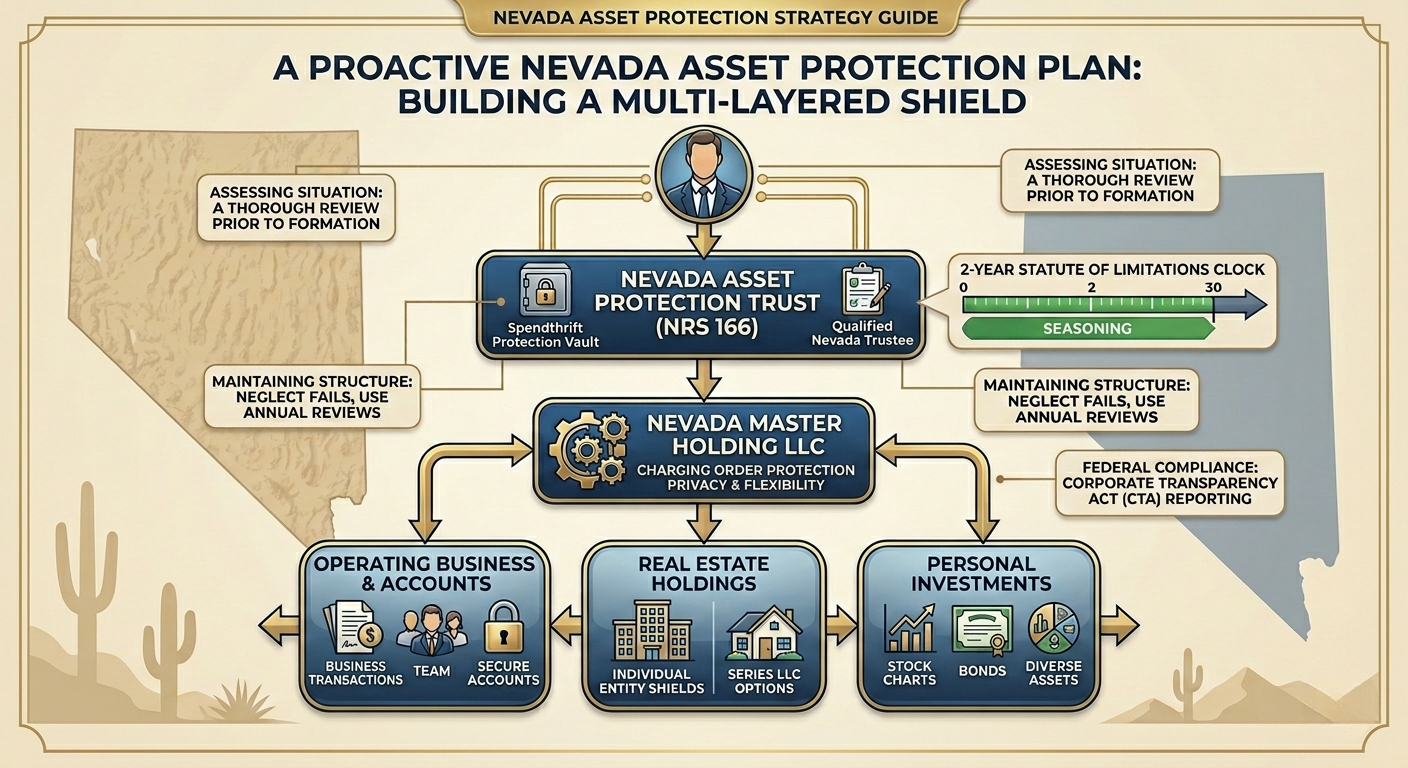

Guide: Nevada Asset Protection
A Nevada asset protection plan, built correctly and maintained properly, provides meaningful protection for business owners, investors, and professionals who face real legal and creditor risks. This guide walks through how these structures are built in practice, what decisions need to be made along the way, and what separates plans that hold up from those that do not.
The starting point is always a realistic assessment of what you own, what risks you face, and what you are trying to accomplish. Nevada offers strong tools, but those tools serve a purpose, and the structure should match the purpose.
Assessing Your Situation
Before any entity is formed or any trust is established, a thorough review of the current situation is necessary. This includes how existing assets are titled, what entities are already in place and how they are maintained, what professional or business risks exist, and whether any claims or potential claims are already on the horizon.
That last point matters significantly. Transfers made after a claim has arisen or when a claim is reasonably foreseeable are subject to a challenge of fraudulent transfer. Nevada’s legal tools work best when they are put in place proactively, as part of ongoing planning rather than in response to an immediate threat. If a dispute is already active or clearly anticipated, the planning options narrow considerably, and the timing of any proposed transfers needs to be reviewed carefully.
Choosing the Right Structure
Nevada’s asset protection toolkit includes LLCs, corporations, and self-settled trusts. Most serious plans use more than one of these in combination, because each addresses a different dimension of the risk picture.
A Nevada LLC is typically used to hold operating business interests or investment assets. It provides limited liability for members, charging order protection against personal creditors, and a flexible management structure. The operating agreement defines how the entity functions, who has authority to act, and how distributions are handled. A well-drafted operating agreement is not optional; it is central to whether the entity functions as a real legal structure or just a piece of paper.
A Nevada asset protection trust is typically used to protect personal assets, including cash, securities, real estate, and other investments, over the long term while retaining some access as a discretionary beneficiary. The trust requires a qualified Nevada trustee, an irrevocable trust agreement that complies with Nevada’s DAPT statute, and a transfer of assets completed before any claims arise during the seasoning period.
Forming and Documenting the Entities
Formation documents for Nevada LLCs are filed with the Nevada Secretary of State and are straightforward. The Articles of Organization identify the registered agent and the organizer; members and managers need not be publicly listed. Annual fees are modest compared to many other states.
The real work is in the operating agreement. This document should address membership interests, management authority, voting rights, distribution policy, transfer restrictions, and what happens if a member becomes subject to a charging order or other creditor action. A generic template will not accomplish this. The operating agreement needs to reflect the actual situation of the entity and its members.
For a Nevada DAPT, the trust agreement is the central document. It must comply with Chapter 166 of the Nevada Revised Statutes, designate a qualified Nevada trustee, include appropriate spendthrift provisions, and define the settlor’s retained rights in a way that does not undermine the protection. The trust is irrevocable once established, which means the drafting needs to be thorough and deliberate from the outset.
Maintaining the Structure
One of the most common reasons asset protection structures fail is neglect. An LLC that fails to pay its annual fees loses good standing and may be administratively dissolved, thereby eliminating its protective function. An entity that commingles personal and business funds, that fails to document significant decisions, or that is not operated as a genuinely separate legal entity provides much weaker protection than one that is run correctly.
For a Nevada DAPT, the ongoing administration requirements include keeping the trustee properly appointed, maintaining trust records, and ensuring that any additions to the trust are properly documented and timed. The trust does not manage itself, and a trustee who is not actively engaged in its administration is problematic.
Annual reviews of the overall structure are a sound practice. Circumstances change, ownership interests change, and the structure that made sense three years ago may need adjustment today. Treating the plan as a living document rather than a one-time event is what keeps it effective.
Federal Compliance
No discussion of Nevada asset protection is complete without addressing federal obligations. The Corporate Transparency Act requires most Nevada LLCs and corporations to report their beneficial owners to FinCEN. This federal obligation exists alongside any privacy protections provided by Nevada state law, and compliance is not optional.
Tax obligations also depend on the full picture. A Nevada entity owned by a resident of another state may trigger tax obligations in that state depending on the entity’s activities and the applicable nexus rules. Working with a tax advisor who understands multi-state issues is part of the process, not an afterthought.
What to Expect
A properly built Nevada asset protection plan takes time, deliberate effort, and ongoing attention. It is not a quick filing or a single conversation. The plans that work are those in which the principals understand what they have built, why it is structured as it is, and what their ongoing obligations are.
Nevada provides a genuine legal advantage for serious asset protection planning. The jurisdiction has the statutes, the legal infrastructure, and the track record to support sophisticated work in this area. What you bring to it, in terms of proper implementation and ongoing maintenance, determines what you get out of it.
Disclosure: The information in this article reflects general structural principles and practical observations from consulting experience and is provided for educational purposes only. It should not be interpreted as individualized legal or tax advice.