
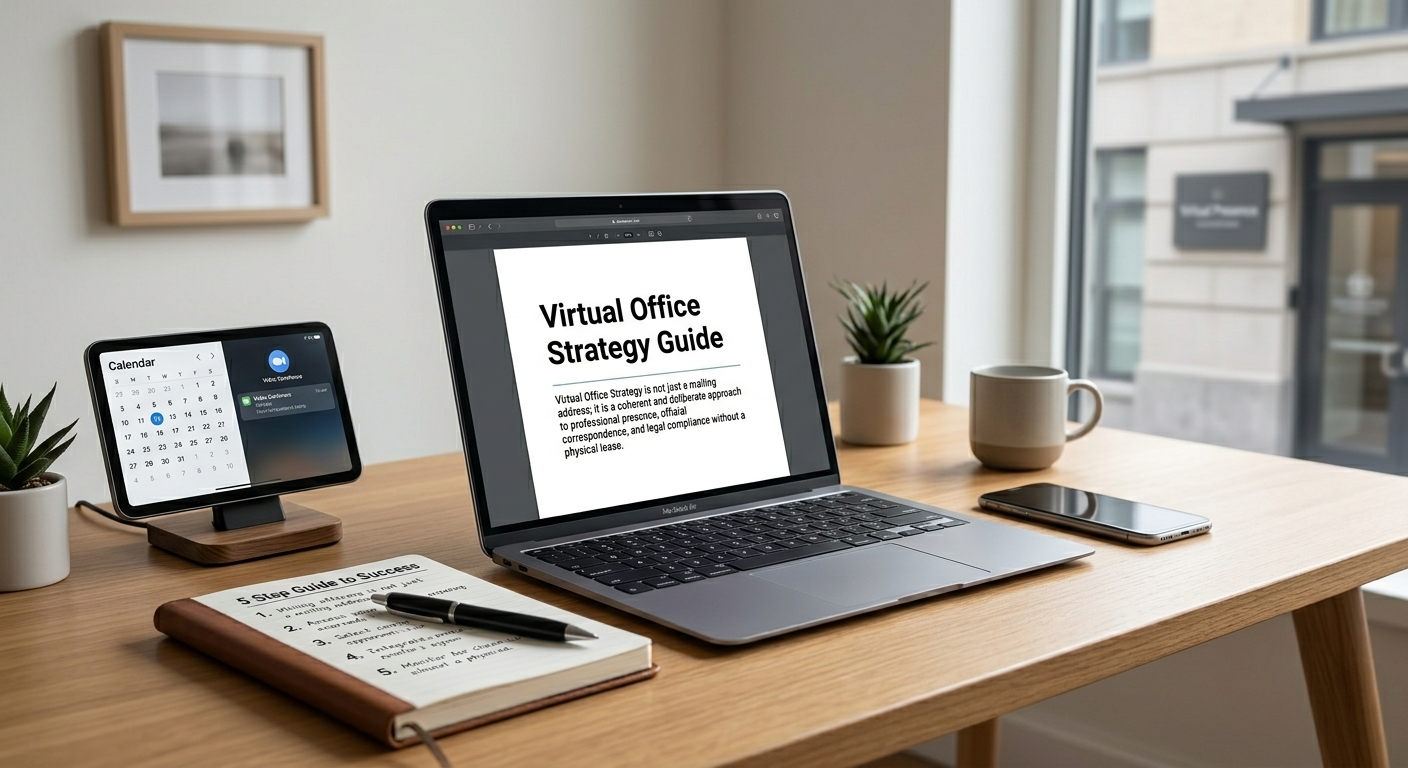

Guide: Virtual Office Strategy
A virtual office strategy is not simply a decision to use a mailing address service. It is a deliberate approach to how a business maintains its professional presence, manages its official correspondence, meets its legal address requirements, and positions itself to clients and counterparties without committing to a physical lease. Done well, it is coherent and efficient. Done poorly, it creates gaps that accumulate into compliance problems and credibility issues.
This guide walks through how to think strategically about virtual office services, select the right components, and integrate them into a well-structured business.
Start with What You Actually Need
The first step in developing a virtual office strategy is an honest assessment of which functions a physical office would serve for your business and which you need. Not every business operating without a physical office has the same needs, and the right virtual office arrangement should reflect the specific requirements of your situation.
A solo consultant who works entirely remotely and rarely meets clients in person has different needs than a small professional services firm that occasionally hosts client meetings but does not need a full-time office. A business registered in multiple states has different compliance considerations than one registered in a single state. An e-commerce operation with no physical retail presence has different address and credibility considerations than a business in a field where clients expect a recognizable street address.
Start by listing the specific functions you need: a professional address for public-facing use, a reliable mailing address for official correspondence, occasional access to meeting space, phone answering services, or some combination of these. That list becomes the basis for evaluating providers and structuring the arrangement.
Address Selection
The location of your virtual office address matters more than it might initially seem. A commercial address in a recognized professional building or business district carries more credibility than one in an industrial area or a location not clearly associated with professional services.
For businesses serving clients in a specific metropolitan market, an address in a recognized part of that city is a meaningful asset. For businesses that operate nationally, a recognized business district address in a major city may carry more weight than a less recognized location, depending on the industry and client base.
If you are registered to do business in a state where you do not have a physical office, a virtual office address in that state provides the commercial address you need for state filings, correspondence, and professional credibility in that market. This is a common and legitimate use of virtual office services for businesses that are properly registered in multiple states.
Confirm that the address you select is an actual street address, not a suite designation at a post office or mailbox store, and that it is accepted for the specific uses you intend. Banks, state agencies, and licensing bodies each have their own requirements, and a provider that is clear about the nature of the address and its suitability for various purposes is preferable to one that is vague on these points.
Mail Handling Configuration
Once you have selected a provider and an address, carefully configure the mail-handling arrangement. Decide how you want mail delivered: forwarding only, scanning only, or a combination where routine mail is forwarded on a regular schedule and items that appear to be official or time-sensitive are scanned and transmitted immediately.
Provide the provider with clear guidance on categorizing mail. Official government correspondence, legal notices, financial institution mail, and any items marked urgent should trigger immediate notification and same-day scanning. Routine correspondence and marketing mail can be handled on a standard schedule.
Designate a specific contact or email address for mail notifications and ensure that the contact is actively monitored. If the designated contact changes, update the provider promptly. The mail-handling chain is only as reliable as its weakest link, and an unmonitored notification address is a significant weak link.
Separating Registered Agent Service from Business Address Service
If your virtual office address is also intended to serve as your registered agent address for state registration purposes, confirm that the provider offers genuine registered agent service and not merely a mailing address. These are legally distinct functions, and the provider needs to be properly qualified to serve as a registered agent in each relevant state.
A provider that offers both virtual office address service and registered agent service through a single engagement can simplify your compliance structure. You have one provider managing both the general business address and the official registered agent function, with clear accountability for both. If you use separate providers for these functions, make sure both are properly configured and that you have documented which address is used for which purpose in each state.
Multi-State Considerations
For businesses registered in multiple states, a virtual office strategy needs to account for each state’s requirements separately. Each state where you are registered may require a principal business address and a registered agent address. The virtual office address can typically serve as the principal business address in each state where the provider has a location. Still, registered agent requirements must be met by a properly qualified registered agent in each state.
Using a corporate compliance service that manages state registrations alongside your virtual office arrangement creates a more integrated approach to multi-state compliance. Rather than tracking address requirements and registered agent appointments separately across multiple states, a coordinated service provides a complete view. It alerts you to renewal deadlines, filing requirements, and any changes in state requirements that affect your registrations.
Meeting Space and Occasional Physical Presence
If your virtual office strategy includes access to meeting space, establish in advance how that access works and what it costs. Some providers include a set number of meeting room hours per month in the base fee; others charge separately for each reservation. Understand the booking process, cancellation policies, and typical room availability at the specific location you intend to use.
For client-facing meetings, visit the meeting space before you schedule a client there. The quality and professionalism of the physical environment reflect your business, and a conference room that looks dated or poorly maintained or is in an awkward part of a building is not an asset. If the in-person meeting space matters to your client relationships, make sure you have evaluated what you will use for it.
Integrating Virtual Office Services into Your Overall Business Structure
A virtual office arrangement works best when it is deliberately integrated into the broader structure of how the business operates and presents itself. The address should be consistent across all public-facing materials, official registrations, and correspondence. Mail-handling protocols should be documented and understood by anyone in the business who handles official correspondence. The registered agent function, if handled separately, should be clearly assigned with no ambiguity about who is responsible for it in each state.
Periodic review of the arrangement is also worthwhile. Providers change their service offerings, locations, and pricing. As a business grows or its geographic footprint changes, the virtual office strategy that made sense at the start may need to be updated. A business that has expanded into several new states, for example, may need to add virtual office locations or update its registered agent appointments to reflect the current scope of its operations.
The virtual office strategy is, at its core, a practical solution to a practical problem: how to maintain a business’s professional presence and compliance infrastructure without the overhead of physical office space. The businesses that use it most effectively are those that approach it deliberately, configure it carefully, and maintain it as consistently as they would any other operational system.
Disclosure: The information in this article reflects general structural principles and practical observations from consulting experience and is provided for educational purposes only. It should not be interpreted as individualized legal or tax advice.
Expand your knowledge of asset protection, business planning, taxation, and private trusts. Explore the available books on Amazon.