
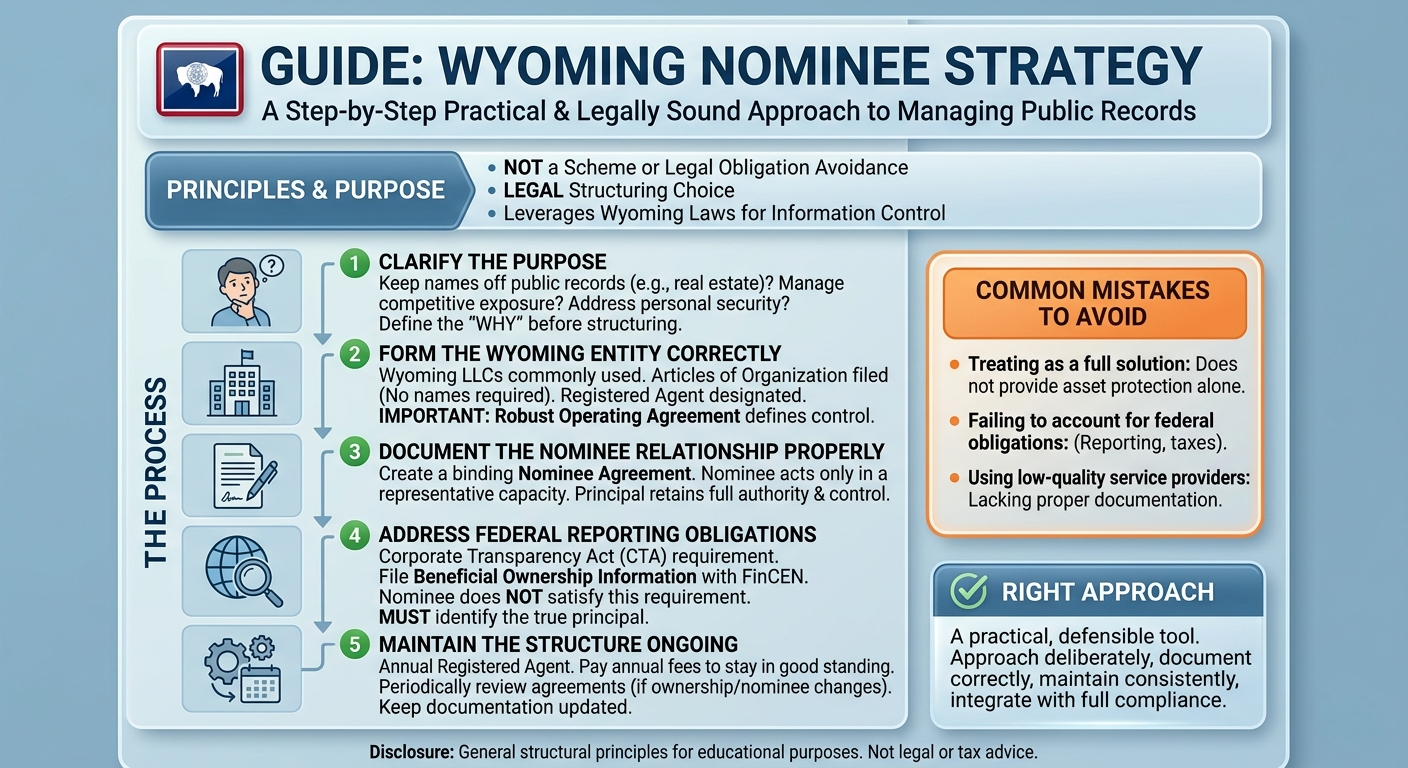

Guide: Wyoming Nominee Strategy
A Wyoming nominee strategy, when properly structured, is a straightforward and legally sound approach to managing what is publicly available in business records. It is not a scheme, and it is not a way to avoid legal obligations. It is a structuring choice that leverages Wyoming’s favorable business laws to give principals appropriate control over their public information footprint.
This guide walks through the practical elements of building a Wyoming nominee strategy, including what it involves, what it requires to function properly, and where people commonly go wrong.
Step One: Clarify the Purpose
Before putting any nominee arrangement in place, the purpose needs to be clear. Are you trying to keep your name off a public real estate record before a transaction closes? Are you managing competitive exposure in a business context? Are you addressing a personal security concern? Each of these is a legitimate reason, and the answer shapes how the arrangement should be structured.
If the purpose is not clearly defined, it is difficult to evaluate whether a nominee arrangement is the right tool or whether something else, such as a trust, a holding company, or simply a different ownership structure, would serve better. Clarity of purpose is the starting point for any serious conversation about structuring.
Step Two: Form the Wyoming Entity Correctly
Wyoming LLCs are the most common vehicle for nominee strategies in the state. The formation process is straightforward; the Articles of Organization are filed with the Wyoming Secretary of State, and a registered agent with a Wyoming address must be designated. The Articles do not require member or manager names to be listed, which is part of what makes Wyoming attractive.
The operating agreement is where the real work happens. This document should define the membership interests, the management structure, and the decision-making authority within the entity. If a nominee manager is used, the operating agreement should accurately reflect the nominee’s role, and the separate nominee agreement should establish the full scope of the principal’s authority over the nominee’s actions.
Step Three: Document the Nominee Relationship Properly
The nominee agreement is the legal document that governs the arrangement. It establishes that the nominee is acting in a representative capacity, not as an independent decision maker. It should specify that the nominee will follow the directions of the principal, that the nominee will not take any action on behalf of the entity without authorization, and that the beneficial ownership and control of the entity remain with the principal.
This documentation is not optional for legal coherence. Courts and regulators who examine a nominee arrangement will look at the underlying agreements. A nominee relationship that is not documented in writing is difficult to defend and creates ambiguity about who actually controls the entity.
Step Four: Address Federal Reporting Obligations
The Corporate Transparency Act requires most Wyoming LLCs and corporations to file beneficial ownership information with the Financial Crimes Enforcement Network. This filing identifies the individuals who own or control the entity, using specific criteria set out in the regulations. A nominee does not satisfy this requirement in place of the actual beneficial owner.
The beneficial ownership report must identify the true principal, the individual who actually owns or controls the entity, regardless of what the public state record shows. Understanding this requirement and building it into the compliance plan from the beginning avoids the kind of oversight that can create serious legal exposure down the line.
Step Five: Maintain the Structure Ongoing
A Wyoming nominee strategy is not a one-time filing. The entity needs to maintain its annual registered agent and pay its annual fees to stay in good standing with the Wyoming Secretary of State. The operating agreement and nominee agreement should be reviewed periodically to ensure they accurately reflect the current arrangement. If ownership changes, if the nominee changes, or if the entity’s activities change materially, the documentation needs to be updated.
Entities that fall out of good standing or that have outdated documentation create unnecessary vulnerability. The administrative requirements in Wyoming are minimal compared to most states, but they still require attention.
Common Mistakes to Avoid
The most common mistake is treating the nominee arrangement as a complete solution rather than one component of a broader structure. A nominee in a Wyoming LLC does not provide asset protection on its own; the LLC’s operating agreement, proper capitalization, and separation from personal finances also matter.
A second common mistake is failing to account for federal obligations. The privacy benefits of Wyoming state law exist within a federal legal framework that includes reporting requirements, tax obligations, and potential legal processes. Ignoring the federal layer does not make it go away.
A third mistake is using nominee services through providers who do not properly document the underlying relationships or who treat the nominee arrangement as a product rather than a legal structure. The documentation is what gives the arrangement its legal standing, and shortcuts in that area create problems that may only become visible when something goes wrong.
The Right Approach
A Wyoming nominee strategy, done properly, is a practical and defensible tool. It takes advantage of a jurisdiction that has deliberately structured its business laws to support privacy-oriented structuring while remaining within the bounds of applicable legal obligations. The principals who benefit most from these arrangements are those who approach them deliberately, document them correctly, maintain them consistently, and integrate them in full compliance with federal requirements.
Wyoming provides an excellent platform for this work. The results depend on how carefully that platform is used.
Disclosure: The information in this article reflects general structural principles and practical observations from consulting experience and is provided for educational purposes only. It should not be interpreted as individualized legal or tax advice.