
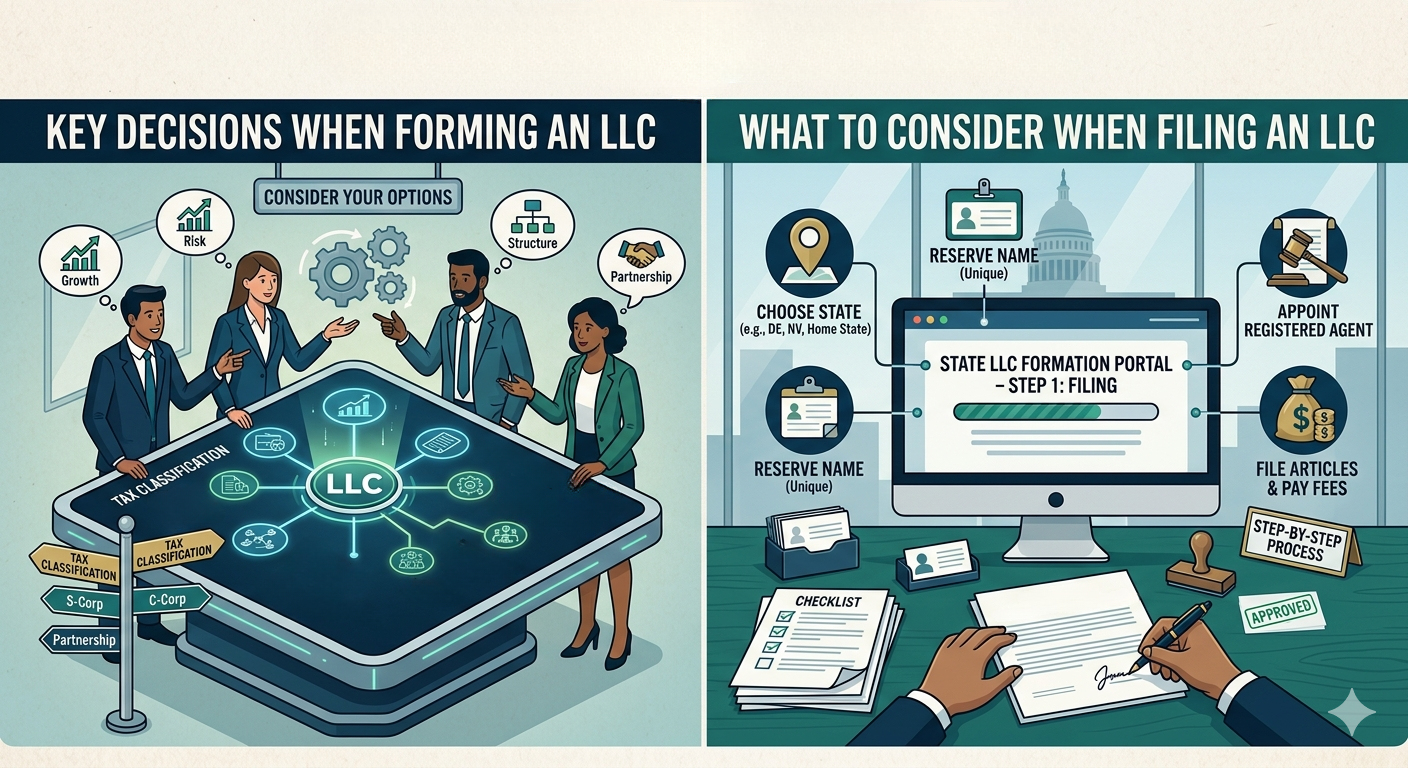

Key Decisions When Forming an LLC
By Michael Freeman | Acacia Business Solutions
The actual filing to form an LLC is, in most states, a relatively simple document. What is not simple are the decisions that happen before and alongside that filing. Those decisions determine whether the entity you create serves your goals or whether it is just a name on a state registration that creates a false sense of protection.
There are several points in the LLC setup process where the choices you make have lasting consequences. Understanding them up front is worth considerably more than fixing them later.
Choosing the Right State
The state where you form your LLC is the state whose laws will govern the entity. If you operate a business that is physically based in one state but formed in another, you will typically need to register as a foreign LLC in your home state anyway. That means paying fees in both states and maintaining compliance in both.
For businesses that operate nationally, online, or across multiple states, the selection of a formation state is a real strategic question. Wyoming and Delaware are popular choices for specific reasons, including strong asset protection statutes and favorable legal precedents. But the right answer depends on your operating model, the number of members, and your long-term plans for the entity. This is one of the first conversations worth having with a business formation services provider before the paperwork starts.
Selecting a Registered Agent
Every LLC is required to designate a registered agent in the state of formation. The registered agent is the entity or individual that receives official legal correspondence on behalf of the LLC, including service of process if the business is sued, tax notices, and state compliance documents.
Using a professional registered agent service matters for a few reasons. It keeps a consistent address on record even if your business moves. It ensures someone is actually available to receive legal documents during business hours. And it provides a layer of separation between your personal address and your public business registration. Acacia Business Solutions provides registered agent services that keep this function handled correctly and continuously, which is more important than it sounds when legal correspondence arrives unexpectedly.
The Operating Agreement
The operating agreement is the governing document of the LLC. It defines who owns the entity, what percentage each member holds, how decisions are made, how profits and losses are distributed, and what happens when a member wants to exit or when the business needs to be dissolved. In most states, an operating agreement is not legally required, but the absence of one is almost always a mistake.
Without an operating agreement, your LLC operates under your state’s default rules. Those defaults may not match your intentions, especially in multi-member situations. If two members each hold 50 percent and they disagree on a major decision, the absence of a clear decision-making process in the operating agreement creates a deadlock with no built-in resolution mechanism.
A properly drafted operating agreement also supports the liability protection the entity is supposed to provide. It demonstrates that LLC is being operated as a real, separate business rather than as an extension of its owners. Acacia Business Solutions includes operating agreement services as part of a complete formation package precisely because this document is too important to skip.
Obtaining an EIN
The Employer Identification Number is the federal tax identification number for the business. Even if the LLC has no employees, the EIN is necessary to open a business bank account, apply for business credit, and establish the entity as a recognized taxpayer separate from its owners.
EIN services handle the filing with the IRS to obtain this number. For foreign nationals or non-residents forming a U.S. LLC, obtaining an EIN requires additional steps since the online IRS application is restricted. Getting this handled correctly at the time of formation, rather than scrambling for it when a bank requires it, keeps the process moving without unnecessary delays.
Tax Classification
As mentioned, an LLC is not itself a tax classification. By default, a single-member LLC is treated as a disregarded entity, and a multi-member LLC is treated as a partnership. Both can elect S corporation or C corporation status if the tax profile of those structures is more advantageous.
This decision should be made with an understanding of how you plan to compensate yourself, what your projected net income looks like, and how you intend to exit the business eventually. The formation stage is the right time to think about this, not year three, when the patterns are already set.
Business Banking and Separation
This is not a filing decision, but it belongs in this list because it is the step that completes the formation. Opening a dedicated business bank account immediately after the LLC is formed, and using it exclusively for business transactions, is what makes the liability separation real in practice.
Courts evaluating whether to pierce the corporate veil look at whether the business was operated as a genuinely separate entity. A business that keeps its own accounts, maintains its own records, and operates with documented procedures is far harder to challenge than one where the owner runs everything through a personal account and pays business expenses with a personal card.
Business formation services set the structure up correctly. The behavior that follows determines whether that structure holds.
The information in this article reflects general structural principles and practical observations from consulting experience and is provided for educational purposes only. It should not be interpreted as individualized legal or tax advice.
Expand your knowledge of asset protection, business planning, taxation, and private trusts. Explore the available books on Amazon.