

Privacy vs Ownership Explained
By Michael Freeman | Acacia Business Solutions
Privacy and ownership are two distinct legal concepts that are often conflated in discussions about business structuring and asset protection. That conflation leads to misunderstandings about what nominee services, holding entities, and privacy-friendly jurisdictions accomplish, and more importantly, what they do not accomplish. Separating the two concepts is essential to building a structure that is both effective and legally sound.
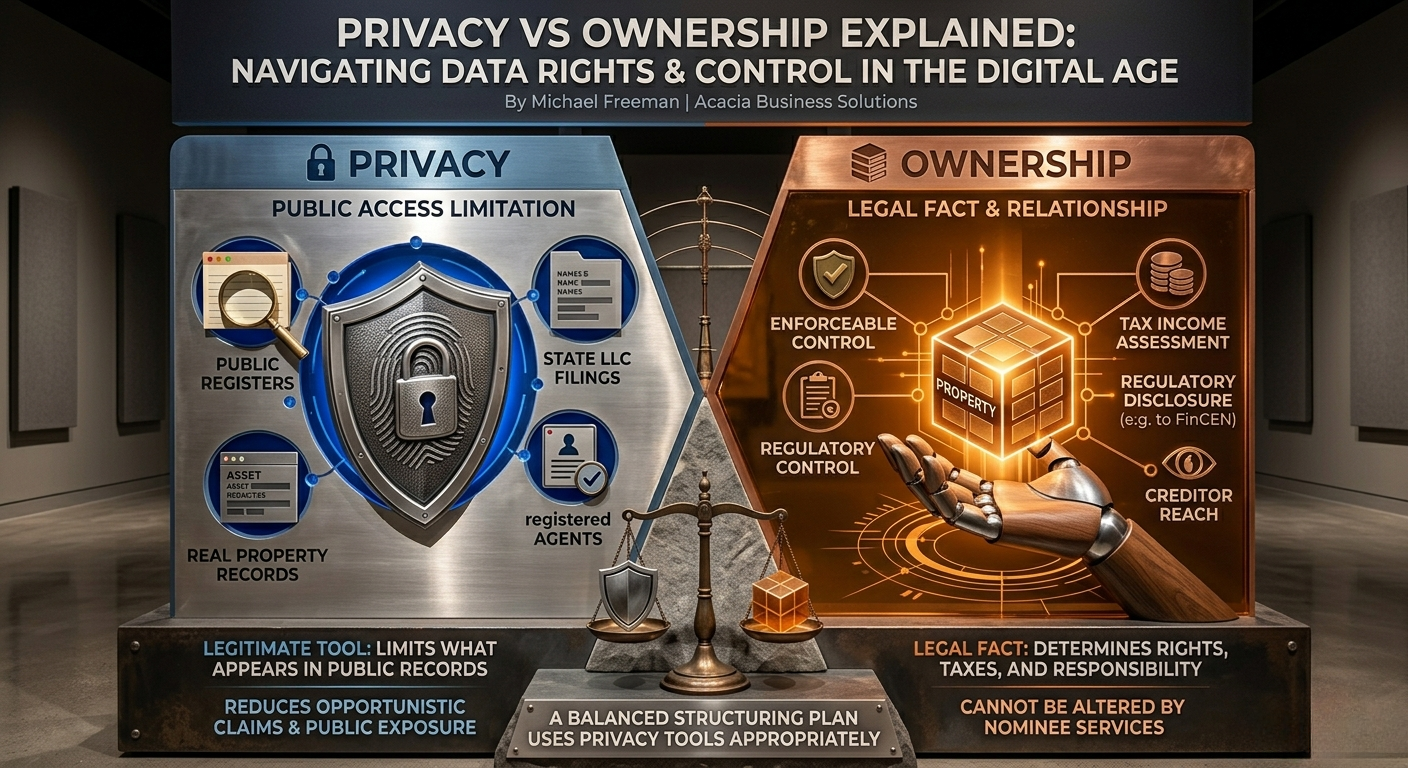
Ownership is the legal relationship between a person and an asset. It determines who has the enforceable right to control, transfer, encumber, and benefit from that asset. Ownership is what courts consider when evaluating creditor claims, what tax authorities consider when determining who is taxed on income, and what regulators consider when assessing control over a regulated entity. It is a legal fact, not a public relations matter.
Privacy, in the structuring context, refers to the degree to which ownership information appears in publicly accessible records. Public corporate registers, state LLC filings, real property records, and similar repositories contain information about entity formation, registered agents, directors, officers, and sometimes members. Privacy structuring is the practice of limiting what appears in those records, using legally available tools, without altering the underlying ownership relationships that are disclosed to relevant authorities.
Why Distinction Matters
The distinction between privacy and ownership matters because conflating them leads to structures that fail to accomplish either goal well. A business owner who uses nominee services, expecting those services to change who legally owns the assets, will find that, when a creditor or court scrutinizes the arrangement, the nominee structure has no effect on the ownership analysis. The beneficial owner is still the owner. The creditor can still reach the assets. The court can still compel disclosure.
Conversely, a business owner who dismisses privacy planning because they misunderstand it as a form of concealment may forego tools that serve a genuine and legitimate function: reducing unnecessary public exposure of ownership information, limiting the information available to opportunistic plaintiffs during the early stages of evaluating a claim, and separating the public face of a business from the private structure of its beneficial ownership.
Those are real benefits, within real limits. Understanding both is what allows a structuring plan to use privacy tools appropriately rather than over-relying on them or dismissing them altogether.
What Legitimate Privacy Structuring Accomplishes
In practical terms, legitimate privacy structuring reduces the information that appears in publicly searchable databases about ownership. When a real estate investor holds properties in LLCs whose managing member is a nominee, a public records search does not immediately connect those properties to the investor’s name. When a business owner’s name does not appear as a director or officer of an entity in a public corporate register, a casual search does not reveal that ownership connection.
This serves a real function in the context of litigation risk. A plaintiff’s attorney evaluating whether to pursue a claim against an individual will typically conduct a preliminary asset search. If that search reveals obvious, easily accessible assets, the calculus of the lawsuit changes. If the search is inconclusive because the assets are held in entities whose public records do not reveal the beneficial owner, the plaintiff’s attorney must weigh the cost of further investigation against the uncertainty of what will be found. That uncertainty does not eliminate the risk of litigation, but it can affect its economics.
Privacy structuring also serves a competitive function in some business contexts. An investor or operator who does not want competitors to identify their holdings through public records has a legitimate interest in limiting that exposure. A person in a position of public prominence who prefers to keep business activities separate from their public profile has a similar interest. These are recognized and legally permissible reasons to use privacy structuring tools.
What Privacy Structuring Does Not Accomplish
Privacy structuring does not change the legal ownership of assets for purposes of creditor claims. A judgment creditor who obtains the right to collect from an individual’s assets is entitled to pursue those assets regardless of how the public record characterizes the ownership. If the beneficial owner is the true owner under a nominee arrangement, those assets are reachable. The nominee is a record-keeping convenience, not a legal transfer of ownership.
This is where the interaction between privacy structuring and genuine asset protection structures becomes important. To protect assets from creditor claims, the assets need to be held in a structure in which legal ownership has genuinely changed, such as an irrevocable trust or a properly structured entity in which the beneficial owner’s interest is limited by the entity’s operating terms and applicable state law. Nominee arrangements alone do not accomplish that.
Privacy structuring also does not eliminate disclosure obligations to relevant authorities. The Corporate Transparency Act’s beneficial ownership reporting requirement means that the actual beneficial owners of most U.S. entities must be reported to the Financial Crimes Enforcement Network, regardless of who appears in state filing records. Tax reporting obligations require the beneficial owner of income to report and pay tax on it, regardless of nominee arrangements. Know-your-customer requirements at financial institutions mandate beneficial ownership disclosure regardless of whether it is publicly recorded.
Any planning that treats nominee structures as a means of avoiding these obligations is not planning. It is non-compliance with federal law, and the consequences of that non-compliance are considerably worse than whatever the arrangement was designed to prevent.
Ownership Structures That Combine Privacy and Protection
The most effective structures combine genuine separation of legal ownership with appropriate privacy tools, each serving its distinct function. An irrevocable trust, for example, genuinely transfers legal ownership of assets from the grantor to the trustee. The trust may be formed in a jurisdiction whose trust records are not publicly accessible. The trustee may be a professional trust company rather than an individual whose name is widely associated with the grantor. The combination provides both genuine asset protection through the ownership transfer and privacy through the structure’s limited public footprint.
An LLC holding structure can achieve something similar at the entity level. The LLC is formed with a nominee manager of record, and the actual beneficial ownership is documented privately through a nominee agreement and disclosed as required to the relevant authorities. The operating agreement governs the actual management authority. The entity is held within a trust or another holding entity, adding a further layer of protection and privacy.
Acacia Business Solutions structures these arrangements to serve both functions simultaneously, with the understanding that they are distinct functions requiring different legal tools. The privacy component determines what appears in the public record. The protection component determines what a creditor can reach. Neither substitute for the other, and a plan that uses only one has a gap.
The Beneficial Ownership Record
The concept of beneficial ownership has become significantly more prominent in recent years as anti-money-laundering frameworks have tightened globally. The Financial Action Task Force, the international body that sets anti-money-laundering standards, has urged member countries to require transparency of beneficial ownership, and most developed jurisdictions now have some form of beneficial ownership registry or reporting requirement.
For U.S. entities, the Corporate Transparency Act created a centralized beneficial ownership database maintained by the Financial Crimes Enforcement Network. The information in that database is not publicly accessible in the same way a state corporate register is, but it is accessible to law enforcement, certain financial institutions, and, in some circumstances, to other federal agencies. The reporting obligation is real, the penalties for noncompliance are significant, and nominee arrangements do not change who is required to be reported.
Understanding this framework is part of understanding what privacy structuring can and cannot deliver in the current regulatory environment. The tools available are real and useful. Their limits are also real, and a structuring plan that does not account for them is incomplete.
The information in this article reflects general structural principles and practical observations from consulting experience and is provided for educational purposes only. It should not be interpreted as individualized legal or tax advice.
Expand your knowledge of asset protection, business planning, taxation, and private trusts. Explore the available books on Amazon.