

The Role of Managers and Trustees in Business Structures
When people think about who runs a business, they usually think in terms of ownership. The owner runs it; that is the default assumption. It is also frequently inaccurate, particularly as business structures become more sophisticated. The people with actual decision-making authority in a well-structured business or holding arrangement are often managers or trustees whose role is defined by the governing documents and applicable law rather than by their economic stake.
Understanding what managers and trustees do, what authority they hold, and what obligations they carry is essential for anyone involved in structuring, operating, or advising on these arrangements.
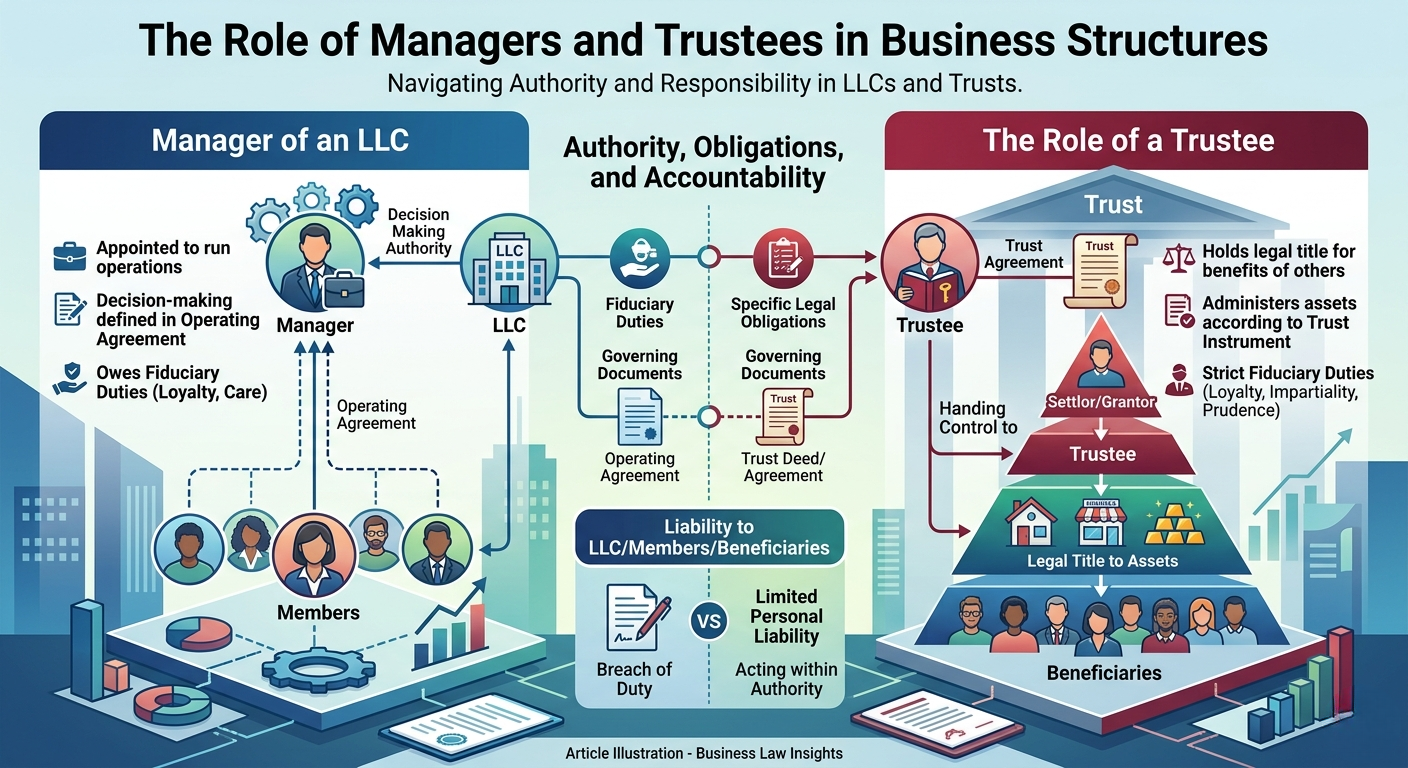
The Manager of the LLC
A manager-managed LLC is governed by one or more designated managers rather than by all of the members collectively. The operating agreement defines the scope of the manager’s authority: what decisions the manager can make unilaterally, what require member approval, and what procedural requirements apply to significant decisions.
Managers owe fiduciary duties to the LLC and its members, though the specific duties and the degree to which they can be modified by agreement vary by state. Most states recognize at least a duty of loyalty, which prohibits the manager from placing personal interests ahead of the LLC’s interests, and a duty of care, which requires the manager to act with reasonable diligence in managing the entity’s affairs. Some states also recognize an implied covenant of good faith and fair dealing.
The manager does not need to be a member of the LLC. An outside professional, a family office, a corporate entity, or an institutional manager can serve as the managing member or non-member manager of an LLC. This flexibility is one of the reasons the LLC structure is so useful in holding arrangements, real estate structures, and family wealth management contexts. The management function can be placed with whoever is best positioned to exercise it, regardless of where the economic interest lies.
In practice, the manager’s role should be clearly documented. Decision-making authority should be defined specifically rather than described in general terms. The operating agreement should address succession in the manager’s role, including what happens if the manager dies, becomes incapacitated, resigns, or is removed. Vagueness in these provisions is a reliable source of future disputes.
The Trustee in a Trust Structure
The trustee holds a more formalized and legally demanding role than a corporate manager in most respects. The trustee holds legal title to the trust assets and is responsible for managing them in accordance with the trust agreement and applicable trust law, which in most jurisdictions imposes a comprehensive set of fiduciary duties that cannot be fully waived by agreement.
The core trustee duties include the duty of loyalty, which requires the trustee to administer the trust solely in the interest of the beneficiaries; the duty of prudence, which requires the trustee to manage trust assets with the care, skill, and caution of a prudent person in similar circumstances; the duty of impartiality among beneficiaries; the duty to keep adequate records; and the duty to keep trust assets segregated from the trustee’s personal assets. These duties are not merely aspirational; they carry personal liability for trustees who breach them.
The trustee also has administrative obligations: filing required tax returns for the trust, maintaining trust accounts, distributing income and principal in accordance with the trust agreement, communicating with beneficiaries as required by law and the trust agreement, and keeping beneficiaries reasonably informed about the trust’s administration and assets.
The selection of a trustee is one of the most consequential decisions in trust planning. An individual trustee, whether a family member, a friend, or a professional, carries personal liability for breaches of fiduciary duty. An institutional trustee, such as a bank trust department or a professional trust company, brings professional expertise, fiduciary accountability, and continuity, but typically entails ongoing fees and may not provide the personal knowledge of the family and its circumstances that an individual trustee would.
Many trust structures use a combination: a professional or institutional co-trustee for investment management and administrative accountability, alongside an individual trustee or trust protector with authority over discretionary distribution decisions that require knowledge of the beneficiaries’ circumstances. This division of responsibility can produce better outcomes than placing all trustee functions with a single party.
The Trust Protector
A trust protector is a role that appears in many modern trust agreements, particularly in irrevocable trust structures. The trust protector holds limited powers defined by the trust agreement, typically including the authority to remove and replace trustees, modify the trust to account for changes in law, and, in some cases, expand or limit the trustee’s powers or the beneficial interests. The trust protector does not manage the trust assets or serve as a trustee, but their powers can be significant.
The trust protector role is a useful mechanism for building flexibility into irrevocable trusts that must remain effective over long periods. Tax laws change, family circumstances change, and the trustee originally named may no longer be the right choice years later. A well-defined trust protector with appropriate powers can address these situations without requiring a court modification of the trust.
Managers and Trustees Acting Together
In many sophisticated holding structures, trusts own interests in LLCs or other business entities, and the trust’s trustee also serves as the LLC’s manager, or the entities are managed by related parties operating under a coordinated governance framework. These arrangements can be highly effective, but they require careful attention to the distinct roles and obligations involved.
The trustee acting as manager of an LLC owned by the trust is subject to both the fiduciary duties applicable to trustees and the duties applicable to LLC managers under the operating agreement and state law. Decisions that benefit the LLC manager’s interests at the expense of the trust beneficiaries may constitute a breach of the trustee’s fiduciary duty even if they are technically within the manager’s authority under the operating agreement. The two roles create overlapping obligations that must be navigated carefully.
This is not a reason to avoid these structures; it is a reason to design them thoughtfully, with explicit attention to how conflicts of interest are identified and managed, and with governance documents that clearly address the intersection of the two roles.
Disclosure: The information in this article reflects general structural principles and practical observations from consulting experience and is provided for educational purposes only. It should not be interpreted as individualized legal or tax advice.
Expand your knowledge of asset protection, business planning, taxation, and private trusts. Explore the available books on Amazon.