

What Foreign Qualification Means
By Michael Freeman | Acacia Business Solutions
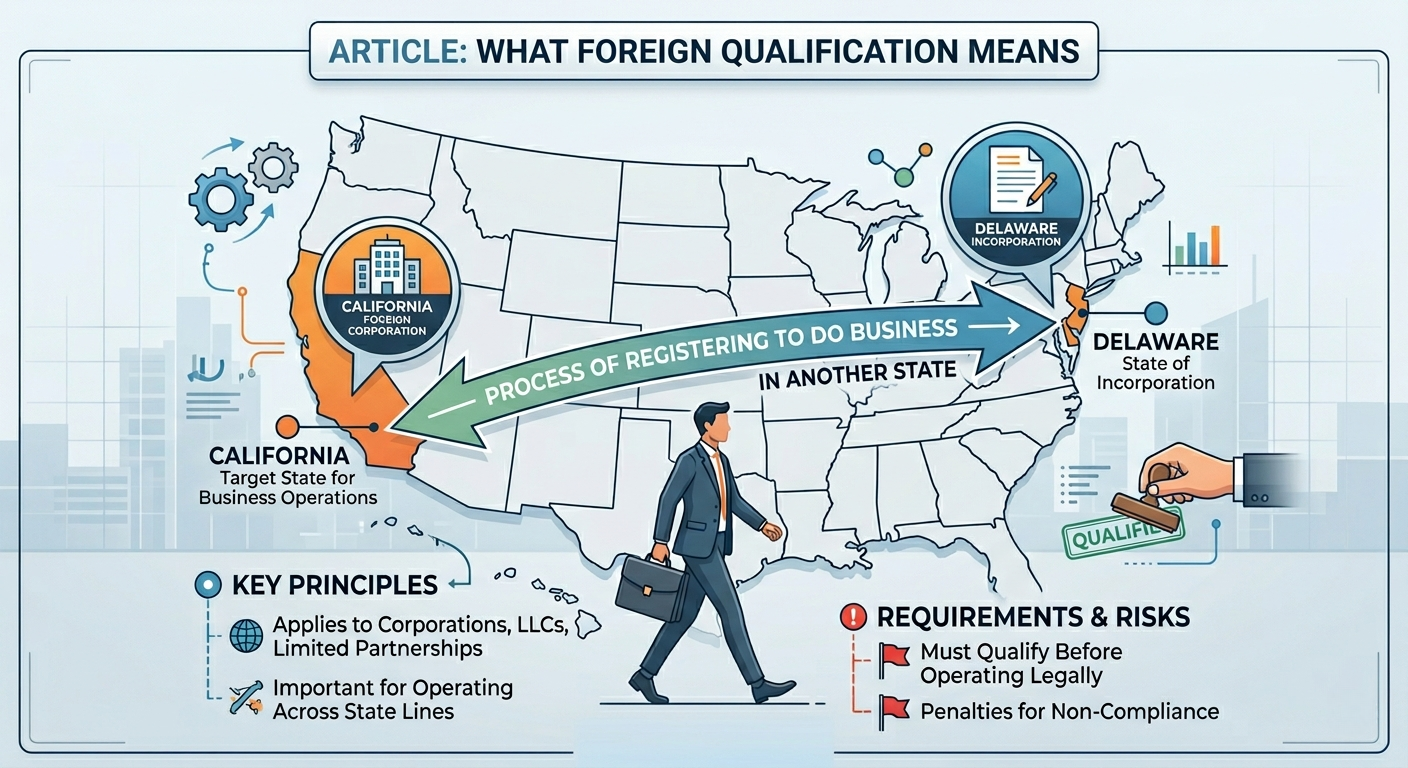
The phrase foreign qualification has nothing to do with operating internationally. In the context of U.S. business law, it refers to the process by which a business entity that was formed in one state registers to do business in another state. A corporation incorporated in Delaware that conducts business in California is a foreign corporation in California and must qualify to do business there before it can legally operate in that state. The same principle applies to LLCs, limited partnerships, and other business entities.
Understanding what a foreign qualification actually involves, when it is required, and what happens when it is not done properly is important for any business that operates or intends to operate across state lines.
The Domestic and Foreign Distinction
Every business entity is formed under the laws of a particular state. That state is the home state, and the entity is considered a domestic entity there. In every other state, the same entity is treated as a foreign entity. This is purely a legal classification based on where the entity was formed; it has nothing to do with the nature of the business or whether the entity has any connection to another country.
A Wyoming LLC doing business in Texas is a foreign LLC in Texas. An Ohio corporation expanding into Florida is a foreign corporation in Florida. The entity’s legal existence derives from its home state, but its authority to conduct business in another state derives from that state’s registration process, which is what foreign qualification refers to.
When Foreign Qualification Is Required
The threshold question is what it means to be doing business in a state. This is where business owners and advisors frequently run into difficulty, because the answer is not a bright line. Every state has a statutory definition of what constitutes doing business for purposes of its foreign qualification requirement, and those definitions vary. Most state statutes also include a list of activities that do not constitute doing business, and those exclusions provide some guidance.
Activities that generally do not trigger a foreign qualification requirement include maintaining bank accounts in the state, defending a lawsuit there, holding occasional meetings, making sales through independent contractors without a fixed presence, and shipping goods into the state from outside the state. Activities that generally trigger the requirement include maintaining a physical office or place of business, having employees regularly working in the state, holding real property there, and regularly soliciting or conducting business with in-state customers through a fixed presence.
The difficulty is that many businesses fall into the middle ground where the activities do not clearly fit into either category. A technology company with remote employees working from their homes in multiple states, a consulting firm with consultants who regularly travel to client sites in different states, a service business that has opened a satellite office in a new market without formally registering there: these situations require a judgment call about whether the activities constitute doing business for foreign qualification purposes, and the answer may differ from state to state.
When there is genuine uncertainty, erring on the side of registering is generally the more defensible choice. The cost of a foreign qualification is modest relative to the consequences of failing to qualify when required.
The Consequences of Failing to Qualify
The consequences of conducting business in a state without the required foreign qualification registration vary by state but are consistently meaningful. The most common penalty is the denial of access to the state’s courts: a foreign entity that has not qualified to do business in a state may be barred from filing a lawsuit or maintaining legal proceedings in that state’s courts until it registers and pays any outstanding fees and penalties. This can be a significant practical problem if the business needs to pursue a contract claim, collect a debt, or enforce its rights against a party in that state.
States also impose monetary penalties for operating without required registration, and those penalties can accumulate over the period during which the business was operating without registration. In some states, officers, directors, or members of the entity may be held personally liable for contracts entered into on the entity’s behalf while it was conducting business without the required registration.
Retroactive registration is possible in every state, but it requires paying all applicable fees, often including those for prior years, along with any assessed penalties. The longer the period of unregistered operation, the higher the cost of bringing the entity into compliance.
The Registration Process
Foreign qualification requires filing an application with the Secretary of State or equivalent agency in each state where the entity intends to do business. The application typically requires: the entity’s legal name and its jurisdiction of formation; a certificate of good standing or similar document from the home state, confirming that the entity is in good standing there; the name and address of the entity’s registered agent in the new state; the entity’s principal office address; and basic information about the entity’s structure, such as its management type for an LLC.
Processing times vary by state, from a few days to several weeks. Some states offer expedited processing for an additional fee. Once the application is approved, the entity receives a certificate of authority or similar document confirming that it is authorized to do business in that state. The entity then has ongoing compliance obligations in the foreign state, including maintaining a registered agent, filing annual reports, and paying applicable fees, just as it does in its home state.
The foreign qualification process is not complicated, but it requires attention to each state’s specific requirements, timely filing, and follow-through on the ongoing compliance obligations that follow registration. A formation and compliance service that handles foreign qualification filings in multiple states can considerably simplify the process for businesses expanding into new markets.
Disclosure: The information in this article reflects general structural principles and practical observations from consulting experience and is provided for educational purposes only. It should not be interpreted as individualized legal or tax advice.
Expand your knowledge of asset protection, business planning, taxation, and private trusts. Explore the available books on Amazon.