

What LLC Formation Really Means
When someone asks me how to form an LLC, the conversation rarely starts where it should. Most people come in focused on the paperwork, the filing fees, and the turnaround time. Those things matter, but they are downstream of a more important question: what are you trying to accomplish, and is LLC formation the right structure to get you there?
LLC formation is not a transaction. It is a structural decision, and understanding what it entails will save you from revisiting it at a much higher cost later.
The Legal Separation That Makes It Matter
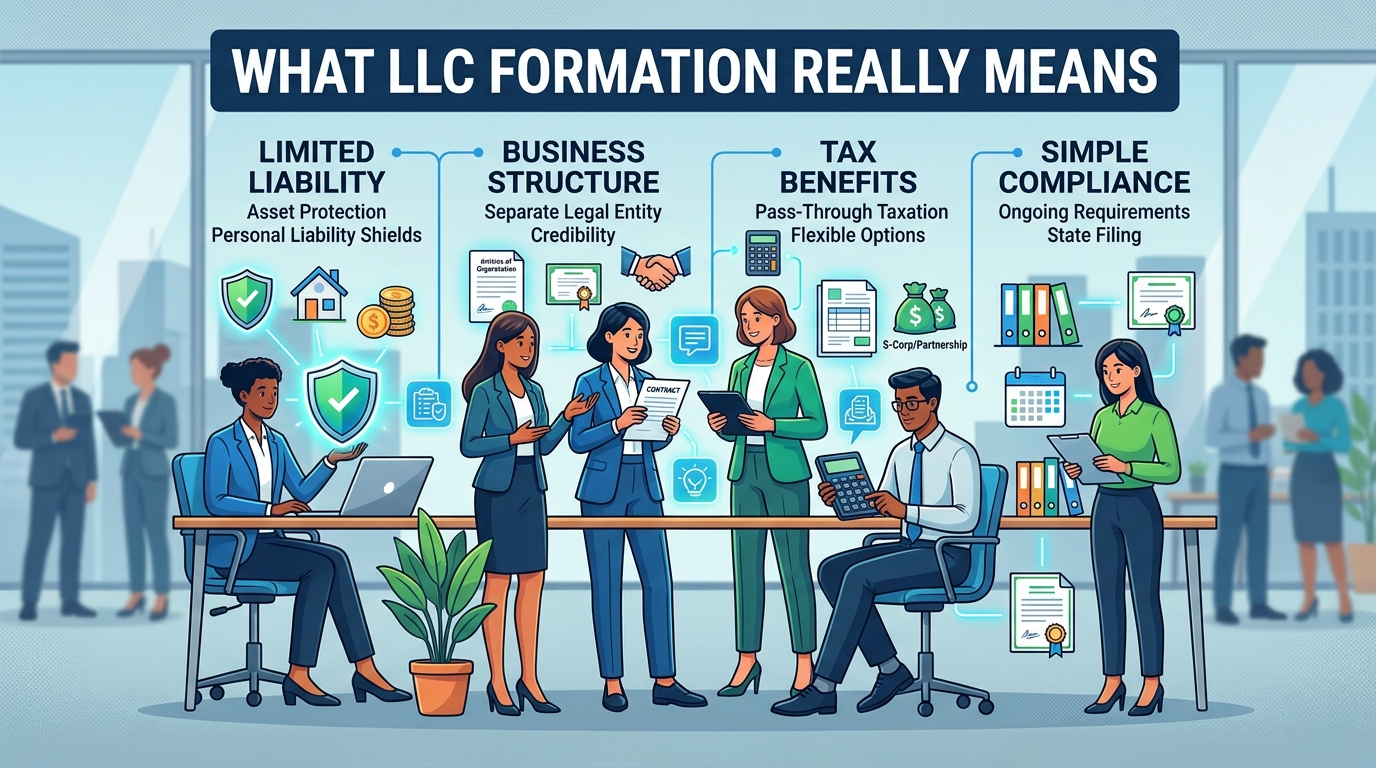
At its core, forming an LLC creates a legal boundary between you as an individual and the business you operate. That boundary is the source of what people commonly call liability protection. When an LLC is properly formed and maintained, debts and legal claims against the business generally cannot reach your personal assets, and personal liabilities generally cannot reach the business.
I say generally because that protection is not automatic or permanent. Courts have a doctrine called piercing the corporate veil, and it applies to LLCs just as it does to corporations. Commingling funds, failing to follow operating procedures, or treating the LLC as a personal account are all ways in which protection is stripped away. Proper LLC setup through a service like Acacia Business Solutions is a starting point, not a finish line.
The entity exists on paper when you file the articles of organization with your state. It exists in practice when you operate it correctly.
What Business Formation Services Actually Provide
There is real value in using professional business formation services to establish your LLC. The filing process involves selecting a registered agent, choosing the correct state, naming the entity in compliance with state requirements, and, in some cases, navigating publication requirements. These are not difficult steps, but errors here create problems that compound over time.
Acacia Business Solutions handles the formation process in a way that accounts for the downstream decisions, not just the immediate filing. That includes the registered agent service needed to receive legal correspondence on behalf of the entity, the operating agreement that defines how the business functions, and EIN services to establish the entity’s federal tax identity.
Each of these components connects to the others. An LLC without an operating agreement is an LLC operating on whatever default rules your state applies, which may not reflect your intentions at all. An LLC without an EIN cannot open a business bank account, which puts you right back into the commingling problem that undermines the liability protection you formed the entity to get.
State Selection and What It Actually Means
A lot of attention goes to state selection when people think about how to form an LLC. Delaware and Wyoming come up frequently, and there are legitimate reasons for that. Delaware has one of the most developed bodies of case law around business entities, and Wyoming offers strong charging order protections and relatively low fees.
But state selection decisions should be based on your actual situation. If you operate in California, forming in Wyoming still means registering as a foreign entity in California and paying California fees. The arbitrage is often smaller than it appears. For many small and mid-sized operations, forming in the state where you actually do business is the most efficient approach. A proper LLC setup consultation should address this question directly rather than defaulting to a generic recommendation.
The Tax Identity of the Entity
One thing that surprises people is that an LLC is not a tax classification. For federal income tax purposes, a single-member LLC is disregarded by default, meaning its income flows through to your individual return. A multi-member LLC is treated as a partnership by default. Either structure may elect to be taxed as an S corporation or a C corporation if that designation offers a better outcome.
This distinction matters for how you pay yourself, how you handle self-employment taxes, and how the business is eventually sold or transferred. It connects directly to EIN services and the way the entity is set up from the beginning. Getting this right at formation is considerably easier than correcting it after the fact.
Formation as a Foundation, not a Checkbox
The clients who get the most out of LLC formation are those who treat it as the beginning of a business structuring process rather than as a filing they need to complete. That means having the operating agreement reflect the actual ownership and management structure. It means maintaining a separate business account from day one. It means understanding what the registered agent service is doing on your behalf and keeping that relationship up to date.
Acacia Business Solutions approaches LLC formation from that perspective. The goal is not to file the paperwork. The goal is to establish a structure that does what you need it to do for as long as you need it to.
The information in this article reflects general structural principles and practical observations from consulting experience and is provided for educational purposes only. It should not be interpreted as individualized legal or tax advice.
Expand your knowledge of asset protection, business planning, taxation, and private trusts. Explore the available books on Amazon.