

What Self-Directed Pension Plans Are
By Michael Freeman | Acacia
Most retirement accounts operate inside a narrow corridor. A brokerage selects the available funds, the custodian sets the rules, and the account holder makes choices from the approved list. Self-directed pension structures work differently, and understanding that difference matters considerably for anyone managing serious retirement capital.
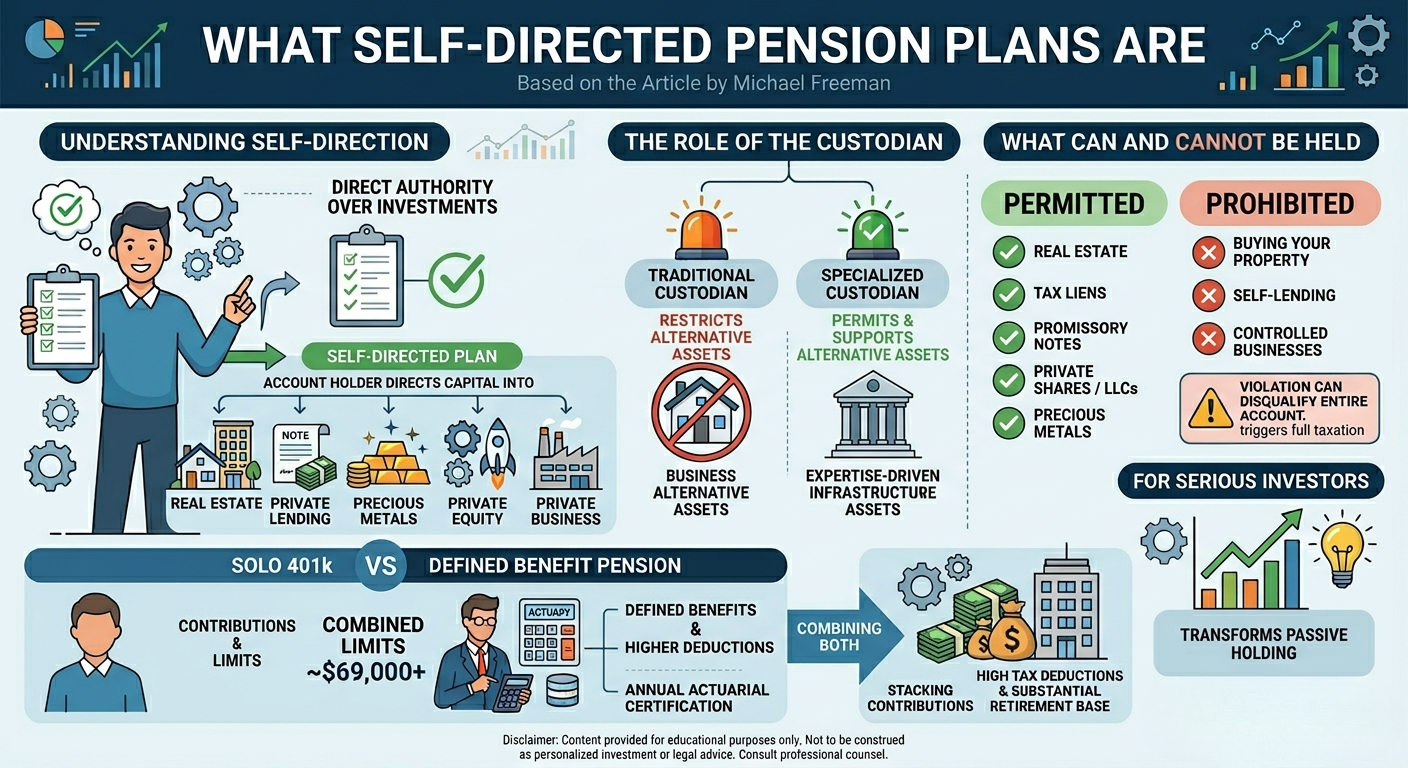
A self-directed pension plan, in its broadest sense, is a retirement account in which the account holder retains direct authority over investment decisions. Rather than delegating those decisions to a fund manager or being restricted to a menu of mutual funds, the plan owner can direct capital into a much broader range of assets, including real estate, private lending, precious metals, private equity, and in some structures, even operating businesses.
The IRS does not define retirement accounts by what they can invest in. It defines them by their structure, contribution rules, and distribution requirements. A self-directed IRA and a self-directed solo 401k both follow the same foundational tax treatment as their conventional counterparts. The distinction is purely about investment authority and what the custodian or trustee will permit the account to hold.
The Role of the Custodian
What most people do not realize is that self-direction largely depends on who holds the account. A traditional brokerage that offers IRAs simply will not allow real estate or private notes to be held inside their system. That is not a legal limitation; it is a business model choice.
Specialized custodians exist specifically to hold alternative assets for self-directed accounts. Firms like Acacia operate in this space, providing the administrative and custodial infrastructure that enables account holders to move beyond conventional paper assets. The legal framework remains the same; the difference is operational willingness and expertise.
What Can and Cannot Be Held
Permitted investments in a self-directed retirement account are quite broad, but the IRS does impose specific prohibitions. These are not ambiguous: transactions between the plan and disqualified persons (the account holder, certain family members, and related businesses) are prohibited. This includes purchasing property you already own, lending money to yourself through the plan, or using plan funds to benefit a business in which you hold a controlling interest.
Assets commonly held in self-directed accounts include residential and commercial real estate, tax liens, promissory notes, private company shares, LLCs, precious metals meeting IRS purity standards, and certain foreign assets. What cannot be held includes life insurance contracts (within IRAs), collectibles, and any asset involved in a prohibited transaction.
Understanding these rules before structuring anything is not optional. A prohibited transaction does not simply generate a penalty; it can disqualify the entire account for the year in which it occurs, triggering full taxation on the account balance. Getting this right from the beginning is the only appropriate approach.
Why This Matters for Serious Investors
For someone building a conventional investment portfolio, a standard brokerage IRA is probably adequate. For someone with access to off-market real estate, private lending opportunities, or operating business investments, a self-directed structure takes on an entirely different form. It transforms the retirement account from a passive holding vehicle into an active capital deployment tool.
The tax advantages remain. A self-directed Roth IRA can hold real estate and accumulate rental income and appreciation tax-free. A self-directed traditional account can deploy capital into private lending and defer tax on interest income until distribution. These are real, material advantages, not theoretical ones.
If you are working through whether this structure fits your situation, the team at Acacia provides pension structuring guidance for clients with more complex capital positions. For broader structuring context, MichaelIoane.com covers these topics in additional depth.
The information in this article reflects general structural principles and practical observations from consulting experience and is provided for educational purposes only. It should not be interpreted as individualized legal or tax advice.
Expand your knowledge of asset protection, business planning, taxation, and private trusts. Explore the available books on Amazon.