
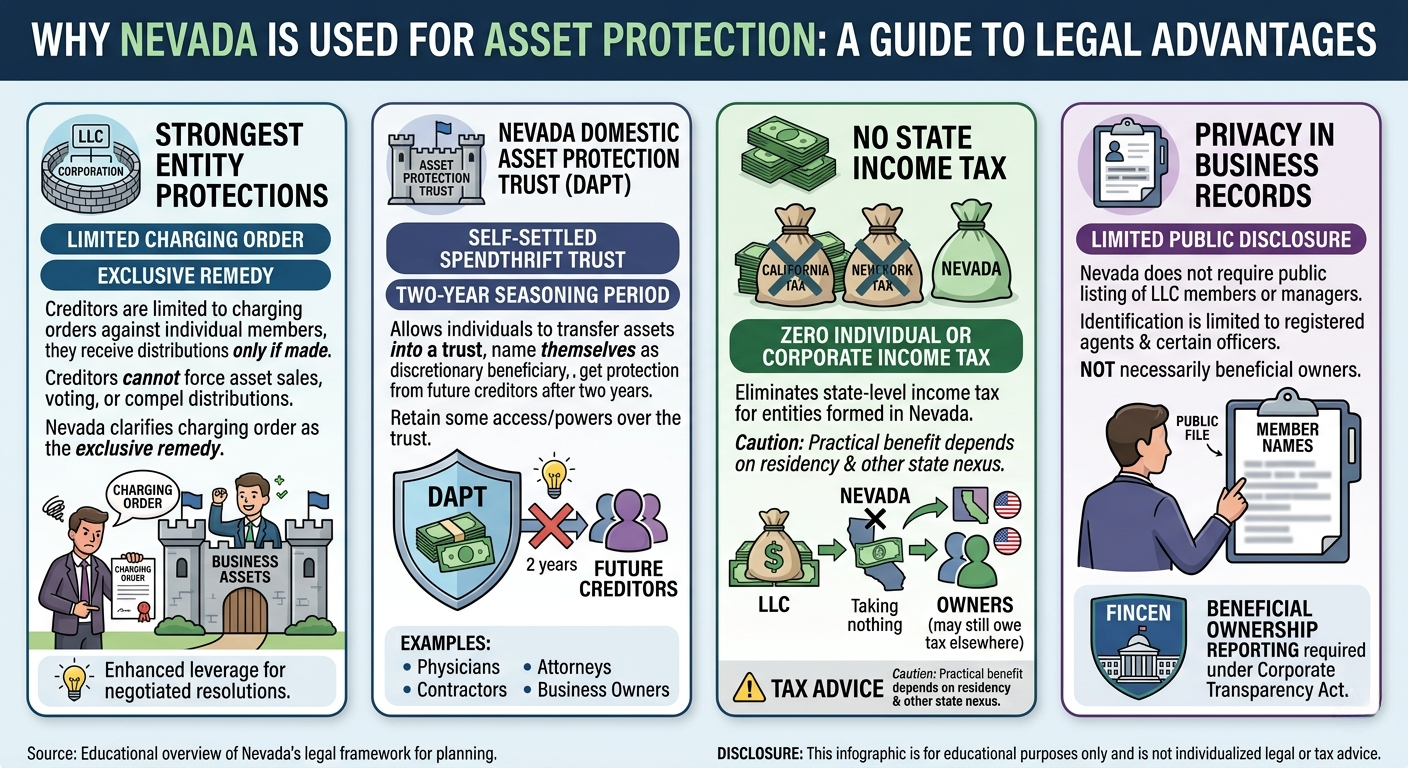

Why Nevada Is Used for Asset Protection
Nevada did not become a preferred jurisdiction for asset protection by chance. The state made a series of deliberate legislative decisions over several decades that collectively produced a legal environment more favorable to creditor-protection planning than in most other states. Practitioners who work in this field understand why Nevada comes up in serious conversations, and it is worth being specific about what the state actually offers.
The reasons Nevada is used for asset protection fall into a few distinct categories: entity law, trust law, the absence of a state income tax, and the state’s overall posture toward business and financial privacy. Each of these contributes something different to the overall picture.
Strong Entity Protections
Nevada’s LLC and corporation statutes contain some of the most creditor-friendly charging order provisions in the country. A charging order, in practical terms, means that a creditor who obtains a judgment against an individual member of an LLC is limited to receiving distributions from the entity if and when they are made. The creditor cannot force the entity to make distributions, exercise voting rights, or compel a sale or liquidation of the entity’s assets.
This matters because it limits a creditor’s leverage over a debtor who holds significant assets through Nevada entities. The creditor’s charging order does not give them control; it gives them a waiting position. In many cases, the practical effect is that a negotiated resolution becomes more likely than a forced execution against business assets.
Nevada has also been explicit in its statutes that the charging order is the exclusive remedy available to a creditor against a membership interest, at least for multi-member LLCs. Statutory clarity reduces ambiguity and limits creditors’ ability to argue for broader remedies.
The Nevada Domestic Asset Protection Trust
Nevada’s self-settled spendthrift trust, commonly referred to as a Nevada asset protection trust or DAPT, allows an individual to transfer assets into a trust, name themselves as a discretionary beneficiary, and receive protection from future creditors after a two-year seasoning period. This is a significant tool that is not available in most states.
The key features that make Nevada’s version attractive include the relatively short seasoning period, the ability to retain some access to the assets as a discretionary beneficiary, the ability to retain certain limited powers over the trust without destroying the protection, and Nevada’s developed body of case law and practice in administering these structures.
Professionals in fields with elevated litigation exposure, including physicians, attorneys, and contractors, use these structures as part of long-term wealth protection planning. Business owners with significant personal assets outside their operating companies are another common group. The tool is not appropriate for everyone, and it requires proper implementation to function as intended.
Tax Environment
Nevada imposes no state income tax on individuals or corporations. For entities formed in Nevada, this eliminates a layer of state-level taxation that would exist in states like California or New York. The tax benefit is real, though its practical significance depends on where the beneficial owners are resident and what nexus the entity has with other states.
A Nevada LLC owned by a California resident, for example, may still have California tax obligations depending on how the entity is structured and what activities it conducts. Nevada’s tax environment is an advantage, but it does not create a tax-free structure for owners who live in high-tax states without additional careful planning.
Privacy in Business Records
Nevada does not require that LLC members or managers be listed in public filings with the Secretary of State. The public record identifies the registered agent and certain officers, but not necessarily the beneficial owners. This is consistent with other privacy-friendly jurisdictions such as Wyoming and limits what is easily visible to competitors, counterparties, and the general public.
As with any privacy structure, this operates within the framework of federal law. Beneficial ownership reporting under the Corporate Transparency Act requires disclosure to FinCEN regardless of what appears in state records. Nevada’s privacy advantages are meaningful in the commercial context; they do not affect federal reporting obligations.
Why Nevada Over Other States
Nevada’s combination of strong charging order protections, a well-developed DAPT statute, no state income tax, and business-friendly administration makes it a competitive choice among asset-protection-friendly states. Wyoming and Delaware are often mentioned in the same conversation, and each has its own strengths. Nevada is often preferred when a self-settled trust is part of the plan, given its established practice in that area, and when charging-order protections for entities are a primary concern.
The choice of jurisdiction should always be driven by the specific situation, not by general reputation. A thoughtful analysis of what the client owns, what risks they face, and what structures make sense given their circumstances is the right starting point, and the jurisdiction follows from that analysis.Disclosure: The information in this article reflects general structural principles and practical observations from consulting experience and is provided for educational purposes only. It should not be interpreted as individualized legal or tax advice