
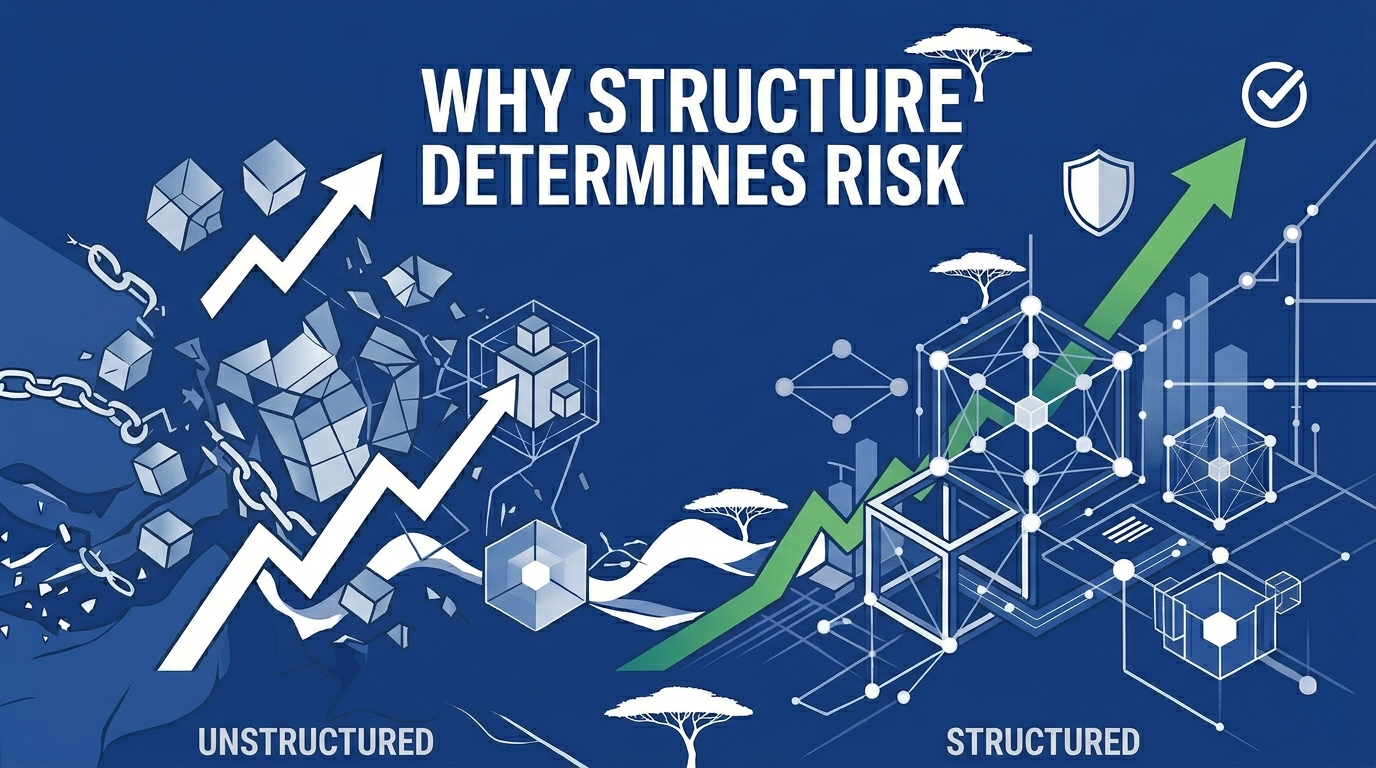

Why Structure Determines Risk
By Michael Freeman | Acacia Business Solutions
Most business owners think about risk in operational terms: the risk of a bad contract, a difficult client, an employee dispute, a product liability claim, or a market downturn. Those are real risks, and managing them matters. But the structure of the business itself, how the legal entities are organized, what they own, and how they relate to each other, determines how much of that operational risk can reach the owner’s personal assets and how much can be contained within the entity where it originated.
Structure is not a risk management strategy in the conventional sense. It does not prevent problems from arising. What it does is determine the boundary between a business problem and a personal one, and how far liability can travel when something goes wrong.
How Liability Travels Through an Unstructured Business
Consider a business owner who operates without a formal entity, as a sole proprietor, or who has formed an entity but commingled personal and business finances, used the entity inconsistently, or conducted business in their personal name alongside the entity. In that situation, there is no meaningful legal boundary between the business and the person. A judgment against the business is effectively a judgment against the owner. A liability arising from one business activity can affect assets associated with every other activity.
The absence of structure not only exposes the owner to business liabilities; it also means that assets the owner considers personal, such as savings, real estate, and investment accounts, are available to satisfy business creditors. The owner who thought they were running a business finds out, in the worst circumstances, that they were personally running it in a way that offered none of the protections a properly structured entity would have provided.
What a Legal Entity Actually Does
A properly formed and maintained business entity, whether a corporation, a limited liability company, or a limited partnership, creates a legal person separate from its owners. That legal person can own assets, enter into contracts, incur debt, and be sued. The entity’s liability, when it arises, belongs to the entity. The owners’ exposure is generally limited to what they have invested in the entity, not to their personal assets.
This separation is real and meaningful, but it is not automatic or absolute. It depends on the entity being maintained as a genuine legal person: capitalized adequately for its activities, operated with its own accounts and records, governed in accordance with its organizing documents, and not used as a personal financial convenience by the owner. Courts that pierce the corporate veil do so when the entity and the owner are, in substance, the same, regardless of the formal structure on paper.
A well-maintained entity provides a creditor with recourse to the entity’s assets. It does not, in most circumstances, provide recourse against the owner’s personal assets or against assets held in other entities. That containment is the structural benefit.
Risk Concentration Is the Core Problem
The structural risk that most business owners face is not simply a lack of any entity, though that is certainly a problem. The more common issue is risk concentration: operating multiple activities through a single entity, holding valuable assets in the same entity that carries operating risk, or using a holding structure that does not meaningfully separate liabilities across different parts of the business.
A business that operates three different service lines through a single LLC is exposed to the risk that any of those service lines cannot reach the assets of the others. A single entity that both operates a business and holds significant real estate is exposing the real estate to the liabilities of the operating business and exposing the operating business to any liabilities associated with the property.
Risk concentration often results from prioritizing simplicity at formation. One entity is easier to set up and administer than three. But the simplicity that was attractive at the start becomes a structural vulnerability as the business grows, as asset values increase, and as the activities of the business become more varied and more exposed to liability.
Structure and Insurance Are Not the Same Thing
Business owners sometimes treat insurance and corporate structure as alternative approaches to the same problem. They are not. Insurance covers defined categories of risk up to policy limits, subject to exclusions, conditions, and the insurer’s financial health. Structural separation does something different: it determines which assets a creditor can reach, regardless of whether a covered claim was involved.
A judgment that exceeds policy limits, a claim that falls under a policy exclusion, a circumstance in which insurance is unavailable or unaffordable, and the period before a claim is made and insurance responds are all situations in which structural protection either works or does not. Insurance and structure should both be in place, and they serve complementary rather than interchangeable functions.
Structure Decisions Have Long Time Horizons
Structural decisions made at the formation stage have consequences that play out over years and sometimes decades. An entity structure set up without much thought, using a standard template, in a state chosen for convenience rather than suitability, may serve adequately in the early years but become problematic as the business grows or circumstances change.
Restructuring an existing business to correct structural deficiencies is possible but involves complications that formation-stage planning would have avoided: tax consequences of transferring assets between entities, the need to renegotiate contracts and financing arrangements that reference the existing structure, and the practical disruption of changing how banking, payroll, and vendor relationships are organized.
This is not an argument for paralysis at the formation stage; getting started with a reasonable structure is better than waiting for a perfect one. It is an argument for revisiting structural decisions as the business grows and for treating the structure as something that needs to evolve alongside the business rather than something that was decided once and can be ignored.
Disclosure: The information in this article reflects general structural principles and practical observations from consulting experience and is provided for educational purposes only. It should not be interpreted as individualized legal or tax advice.
Expand your knowledge of asset protection, business planning, taxation, and private trusts. Explore the available books on Amazon.