
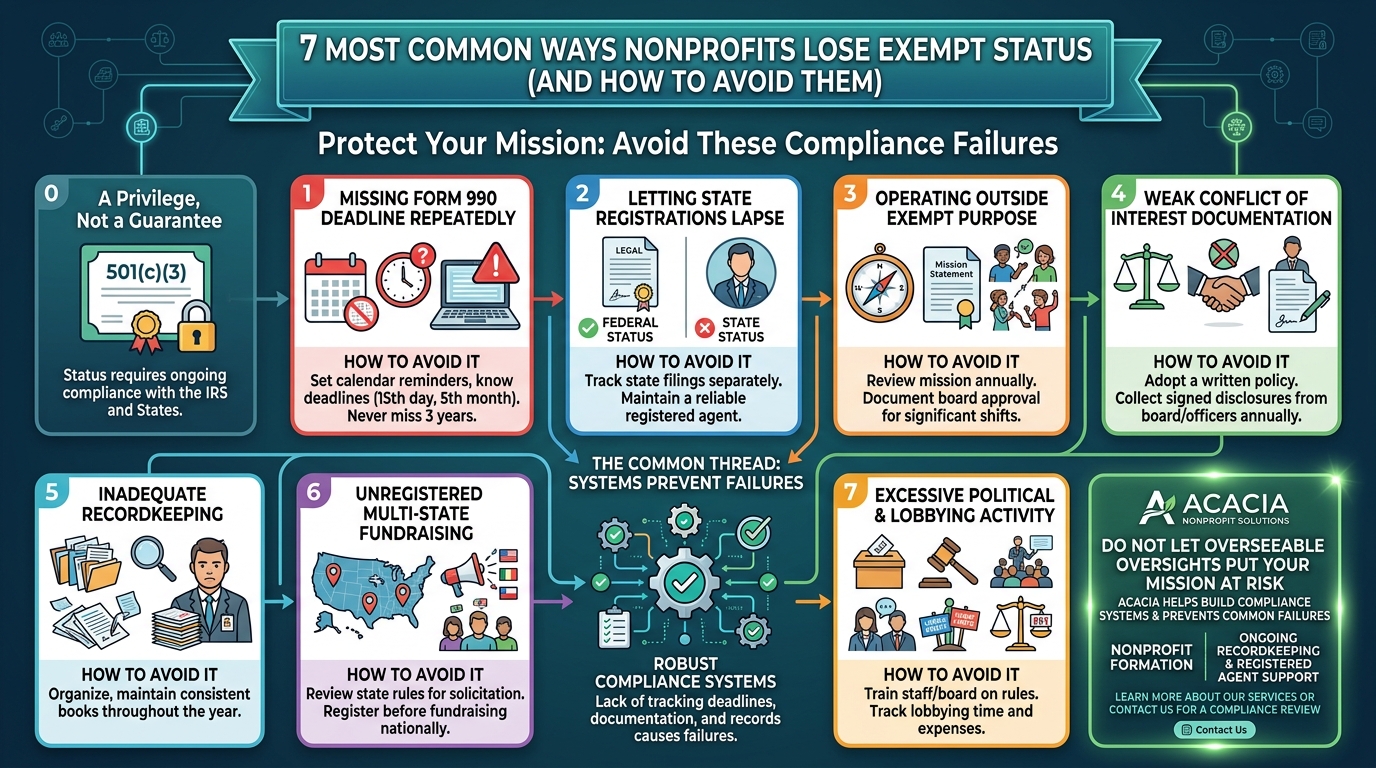

7 Essential Compliance Mistakes and How to Fix Them
1. Missing the Form 990 Filing Deadline Repeatedly
The most common cause of exemption revocation is simple. This can reflect nonprofit compliance failures. Small organizations often assume that because they have little or no revenue, no filing is required. Even organizations that qualify for the Form 990 N e Postcard must still submit it every year.
To avoid nonprofit compliance failures, set calendar reminders well before the filing deadline. Additionally, the deadline is the fifteenth day of the fifth month after the fiscal year ends. Never allow three years to pass without a filing.
2. Letting State Registrations Lapse
Federal tax-exempt status and state good standing are two separate matters. A nonprofit can be fully compliant with the IRS and still be administratively dissolved by its state for missing annual reports or registered agent requirements.
How to avoid it: Track state filing deadlines separately from federal ones and maintain a registered agent who reliably forwards state correspondence.
3. Operating Outside the Stated Exempt Purpose
When a nonprofit’s actual activities drift significantly from what was described in its original exemption application, a compliance gap is created that can surface during an IRS review or audit.
To prevent nonprofit compliance failures, review the mission statement and programs annually.
Also document board approval for any significant strategic shifts.
4. Weak or Missing Conflict of Interest Documentation
Boards that fail to disclose and document potential conflicts of interest expose the organization to private inurement and excess benefit concerns, particularly around vendor contracts, compensation, or related party transactions.
How to avoid it: Adopt a written conflict of interest policy and collect signed disclosures from board members and officers annually.
5. Inadequate Recordkeeping
Poor financial records make accurate Form 990 reporting difficult. They are often the first item regulators and auditors examine when questions arise.
How to avoid it: Maintain organized, consistent books throughout the year rather than reconstructing records at tax time.
6. Unregistered Fundraising Across State Lines
Many nonprofits solicit donations nationally through websites and social media.
Moreover, most states require separate charitable solicitation registration before fundraising can take place there.
How to avoid it: Review which states the organization actively solicits donations in, and register accordingly, or work with a compliance partner who tracks this on your behalf.
7. Excessive or Undisclosed Lobbying and Political Activity
501(c)(3) organizations that engage in political campaign activity, even informally, or that exceed lobbying limits risk penalties and revocation.
These actions can lead to nonprofit compliance failures and increased scrutiny.
How to avoid it: Train board members and staff on the rules governing political activity and track lobbying time and expenses if the organization engages in advocacy work.
The Common Thread: Systems Prevent Failures
Nearly every compliance failure described here traces back to the same root cause, a lack of consistent systems for tracking deadlines, documenting decisions, and maintaining records. Nonprofits that build these systems early rarely face revocation or dissolution later.
Do not let an administrative oversight put your mission at risk. Acacia Business Solutions helps nonprofits build the compliance systems that prevent these common failures, from proper formation to ongoing record-keeping and registered agent support. Learn more about our nonprofit formation and compliance services or contact our team for a compliance review.
Expand your knowledge of asset protection, business planning, taxation, and private trusts. Explore the available books on Amazon.