

Asset Protection Considerations in North Carolina Trust Structuring
Asset protection through trust structuring in North Carolina is a topic that requires precision. The basic concept is straightforward: by transferring assets into a properly structured irrevocable trust, a grantor can potentially remove those assets from the reach of future creditors. The practical reality involves a set of legal constraints that significantly affect how that protection works, when it applies, and what its limits are.
This article addresses the asset-protection dimensions of North Carolina trust structuring, including the fraudulent-transfer framework, the treatment of self-settled trusts under North Carolina law, spendthrift provisions, and how North Carolina compares to other states on domestic asset-protection trusts.
The Fraudulent Transfer Constraint
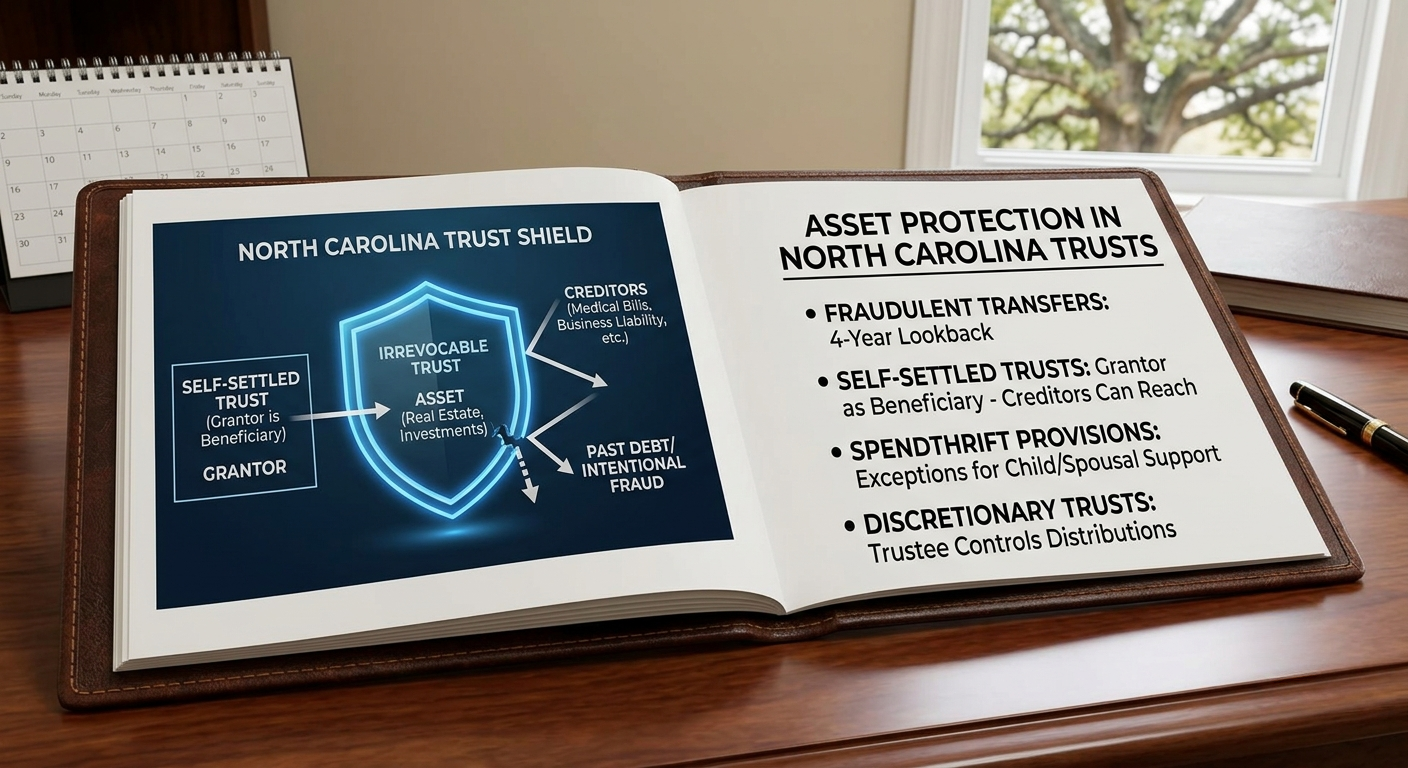
The foundational limit on trust-based asset protection is the fraudulent transfer law. In North Carolina, transfers made with the intent to hinder, delay, or defraud creditors are voidable by those creditors under the North Carolina Uniform Voidable Transactions Act. A transfer can also be voidable as constructively fraudulent if made without receiving reasonably equivalent value in exchange, and the transferor was insolvent at the time or became insolvent as a result of the transfer.
The NCUVTA provides creditors with a lookback period of four years from the date of the transfer, or one year from the date the transfer was discovered or reasonably could have been discovered, whichever is later, subject to an overall limit. Transfers made within that window that meet the criteria for voidability can be unwound by a court.
The practical implication is that trust-based asset protection works prospectively, not retroactively. A trust established and funded before a liability arises, with assets that the grantor can afford to transfer while remaining solvent, serves a legitimate asset-protection function. A trust established after a creditor claim has arisen or after the grantor is already insolvent provides much weaker protection and creates significant legal risk.
Self-Settled Trusts and North Carolina Law
A self-settled trust is one in which the grantor is also a beneficiary. The question of whether a self-settled trust provides asset protection against the grantor’s own creditors is one of the more significant jurisdictional variables in domestic trust planning.
North Carolina does not currently have a domestic asset protection trust statute of the kind enacted by states such as Nevada, South Dakota, and Delaware. Under the traditional common law rule, which North Carolina follows, a creditor of the grantor can reach the maximum amount that the trustee could pay to or for the benefit of the grantor under the trust’s terms. If the grantor is a permissible beneficiary of the trust, that trust generally does not protect the assets from the grantor’s creditors to the extent the trustee has discretion to distribute to the grantor.
This is a meaningful limitation for North Carolina residents who want the kind of self-settled asset protection trust available in certain other states. One approach is to establish a trust in a jurisdiction that has enacted a domestic asset protection trust statute, provided the trust has sufficient nexus to that jurisdiction, including a trustee located there and assets held or administered there. Whether a North Carolina court would respect that out-of-state trust structure for a North Carolina resident is a question that involves conflict-of-laws analysis and has not been uniformly resolved in the case law.
Spendthrift Provisions
North Carolina law recognizes spendthrift provisions in trust documents. A spendthrift provision restricts both the voluntary transfer of a beneficiary’s interest in the trust and the ability of the beneficiary’s creditors to reach that interest before it is distributed. Under the NCUTC, a spendthrift provision is valid if it restrains both voluntary and involuntary transfers of the beneficiary’s interest.
The protection a spendthrift provision provides is real but not absolute. North Carolina law carves out exceptions for certain creditors, including a beneficiary’s child to whom the trustee owes a support obligation; a beneficiary’s spouse or former spouse who has a claim for support or alimony; and a creditor who has provided services to protect the beneficiary’s interest in the trust. Claims by government entities may also be treated differently.
Within those limits, a spendthrift provision in a North Carolina trust is an effective tool for preventing a beneficiary with creditor exposure from reaching trust assets before they are distributed. It is a standard feature of well-drafted North Carolina trusts intended for long-term wealth transfer.
Discretionary Trusts and the Role of Trustee Discretion
A discretionary trust is one in which the trustee has discretion over whether and how much to distribute to beneficiaries, rather than being required to make mandatory distributions on a fixed schedule. The asset protection value of a discretionary trust is significantly greater than that of a trust with mandatory distribution requirements, because a creditor of the beneficiary generally cannot compel the trustee to make a distribution to satisfy the creditor’s claim.
Under the NCUTC, a creditor of a beneficiary of a discretionary trust cannot compel a distribution that the trustee has sole discretion to make or withhold. The creditor’s rights are limited to whatever the trustee actually chooses to distribute. A trustee who is aware of a beneficiary’s creditor situation can simply decline to make discretionary distributions until the situation is resolved, within the bounds of the trustee’s fiduciary duties to the beneficiary.
Asset protection through North Carolina trust structuring is a legitimate planning tool with real constraints. Understanding those constraints, particularly the fraudulent transfer framework and the limitations on self-settled trusts under North Carolina law, is essential to building a structure that actually performs as intended. For consulting perspectives on trust-based asset protection planning, visit MichaelIoane.com.
The information in this article reflects general structural principles and practical observations from consulting experience and is provided for educational purposes only. It should not be interpreted as individualized legal or tax advice.
Expand your knowledge of asset protection, business planning, taxation, and private trusts. Explore the available books on Amazon.