

Asset Protection in Michigan
Asset protection in Michigan is a topic that generates considerable interest and, unfortunately, significant misinformation. The basic concepts are not complicated, but the practical application requires attention to Michigan-specific law, federal law that overlays state planning, and the specific facts of the situation being planned for. This article addresses how asset protection works in Michigan, what tools are available, and where the legal limits lie.
What Asset Protection Is and Is Not
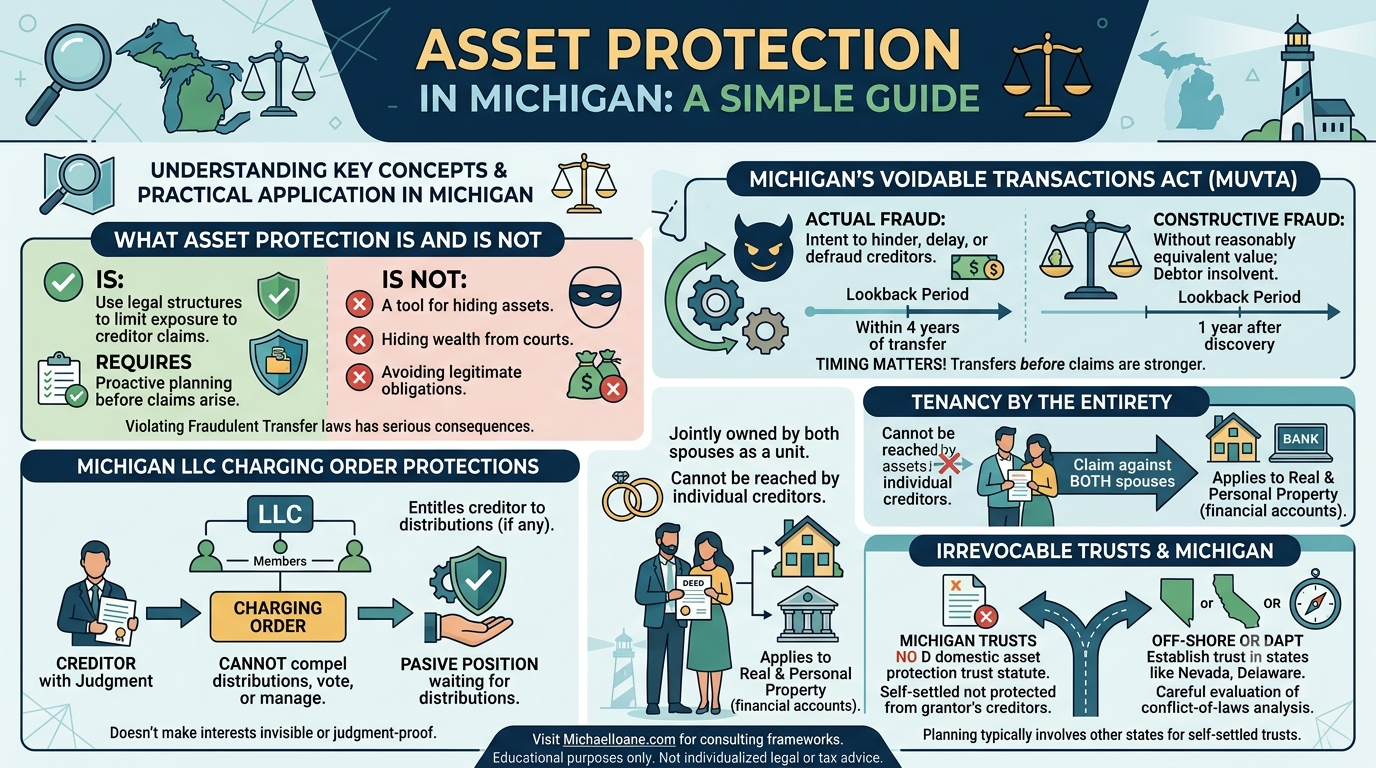
Asset protection planning uses legal structures to limit a person’s exposure of assets to creditor claims. It is not a tool for hiding assets, concealing wealth from courts, or avoiding legitimate obligations. Fraudulent transfer law at both the federal and state level, along with bankruptcy law, sets firm limits on what can be accomplished through asset protection planning and imposes serious consequences for transfers that cross those lines.
Effective asset protection planning is done proactively, before claims arise. A transfer of assets into a protective structure after a lawsuit has been filed, after a creditor claim has arisen, or when the transferor is already insolvent is vulnerable to being unwound under Michigan’s Uniform Voidable Transactions Act or under federal bankruptcy law. The protection available from a properly structured and timely transfer is real; the protection available from a reactive transfer made in response to an existing threat is significantly weaker and potentially counterproductive.
Michigan’s Voidable Transactions Act
Michigan adopted the Uniform Voidable Transactions Act, which replaced the prior Uniform Fraudulent Transfer Act. The MUVTA allows creditors to void certain transfers made by debtors under two theories. The first is actual fraud: a transfer made with actual intent to hinder, delay, or defraud any creditor. The second is constructive fraud: a transfer made without receiving reasonably equivalent value in exchange, when the debtor was insolvent at the time of the transfer or became insolvent as a result of it.
The MUVTA provides a lookback period during which creditors can challenge transfers. For transfers made with actual fraudulent intent, the claim must be brought within four years of the transfer, or one year after the transfer was or reasonably could have been discovered, whichever is later. For constructive fraud claims, the period is four years from the date of the transfer.
The practical implications are significant. Transfers made well in advance of any creditor claim, when the transferor was solvent and received fair value or had a legitimate planning purpose, stand on much firmer ground than transfers made close in time to an adverse event. Timing and solvency at the time of transfer are two of the most important factors in evaluating the defensibility of an asset protection structure.
Michigan LLC Charging Order Protections
One of the more valuable and often-discussed asset-protection features of Michigan LLCs is the charging-order limitation. When a creditor obtains a judgment against an LLC member personally, the creditor’s remedy against the member’s LLC interest is generally limited to a charging order. The charging order entitles the creditor to receive whatever distributions the LLC makes to the judgment debtor, but it does not give the creditor voting rights, management authority, or the ability to compel distributions.
This protection matters because it means a creditor who gets a judgment against a Michigan LLC member cannot simply take over the member’s interest and liquidate the LLC to satisfy the debt. The creditor is in a passive position, waiting for distributions that the LLC’s managers or members may have no obligation to make. In a well-structured Michigan LLC with a properly drafted operating agreement, the charging order protection can be a meaningful deterrent to judgment creditors.
It is important to be precise about what this protection does and does not provide. The charging order does not make the LLC interest invisible or judgment-proof. A creditor holding a charging order on an LLC interest that generates distributions will receive those distributions. And in certain circumstances, including bankruptcy, a trustee may have rights against the LLC interest that go beyond those of a charging-order creditor outside bankruptcy.
Tenancy by the Entirety in Michigan
Michigan recognizes tenancy by the entirety as a form of property ownership available to married couples. Property held in tenancy by the entirety is owned jointly by both spouses as a single legal unit, and it cannot be reached by the individual creditors of either spouse alone. A creditor must have a claim against both spouses jointly, not just one of them, to execute against property held in tenancy by the entirety.
This protection applies to both real property and, in Michigan, personal property, including financial accounts titled in tenancy by the entirety. For married Michigan residents who face individual professional or business liability, tenancy by the entirety can be a meaningful planning tool for assets that are appropriately held in that form. The protection does not apply to joint debts of both spouses, so it is most useful when the liability exposure is clearly on one side of the marital relationship.
Irrevocable Trusts and Michigan Asset Protection
Irrevocable trusts play a role in Michigan asset protection planning, primarily as a vehicle for transferring assets outside the grantor’s estate and the grantor’s creditors’ reach, subject to the fraudulent transfer limitations discussed above. Michigan does not have a domestic asset protection trust statute of the kind enacted in certain other states, which means a Michigan resident cannot establish a self-settled irrevocable trust in Michigan and expect it to be protected from the grantor’s own creditors.
For Michigan residents who want the asset protection benefits associated with a self-settled trust, the planning typically involves establishing a trust in a jurisdiction that has enacted a domestic asset protection trust statute, such as Nevada, South Dakota, or Delaware, with a trustee located there and assets administered there. Whether Michigan courts would respect such a structure for a Michigan resident involves a conflict-of-laws analysis that is not uniformly resolved and warrants careful evaluation.
Asset protection in Michigan works best when the planning is done thoughtfully, proactively, and with an accurate understanding of what the law actually provides. The available tools are real, but they operate within a legal framework with firm limits. For consulting frameworks on Michigan asset protection and business structuring, visit MichaelIoane.com.
The information in this article reflects general structural principles and practical observations from consulting experience and is provided for educational purposes only. It should not be interpreted as individualized legal or tax advice.
Expand your knowledge of asset protection, business planning, taxation, and private trusts. Explore the available books on Amazon.