
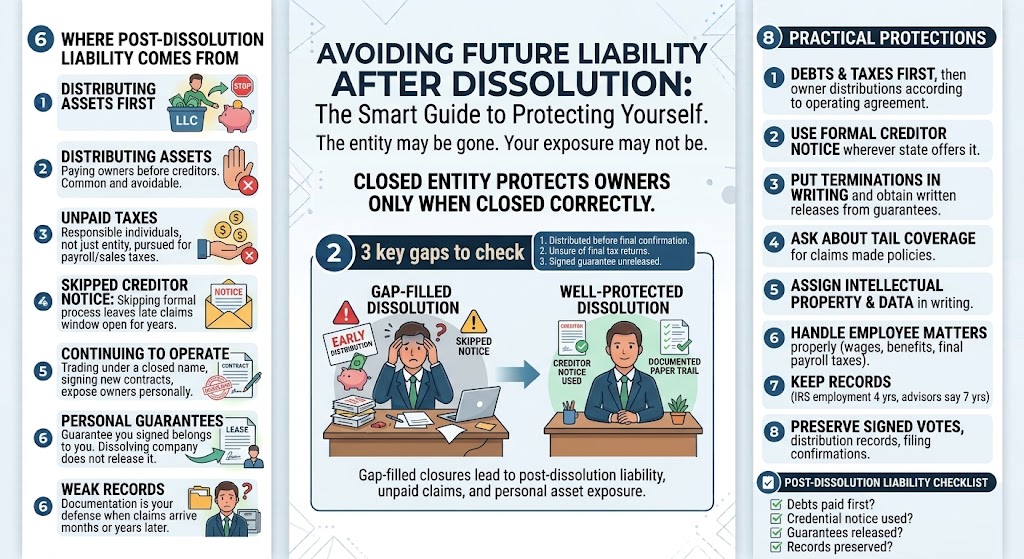

Avoiding Future Liability
The entity may be gone. Your exposure may not be.
An LLC or corporation protects its owners only when it operates and closes correctly. Filing the dissolution paperwork ends the entity’s legal existence, but it does not erase its history. Claims, tax questions, and contract disputes can still arrive afterward, and how you handled the wind-down decides whether they stop at the entity or reach you personally.
This article examines where post-dissolution liability comes from, the protective steps that address each source, and the documentation that holds up when a claim surfaces months or years later.
Where Post-Dissolution Liability Comes From
- Distributing assets before paying creditors. Owners who take money out while debts remain unpaid can face claims to return those distributions, sometimes years later. This is the single most common and most avoidable problem in business closure.
- Unpaid taxes. Payroll taxes withheld from employees are held in trust for the government, and responsible individuals, not just the entity, can be pursued for those amounts even after the entity closes. Many states apply similar trust fund rules to sales taxes collected from customers.
- Skipped creditor notice. Where a formal notice process exists, using it can shorten the window for late claims. Skipping it can leave that window open for years, since general statutes of limitations, rather than a shorter dissolution-specific period, may apply instead.
- Continuing to operate. Trading under a dissolved entity’s name, signing new contracts, or taking on new customers after dissolution can expose owners personally, because the entity no longer exists to stand behind those actions.
- Personal guarantees. A guarantee you signed on a lease, loan, or vendor account belongs to you personally, not the entity. Dissolving the company does not release it. Only a written release from the counterparty does that.
- Weak records. When a claim arrives years later, documentation is your defense. Without a signed vote, a distribution schedule, and proof that creditors were paid first, it becomes difficult to prove the wind-down was handled properly, even when it actually was.
Eight Practical Protections
- Pay debts and taxes first, then distribute what remains according to the operating agreement, never the reverse order
- Use formal creditor notice wherever your state offers it, even when it is not strictly required
- Put every termination in writing, and obtain written releases from landlords and lenders where you signed personal guarantees
- Ask about tail coverage, which extends insurance protection to claims that surface after the policy or the business itself has closed
- Assign intellectual property, domains, and customer data in writing, and follow applicable privacy rules when disposing of customer records
- Handle employee matters properly, including final wages, benefits, and final payroll tax returns
- Keep records for the right length of time. The IRS advises keeping employment tax records for at least four years, and many advisors recommend seven years for corporate and tax files given how long some claims can take to surface
- Preserve the signed dissolution vote, final distribution records, and every filing confirmation in a location that survives even if the business’s own systems are shut down
A Realistic Example
An owner closes a consulting LLC, moves the remaining cash to a personal account, and files nothing with the state. Four months later a vendor invoice arrives, and the entity is later administratively dissolved for unpaid fees. Because distributions were taken before the vendor was paid, and no notice was given, the vendor may pursue the owner personally for the amount. A documented wind down, with creditor notice and payment before distribution, would have addressed the risk directly and likely ended the matter before it ever reached the owner.
Insurance Considerations After Closing
Many business owners carry general liability, professional liability, or errors and omissions coverage while operating, then let it lapse the moment the business closes. Some of these policies are claims made, meaning they only respond to claims reported while the policy is active, not to the period in which the underlying conduct occurred. Tail coverage, sometimes called an extended reporting period endorsement, can be purchased to extend that reporting window for a defined period after closure. Whether this makes sense depends on the type of business, the nature of past work, and how much residual exposure realistically remains.
Signs Your Dissolution May Have Gaps
- You distributed funds before confirming all debts were paid in full
- You are unsure whether final payroll or sales tax returns were actually filed
- You signed a personal guarantee that was never formally released in writing
- You did not keep the dissolution vote, distribution schedule, or filing confirmation
- Customers or vendors still contact the old business looking for a response
Questions To Ask Your Advisor
- Are there personal guarantees I need to have formally released
- Does my state provide a creditor claims process, and how long does it run
- Should I keep any insurance in place after closing, and for how long
- How long should I retain each type of record given my industry and history
Frequently Asked Questions
Q: Can a closed LLC still be sued?
The entity’s ability to be sued is limited after dissolution, but claims can still reach owners personally when debts, guarantees, or improper distributions are involved.
Q: Is insurance still necessary after closing?
Tail coverage can be valuable, especially for professional services businesses, since some policies only cover claims made while the policy is active rather than claims tied to work performed years earlier.
Q: How far back can a creditor reach after dissolution?
It depends heavily on your state’s law and whether a formal notice process was used. A properly noticed claims period can sharply shorten this window compared with relying on the general statute of limitations.
CALL TO ACTION: Protect what you built. Acacia Management helps owners close entities with a documented paper trail and a defensible order of operations. Contact us to schedule a consultation before you distribute a single dollar.
Expand your knowledge of asset protection, business planning, taxation, and private trusts. Explore the available books on Amazon.