

Banking Setup for Georgia Businesses
Opening a business bank account is one of the most consequential early steps a Georgia business takes, not because the process is complicated, but because the account establishes the financial separation between the owner and the entity that is foundational to both liability protection and clean business operations. A business that runs its finances through the owner’s personal account, or that freely mixes personal and business transactions, creates problems that compound over time.
This article covers the practical aspects of banking setup for Georgia businesses, including which documents are required, which types of accounts are available, how to choose the right institution, and which banking practices support good ongoing compliance.
What Georgia Banks Require to Open a Business Account
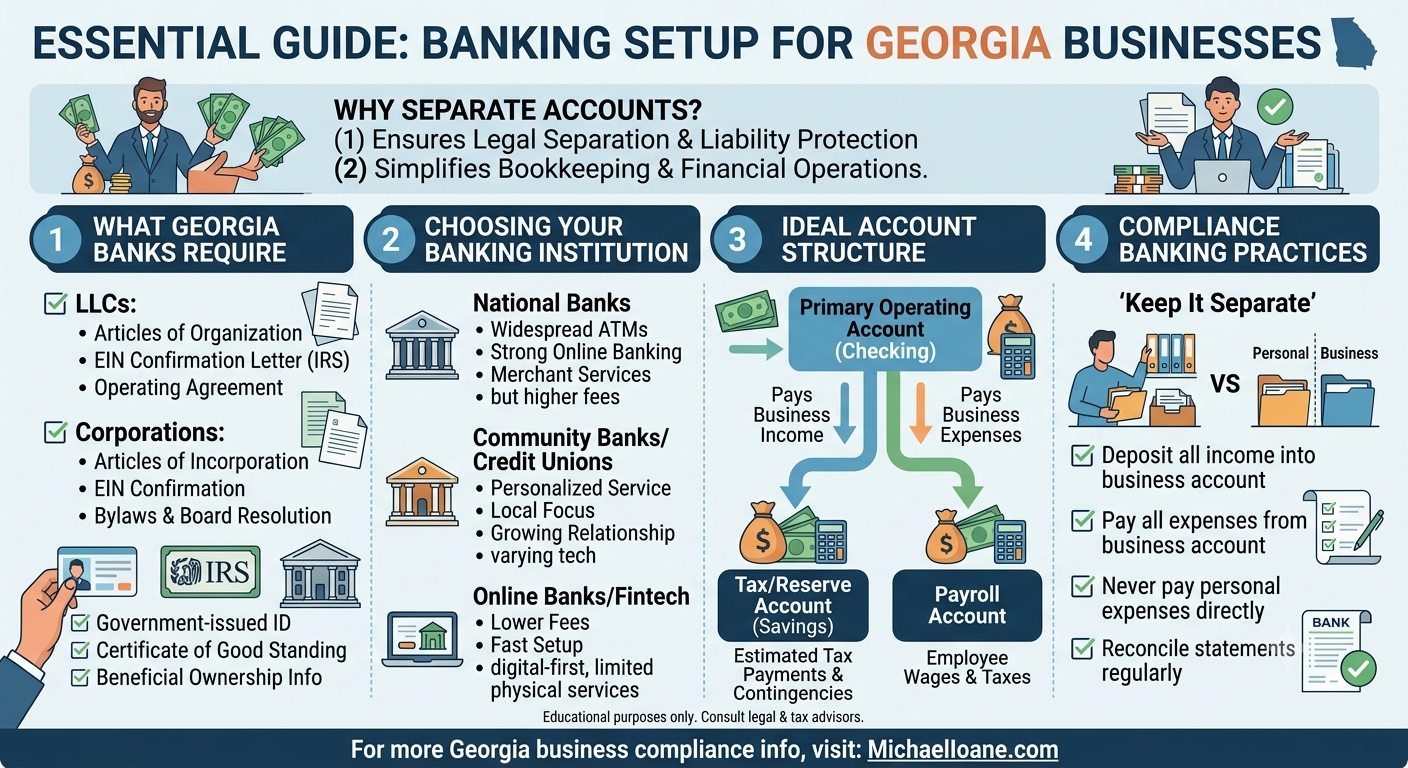
The documentation requirements for opening a business bank account in Georgia are fairly consistent across institutions, though individual banks may have additional requirements. At a minimum, a Georgia LLC will need to provide its Articles of Organization or certificate of organization from the Georgia Secretary of State, its EIN confirmation letter from the IRS, a copy of its operating agreement, and government-issued identification for the individuals authorized to transact on the account.
Corporations will need their Articles of Incorporation, EIN confirmation, corporate bylaws, and in most cases a board resolution authorizing the account opening and identifying the authorized signatories. Some banks will also ask for a certificate of good standing from the Georgia Secretary of State, which confirms that the entity is current on its filings and in active status.
Banks are required under federal law to collect beneficial ownership information for legal entities opening accounts. This requirement, which comes from the Financial Crimes Enforcement Network’s rules on customer due diligence, means the bank will ask for information about individuals who own 25 percent or more of the entity, as well as the individual who controls it. Having that information organized before the account opening appointment saves time.
Choosing the Right Banking Institution
Georgia business owners have a wide range of banking options. Large national banks offer extensive ATM networks, robust online banking platforms, and integrated merchant services, but they often impose monthly fees on business accounts and may have less flexibility in working with newer or smaller businesses. Community banks and credit unions tend to offer more personalized service and may be more willing to build a banking relationship with a growing business, though their technology platforms and ATM coverage vary.
Online banks and fintech platforms have become a practical option for many small businesses, particularly those that operate primarily through digital transactions and do not handle significant cash volume. These platforms often have lower fees and faster account-opening processes, but they may not offer the full range of services a business needs as it grows, including lines of credit, SBA loan origination, or complex cash management tools.
The right choice depends on the specific profile of the business. A retail operation with daily cash deposits needs a different banking infrastructure than a professional services firm that invoices clients and receives ACH payments. Thinking through those operational requirements before choosing an institution avoids the disruption of switching banks later.
Account Structure for Georgia Businesses
Most Georgia businesses operate with at least two accounts: a primary operating checking account and a savings or reserve account to set aside funds for taxes, contingencies, or capital expenditures. Some businesses add a payroll account, which is funded specifically for payroll runs and helps prevent the commingling of payroll funds with general operating funds.
This kind of account structure supports cleaner bookkeeping and makes the periodic obligations, particularly estimated tax payments, easier to manage. If a portion of each revenue deposit is routinely transferred to a tax reserve account, the funds are available when quarterly estimated payments are due rather than having been absorbed into operating expenses.
Ongoing Banking Practices That Support Compliance
The banking setup is only useful if it is maintained consistently. The practices that support ongoing compliance are straightforward: all business income should be deposited into the business account; all business expenses should be paid from the business account; personal expenses should never be paid from the business account without proper documentation of the transaction as a distribution or loan; and bank statements should be reconciled regularly against the accounting records.
Georgia businesses that use their business accounts consistently and keep their personal finances separate have a much cleaner record to present if they are ever audited by the IRS or the Georgia Department of Revenue. They also have a stronger position if the entity’s liability protection is ever challenged, because the financial separation is documented in the bank’s records.
The banking setup for a Georgia business is a practical operational step that, when done correctly from the outset, supports both the entity’s legal integrity and the efficiency of its financial management. For more on Georgia business structuring and compliance practices, visit MichaelIoane.com.
The information in this article reflects general structural principles and practical observations from consulting experience and is provided for educational purposes only. It should not be interpreted as individualized legal or tax advice.
Expand your knowledge of asset protection, business planning, taxation, and private trusts. Explore the available books on Amazon.