

Colorado Business Structuring
Colorado has become one of the more practical states for business formation, largely because it offers straightforward registration requirements, reasonable fees, and a legal environment that gives founders real flexibility in how they organize their operations. Whether you are launching a startup, building a real estate holding structure, or organizing an operating company alongside a separate asset-holding entity, the foundational decisions made at the structuring stage tend to have long-term consequences worth thinking through carefully.
This article walks through the core concepts behind business structuring in Colorado, including entity selection, liability separation, and the basic compliance framework that applies to most Colorado businesses.
Why Structure Matters
Business structuring is not simply a legal formality. The way a company is organized determines how income is taxed, who bears legal exposure when something goes wrong, and whether assets within the business are accessible to outside creditors. A well-structured business creates separation between the owner and the entity, between operating risk and held assets, and in some cases between different lines of business that carry different risk profiles.
In Colorado, as in most states, the liability protection offered by a properly formed and maintained entity is real, but it is not automatic. Courts have consistently held that business owners who commingle personal and business funds, fail to observe basic corporate formalities, or treat the entity as an extension of themselves rather than a separate legal person can lose that protection through a process known as piercing the corporate veil. Structure alone is not enough; the entity must be maintained accordingly.
The Most Common Colorado Entity Types
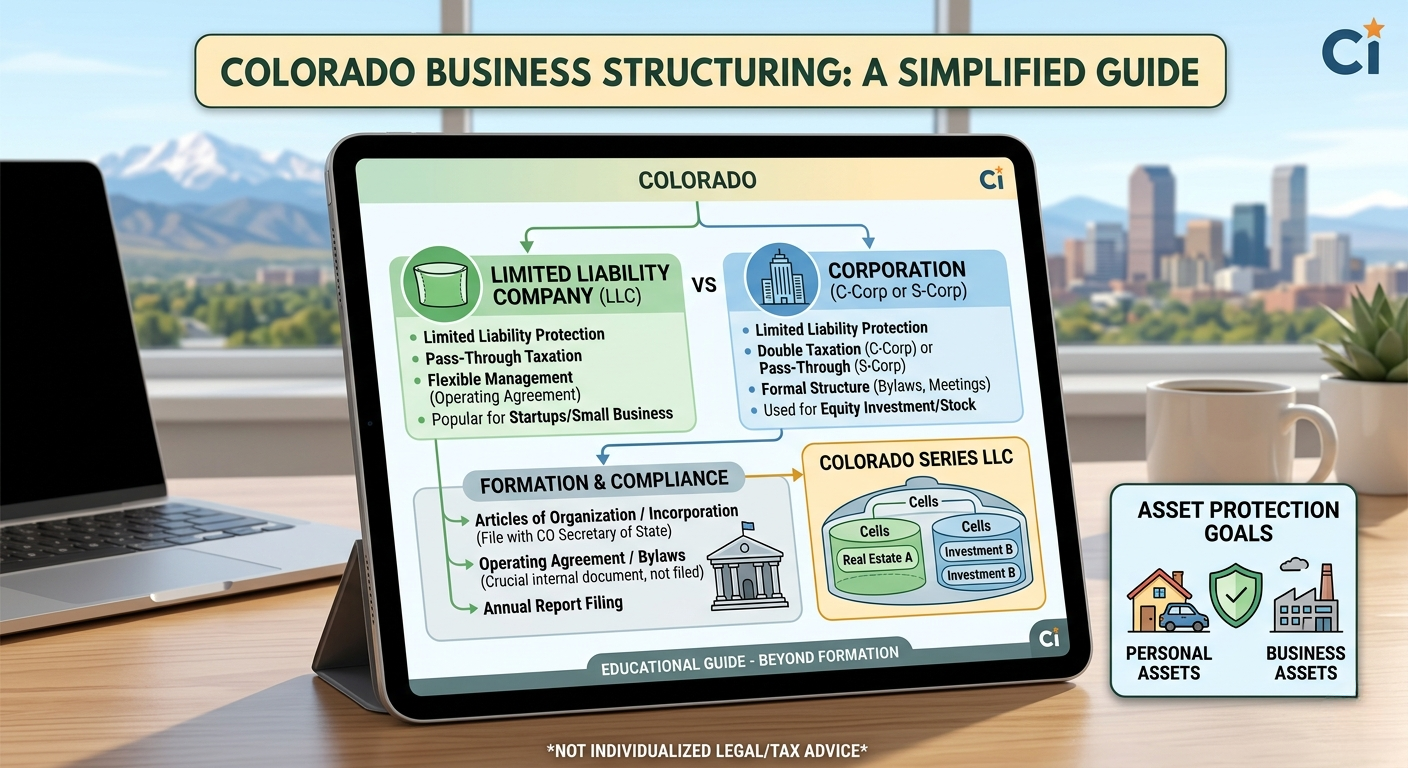
Colorado recognizes several entity types that are commonly used in business structuring: the limited liability company, the corporation, the limited partnership, and the series LLC, which Colorado has adopted under the Colorado Revised Uniform Limited Liability Company Act.
The LLC is by far the most widely used structure for small to midsize businesses in Colorado. It offers pass-through taxation by default, limited liability for members, and significant flexibility in drafting the operating agreement. Colorado LLCs can be member-managed or manager-managed, and the operating agreement can be customized in ways that a corporate charter generally cannot.
Corporations, both standard C-corps and S-corps, are used in situations where equity investment, stock issuance, or specific tax planning strategies require that structure. C-corps are taxed at the entity level and again on distributions to shareholders, which creates double taxation in many situations. S-corps avoid that issue but come with restrictions on the number and type of shareholders permitted.
The Colorado series LLC is worth noting for real estate and investment holding scenarios in which multiple assets need to be separated under a single organizational umbrella. While the series structure is not universally recognized across all states and carries some uncertainty regarding treatment in federal bankruptcy proceedings, it can be an efficient tool within a Colorado-based operation.
Operating Agreements and Formation Documents
When forming an LLC in Colorado, the operating agreement is arguably the most important document in the structure. Colorado does not require the operating agreement to be filed with the Secretary of State, but it governs almost everything about how the company operates internally: capital contributions, profit and loss allocation, voting rights, management authority, and what happens when a member wants to exit.
A generic operating agreement downloaded from the internet will technically satisfy the requirement, but it is unlikely to reflect the business owners’ actual intentions or hold up well in disputes. For any business with more than one member or with assets of meaningful value, a properly drafted operating agreement is not optional.
Connecting Colorado Structure to Broader Planning
Business structuring in Colorado rarely exists in isolation. Most serious operators are considering how their Colorado entity relates to federal tax treatment, whether a Wyoming or Delaware holding company makes sense above or alongside the Colorado operating entity, and how personal assets remain protected if the business faces litigation or debt.
For more on how Colorado business structuring fits into broader asset protection and entity layering strategies, see related resources at
For more on how Colorado business structuring fits into broader asset protection and entity-layering strategies, see the related resources at MichaelIoane.com, where Michael Ioane covers practical consulting frameworks for business owners and investors.The information in this article reflects general structural principles and practical observations from consulting experience and is provided for educational purposes only. It should not be interpreted as individualized legal or tax advice.
Expand your knowledge of asset protection, business planning, taxation, and private trusts. Explore the available books on Amazon.