

Compliance Issues: Washington Registered Agent
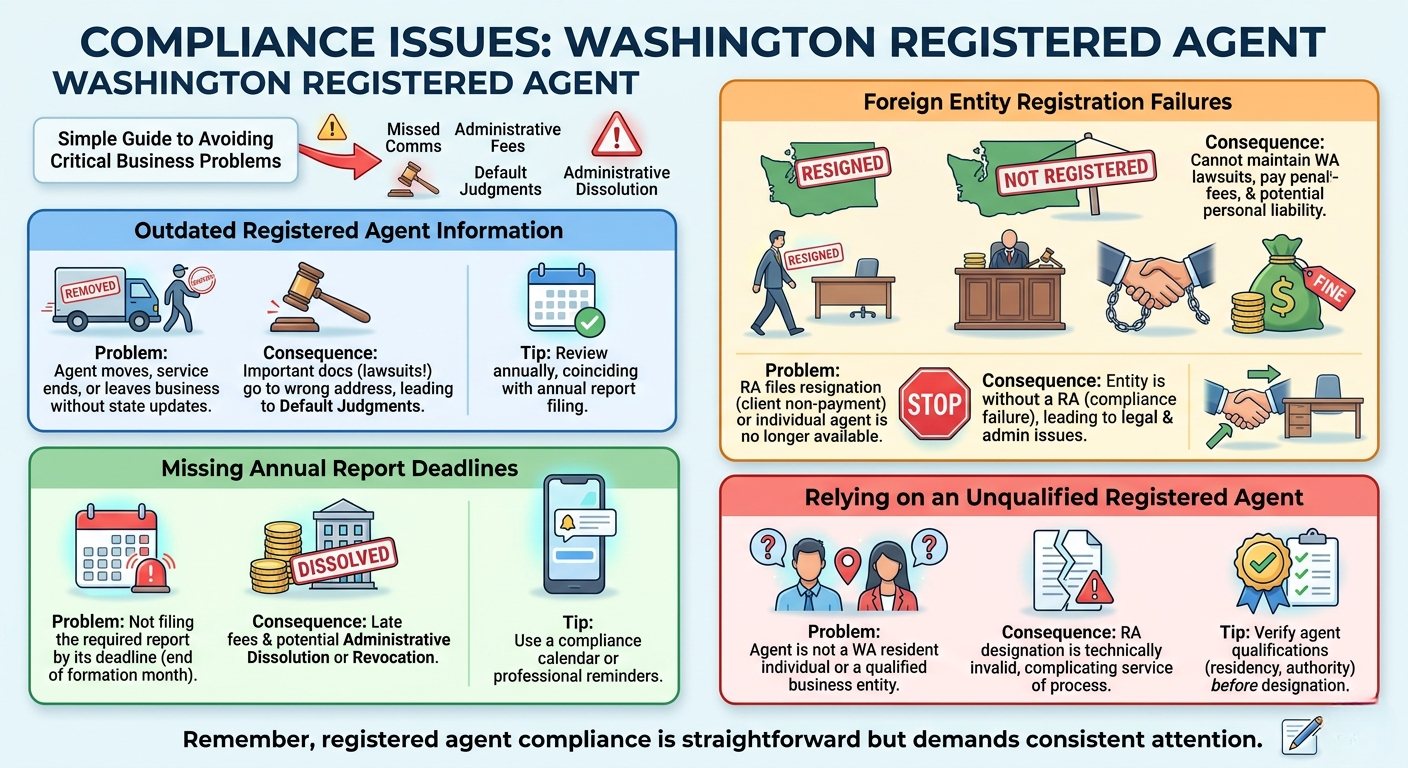
Registered agent compliance in Washington is not complicated in principle, but it consistently creates problems for businesses that do not manage it carefully. The consequences of registered agent compliance failures range from missed communications and administrative fees to default judgments in lawsuits and administrative dissolution of the entity. Understanding the common compliance issues and how they arise is the starting point for avoiding them.
Outdated Registered Agent Information
The most common registered agent compliance problem in Washington is outdated information in the Secretary of State’s records. This happens when an individual serving as the registered agent moves to a new address without updating the state records, when a professional registered agent service is replaced but the change is not filed, or when the person who was serving as the registered agent is no longer associated with the business and no one has thought to update the designation.
The practical consequence of outdated registered agent information is that official correspondence and service of process go to the wrong address. A lawsuit filed against the entity, with service made on the registered agent of record, is legally valid service even if the documents never reach anyone who is actually connected to the entity. The entity’s failure to respond to that lawsuit because it never received the documents does not invalidate the service; it results in a default judgment.
Updating registered agent information is a straightforward filing with the Secretary of State. The update can be made online and takes effect when it is processed. The problem is not that the update is difficult; it is that business owners do not always think to make it when circumstances change. Building a practice of reviewing the registered agent information annually, coinciding with the annual report filing, catches most of these issues before they become problems.
Missing Annual Report Deadlines
Washington’s annual report requirement applies to most domestic and foreign entities registered in the state. Missing the annual report deadline triggers a late fee and, if the entity remains delinquent for a sufficient period, can result in administrative dissolution of a domestic entity or revocation of a foreign entity’s certificate of authority.
Administrative dissolution does not eliminate the entity or its obligations, but it does affect the entity’s ability to conduct business in Washington and can complicate transactions, contracts, and licensing. Reinstating a dissolved entity requires filing the overdue annual reports, paying accumulated fees and penalties, and in some cases, filing additional documents. The reinstatement process is more involved than simply filing the annual report on time would have been.
The annual report deadline in Washington is the end of the month in which the entity was originally formed or registered. Entities formed in different months have different deadlines, so a business with multiple entities may have multiple annual report deadlines throughout the year. Tracking these deadlines in a compliance calendar or using a professional registered agent service that provides deadline reminders reduces the risk of missing them.
Registered Agent Resignation Without a Replacement
A registered agent can resign by filing a notice of resignation with the Washington Secretary of State. When that happens, the Secretary of State notifies the entity. If the entity does not designate a replacement within the period specified in the notice, it will be without a registered agent, which constitutes a compliance failure under Washington law.
Professional registered agent services occasionally terminate client relationships, particularly when clients are delinquent on fees or when the service is discontinuing operations in a particular state. Entities that receive a notice of resignation from their registered agent should treat it as a priority and designate a replacement immediately. Waiting until the compliance calendar comes around, or assuming nothing important will happen in the interim, is a risk not worth taking.
Individual registered agents resign in practice when they leave the organization, move out of Washington, or simply become unwilling to accept the responsibility. Unlike professional services, individual agents typically do not file a formal resignation notice; they simply stop being available. This creates a situation in which the state records still list a registered agent who is no longer receiving documents, which is functionally equivalent to having no registered agent at all.
Foreign Entity Registration Failures
Out-of-state entities doing business in Washington without registering as foreign entities are in violation of Washington law. The consequences include the entity’s inability to maintain a lawsuit in Washington courts until it is properly registered, exposure to penalties and fees for the period of non-compliance, and potential personal liability for the people conducting business on behalf of the unregistered entity.
The question of when an entity’s Washington activities rise to the level of doing business for registration purposes requires judgment based on the specific facts. Washington’s business statutes provide some guidance on activities that do not constitute doing business, such as maintaining a bank account, holding occasional meetings, or selling goods through interstate commerce without a physical presence. Activities beyond these categories may trigger the registration requirement, and the analysis should be done carefully before concluding that registration is not needed.
Relying on an Unqualified Registered Agent
Washington’s registered agent requirements specify that the agent must be either a Washington resident individual or a business entity authorized to do business in Washington. Using someone who does not meet these requirements, even unintentionally, means the registered agent designation is technically invalid. If service of process is made on an invalid registered agent, the question of whether that service was legally effective becomes a litigation issue that could have been avoided entirely.
Professional registered agent services that are properly authorized in Washington satisfy the entity requirement. Individual agents who are Washington residents satisfy the individual requirement. The error arises when someone designates a friend or colleague who is not actually a Washington resident, or when the professional service used is not properly qualified in Washington. Verifying the agent’s qualifications before designating them is a simple step that eliminates this risk.
Disclosure: The information in this article reflects general structural principles and practical observations from consulting experience and is provided for educational purposes only. It should not be interpreted as individualized legal or tax advice.
Expand your knowledge of asset protection, business planning, taxation, and private trusts. Explore the available books on Amazon.